

On this page
Every item below is built on Chapter 2, Human Reproduction, of NCERT Class 12 Biology (Reprint 2026-27). The NMC's NEET (UG)-2026 syllabus places it in Unit 6, Reproduction, which includes "microscopic anatomy of testis and ovary". All 14 are original, not from NCERT exercises or past papers, and none is a forecast. Treat this as a study summary, not medical advice.
How do you read a NEET diagram question?
Name the figure first: which organ, which section, which stage.
Pick one part you are sure of. In a follicle, that is the large round cell.
Move outward or inward one layer at a time, saying each name aloud.
Only then read the options. Wrong options usually swap two neighbouring layers.
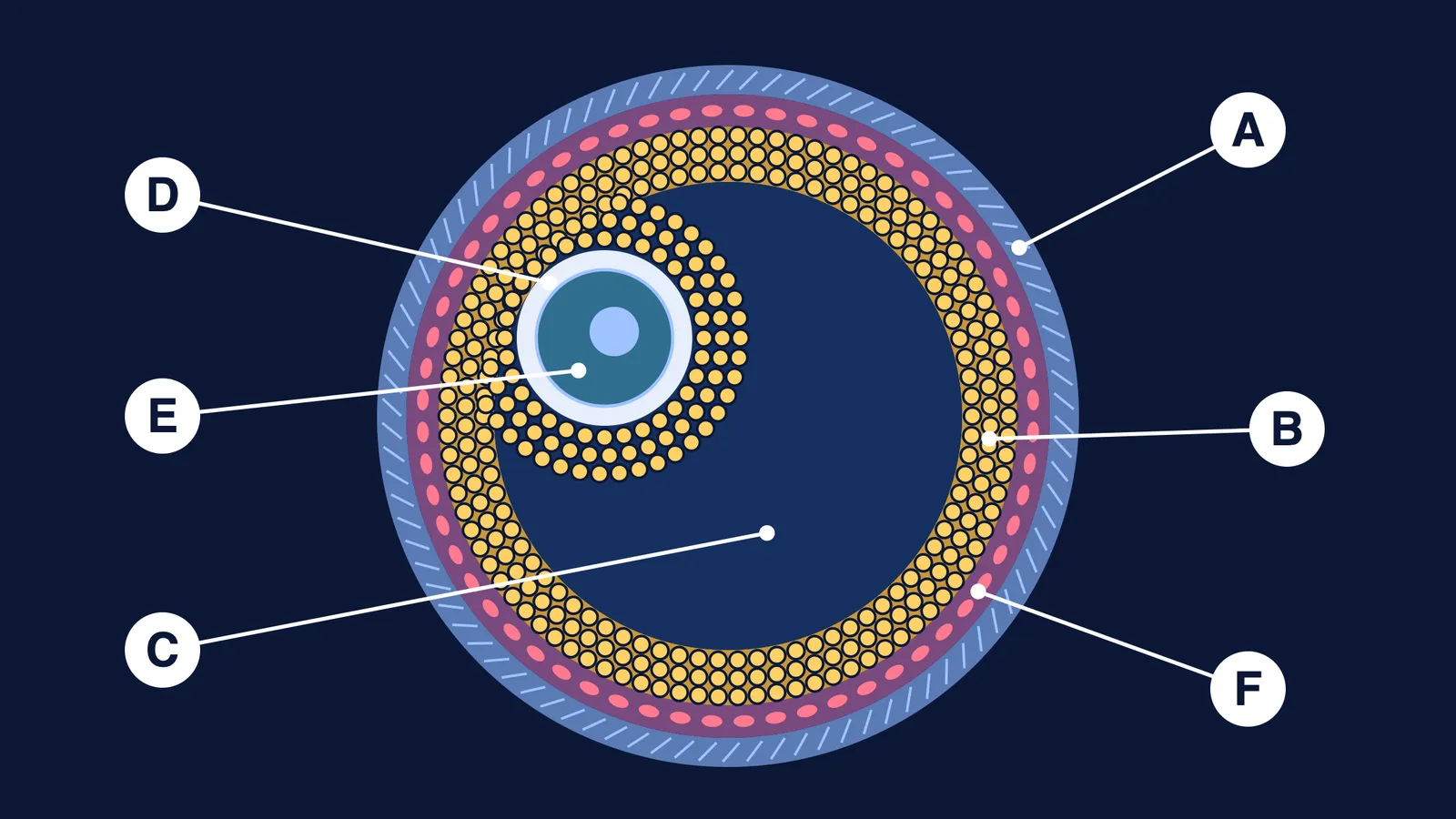
Can you identify the lettered parts of the Graafian follicle?
The hero shows a mature (Graafian) follicle with six parts marked A to F. Q1 to Q7 use it.
How to attack this format: write your own label for every letter before reading any question, then check each option against your list.
Codes for two-statement items: (1) I and II both true (2) Both false (3) I true, II false (4) I false, II true
Q1. The fluid-filled cavity C first appears at which stage? (1) Primary follicle (2) Secondary follicle (3) Tertiary follicle (4) Only after ovulation Answer: (3). NCERT marks the tertiary follicle by its antrum.
Q2. At fertilisation, sperm contact with which lettered layer triggers changes that block more sperms? (1) B (2) D (3) F (4) A Answer: (2). D is the zona pellucida, the layer NCERT names for this block.
Q3. I: Cell E is haploid and comes from an unequal first meiotic division. II: Cell E finishes its second meiotic division before it leaves the ovary. Answer: (3). Meiosis II is completed only after a sperm enters.
Q4. Match List-I with List-II. List-I: A. Letter A; B. Letter B; C. Letter C; D. Letter D. List-II: I. Fluid-filled cavity; II. Outer layer of the theca; III. New membrane formed by the secondary oocyte; IV. Cells that first wrap a primary oocyte to make a primary follicle. (1) A-IV, B-II, C-I, D-III (2) A-II, B-IV, C-III, D-I (3) A-II, B-I, C-IV, D-III (4) A-II, B-IV, C-I, D-III Answer: (4). B is the granulosa layer; A is the theca externa.
Q5. Which pairing of letters is correct? (1) A theca interna, F theca externa (2) A theca externa, F theca interna (3) A granulosa, F theca interna (4) A theca externa, F granulosa Answer: (2). In the tertiary follicle the theca splits into inner and outer layers.
Q6. After E is released, the remaining parts of this follicle become: (1) The corpus luteum, a major source of progesterone (2) A morula (3) A new primary follicle (4) The corpus luteum, which secretes mainly LH Answer: (1). Progesterone from the corpus luteum maintains the endometrium.
Q7. I: The mid-cycle LH surge induces this follicle to rupture. II: Primary follicles, each a primary oocyte with a layer of B cells, are already present before puberty. Answer: (1). Many degenerate between birth and puberty, leaving 60,000 to 80,000 per ovary.
Answer key for the lettered diagram: A theca externa; B granulosa cells; C antrum; D zona pellucida; E secondary oocyte; F theca interna.
Can you answer questions on figures described in words?
Two-statement items use the codes above.
How to attack this format: sketch the figure from the description in ten seconds, then answer from your sketch, not from the options.
Q8. In a sectional view of the male pelvis, which duct rises into the abdomen and curves over the top of the urinary bladder? (1) Epididymis (2) Vasa efferentia (3) Vas deferens (4) Urethra Answer: (3). The epididymis leads into it before the loop.
Q9. A section of a seminiferous tubule is shown. I: Spermatogonia line the outer surface of the tubule. II: Leydig cells sit inside the tubule, among the germ cells. Answer: (2). Spermatogonia line the inside wall; Leydig cells lie in the interstitial spaces.
Q10. A sperm diagram labels a cap over the front part of the head. What fills it? (1) Mitochondria that power the tail (2) A diploid nucleus (3) Fructose (4) Enzymes that help fertilise the ovum Answer: (4). That cap is the acrosome.
Q11. Tracing one oviduct in the female reproductive system figure, from ovary to uterus, the order is: (1) Isthmus, ampulla, infundibulum (2) Ampulla, infundibulum, isthmus (3) Infundibulum, isthmus, ampulla (4) Infundibulum, ampulla, isthmus Answer: (4). The funnel near the ovary widens into the ampulla; the narrow isthmus joins the uterus.
Q12. In a mammary gland section, milk travels from the alveoli by which route? (1) Lactiferous duct, mammary duct, nipple (2) Mammary ampulla, mammary tubules, lactiferous duct (3) Mammary tubules, mammary duct, mammary ampulla, lactiferous duct (4) Mammary duct, mammary tubules, nipple Answer: (3). Tubules join into ducts, ducts into the ampulla, which links to the lactiferous duct.
Q13. A menstrual cycle graph is split into four phases. Match List-I with List-II. List-I: A. Menstrual; B. Follicular; C. Ovulatory; D. Luteal. List-II: I. LH reaches its maximum and the Graafian follicle ruptures; II. Corpus luteum releases large amounts of progesterone; III. Endometrial lining breaks down over 3 to 5 days; IV. Follicles mature while the endometrium regenerates. (1) A-IV, B-III, C-I, D-II (2) A-III, B-IV, C-I, D-II (3) A-III, B-IV, C-II, D-I (4) A-III, B-I, C-IV, D-II Answer: (2). Ovulation sits around day 14, between the follicular and luteal phases.
Q14. A figure tracks the egg and embryo along the fallopian tube. I: Fertilisation is shown in the isthmus. II: The blastocyst's cells are arranged as a trophoblast layer outside and an inner cell mass. Answer: (4). Fertilisation takes place in the ampullary region.
What should you do after this set?
Redo all 14 with answers covered. For each miss, redraw that figure from memory and check it against NCERT.
For text-only practice, try our human reproduction statement and match-the-list set. For a chapter-wide revision order, follow the NCERT-first plan for human reproduction, and revise the human reproduction key terms.
Do follicle layers keep swapping places in your head? Fermi's AI tutor works out what you already know and builds a plan for the session.


