

On this page
These 14 original questions cover Chapter 2 of NCERT Class 12 Biology, Human Reproduction (Reprint 2026-27). The NEET (UG)-2026 syllabus from the NMC places it under Unit 6, Reproduction. None is lifted from NCERT exercises or earlier exam papers, and none is a prediction.
This is a study summary, not medical advice; pregnancy and birth appear only as NCERT describes them.
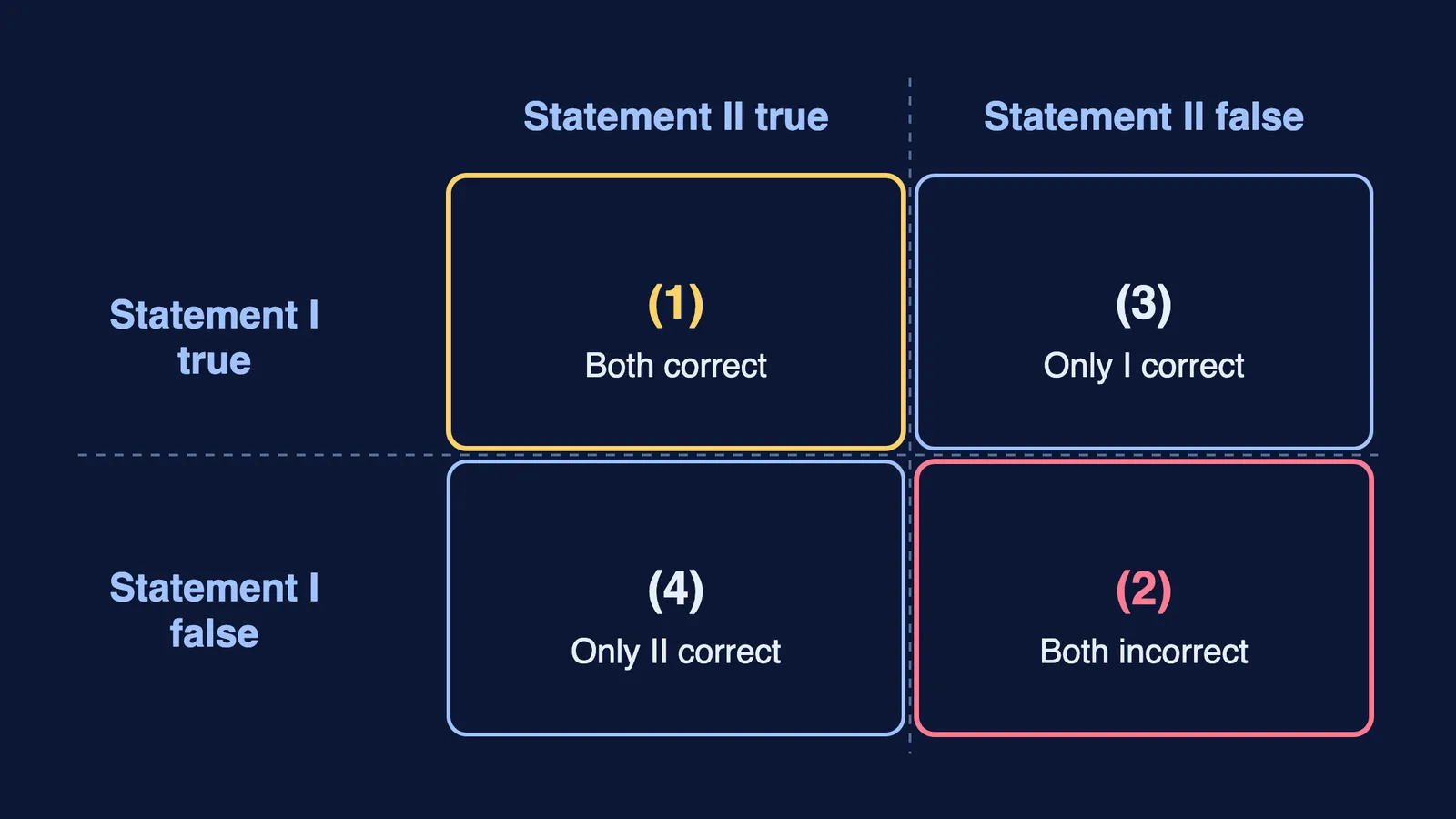
Are these human reproduction statements true or false?
How to attack this format: turn each statement into the short question it answers and answer it yourself. If your answer differs, the statement is false.
Codes for Q1 to Q5 (see grid above): (1) I and II both true (2) Neither true (3) I true, II false (4) I false, II true
Q1 (easy). I: The scrotum keeps the testes 2 to 2.5 °C cooler than normal internal body temperature, which spermatogenesis needs. II: Each testicular lobule holds about 250 seminiferous tubules.
Answer: (3). A testis has about 250 lobules, each with one to three tubules.
Q2 (easy). I: The epididymis lies along the front (anterior) surface of each testis. II: The rete testis carries sperms from the vas deferens to the urethra.
Answer: (2). The epididymis is posterior; the rete testis links tubules to vasa efferentia.
Q3 (medium). I: New oogonia keep being added to the ovary after puberty. II: In oogenesis, the secondary oocyte retains the bulk of the primary oocyte's food-rich cytoplasm.
Answer: (4). No oogonia are added after birth.
Q4 (medium). I: Each fallopian tube is about 10 to 12 cm long. II: The ovarian stroma has an inner cortex and an outer medulla.
Answer: (3). NCERT places the cortex at the periphery and the medulla inside.
Q5 (medium). I: Cleavage begins as the zygote moves through the isthmus towards the uterus. II: The morula changes into a blastocyst as it travels further into the uterus.
Answer: (1). Cleavage starts in the isthmus; the morula becomes a blastocyst in the uterus.
Q6 (hard). Which statements match NCERT's month-by-month account of pregnancy?
A. The embryo's heart forms after one month. B. Limbs and digits develop by the end of the second month. C. The first movements of the foetus are usually noticed in the third month. D. Eyelids separate by the end of about 24 weeks. E. Hair on the head usually appears during the fifth month.
(1) A, C, D (2) B, C, E (3) A, D, E (4) A, B, D, E
Answer: (4). First movements are usually noticed in the fifth month.
Can you pair List-I with List-II?
How to attack this format: place the List-II entry with the sharpest clue first (a unit, a place, a stage); one placement often rules out two codes.
Q7 (easy). List-I: A. Rete testis; B. Ejaculatory duct; C. Urethral meatus; D. Foreskin. List-II: I. External opening of the urethra; II. Loose fold of skin over the glans penis; III. Joins the seminiferous tubules to the vasa efferentia; IV. Formed where the seminal vesicle duct joins the vas deferens; opens into the urethra.
(1) A-III, B-I, C-IV, D-II (2) A-II, B-IV, C-I, D-III (3) A-III, B-IV, C-I, D-II (4) A-IV, B-III, C-I, D-II
Answer: (3). Section 2.1 describes all four, from rete testis to foreskin.
Q8 (medium). List-I: A. Primary follicle; B. Secondary follicle; C. Tertiary follicle; D. Graafian follicle. List-II: I. Ruptures to release the secondary oocyte; II. Primary oocyte with one layer of granulosa cells; III. Has a fluid-filled antrum; IV. More granulosa layers and a new theca.
(1) A-II, B-III, C-IV, D-I (2) A-IV, B-II, C-III, D-I (3) A-II, B-IV, C-I, D-III (4) A-II, B-IV, C-III, D-I
Answer: (4). The antrum marks the tertiary stage.
Q9 (medium). List-I: A. Alveoli; B. Lactiferous duct; C. Mons pubis; D. Cervical canal. List-II: I. Forms the birth canal with the vagina; II. Fatty cushion covered by skin and pubic hair; III. Cells that secrete milk, stored in their lumens; IV. Connects to the mammary ampulla and opens at the nipple.
(1) A-III, B-IV, C-II, D-I (2) A-IV, B-III, C-II, D-I (3) A-III, B-II, C-IV, D-I (4) A-I, B-IV, C-II, D-III
Answer: (1). Alveoli make milk; cervical canal plus vagina form the birth canal.
Q10 (hard). List-I: A. 15 to 20; B. 4 to 5 cm; C. 200 to 300 million; D. 2 to 4 cm. List-II: I. Length of each ovary; II. Mammary lobes in each breast; III. Length of an adult testis; IV. Sperms released in one ejaculation.
(1) A-II, B-I, C-IV, D-III (2) A-II, B-III, C-IV, D-I (3) A-IV, B-III, C-II, D-I (4) A-II, B-III, C-I, D-IV
Answer: (2). NCERT gives the testis 4 to 5 cm, the ovary 2 to 4 cm.
Can you pick the one right option?
How to attack this format: hide the four choices and name the answer in one word. If that word is not among them, reread the stem for "first" or "only".
Q11 (easy). In NCERT's account of parturition, what sets off the foetal ejection reflex?
(1) Oxytocin from the maternal pituitary (2) Signals from the mature foetus and the placenta (3) Relaxin from the ovary (4) Colostrum from the mammary glands
Answer: (2). Oxytocin release comes after these mild contractions.
Q12 (medium). Immediately after implantation, the inner cell mass differentiates into:
(1) Trophoblast and chorionic villi (2) Mesoderm and endoderm only (3) Ectoderm and endoderm, with mesoderm soon between them (4) Morula and blastocyst
Answer: (3). These three layers form all adult tissues.
Q13 (medium). What links the placenta to the embryo, carrying substances both ways?
(1) Umbilical cord (2) Chorionic villi (3) Myometrium (4) Isthmus
Answer: (1). Chorionic villi help form the placenta itself.
Q14 (hard). Per NCERT, why don't all copulations lead to fertilisation?
(1) Sperms cannot pass through the cervix (2) The ovum and sperms must reach the ampullary region at the same time (3) Only X-bearing sperms can fertilise an ovum (4) An ovum is released only in alternate cycles
Answer: (2). Both must arrive together for fertilisation.
What should you do after this set?
Answer all 14 without notes. For each miss, note its section (2.1 to 2.7) and reread only that part.
For cell counts and hormone timing, try our solved human reproduction NEET questions. If terms blur, revise the human reproduction key terms. Next chapter: reproductive health statement and match-the-list set.
Do this chapter's numbers keep swapping organs? Fermi's AI tutor works out what you already know and builds a plan for the session.


