

On this page
These 14 original questions cover NCERT Class 12 Biology Chapter 3, Reproductive Health (Reprint 2026-27), part of Unit 6, Reproduction, in the NMC's NEET (UG)-2026 syllabus. Each has one correct option and a one-line NCERT reason.
This is a study summary, not medical advice: methods and infections appear only as NCERT describes them.
Which reproductive health statements are correct?
How to attack this format: judge each statement alone against one NCERT line. Words like only, all or always often make it false.
Options for Q1 to Q5: (1) Both correct. (2) Both incorrect. (3) I correct, II incorrect. (4) I incorrect, II correct.
Q1 (easy). I: Lactational amenorrhea is reported effective for at most six months after parturition. II: Natural methods use no medicines or devices, so their failure rate is almost nil.
Answer: (3). Side effects are almost nil; failure chances are high.
Q2 (easy). I: Copper ions released by a CuT suppress sperm motility and fertilising capacity. II: Lippes loop releases hormones that make the cervix hostile to sperms.
Answer: (3). Lippes loop is non-medicated; Progestasert and LNG-20 release hormones.
Q3 (medium). I: In tubectomy, the fallopian tube is reached only through an abdominal incision. II: In vasectomy, part of the vas deferens is removed or tied through a small scrotal cut.
Answer: (4). Tubectomy uses a small incision in the abdomen or goes through the vagina.
Q4 (medium). I: Amniocentesis analyses fetal cells and dissolved substances in amniotic fluid. II: Using it to find a foetus's sex is banned by law in India.
Answer: (1). NCERT describes the test and its statutory ban for sex-determination.
Q5 (medium). I: STI incidence is reported very high in the 15 to 24 age group. II: Pelvic inflammatory disease is a listed ill-effect of contraceptives.
Answer: (3). PID is a complication of STIs not detected and treated in time.
Q6 (hard). Which features does NCERT give for an ideal contraceptive? A. User-friendly B. Easily available C. Irreversible D. No or least side-effects E. No interference with sexual drive
(1) A, B and C only (2) A, B, D and E only (3) B, C and D only (4) A, C and E only
Answer: (2). An ideal method is reversible, so C is out.
How do you match reproductive health lists?
How to attack this format: fix the pair you know best and strike out codes that contradict it; check another pair only if two survive.
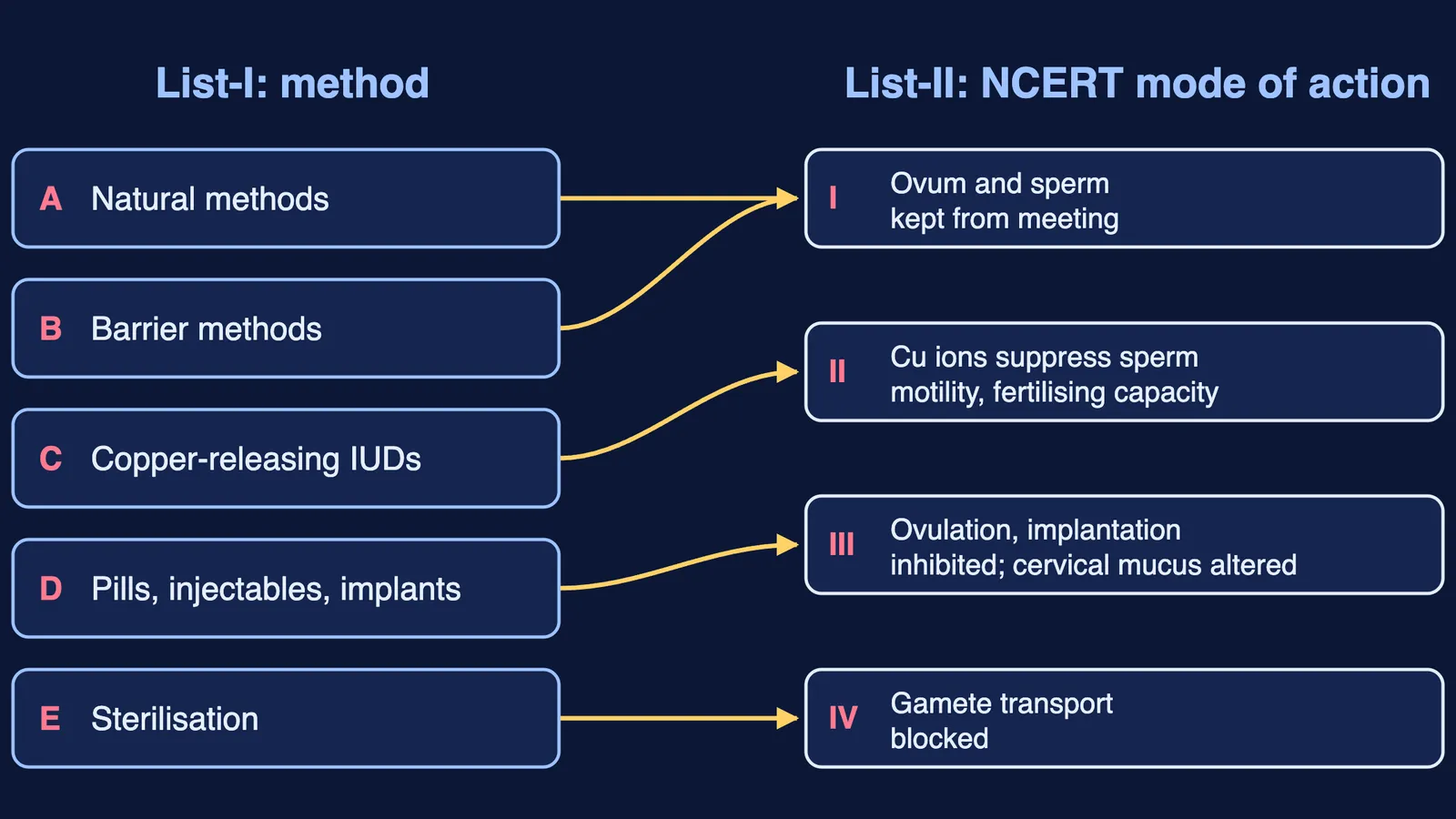
Q7 (easy). List-I: A. Lactational amenorrhea; B. Spermicidal jellies; C. Emergency contraception; D. Implants. List-II: I. Used within 72 hours of coitus; II. Used with barriers to raise efficiency; III. No ovulation during intense lactation; IV. Hormones under the skin, effective longer than pills.
(1) A-III, B-II, C-I, D-IV (2) A-III, B-I, C-II, D-IV (3) A-IV, B-II, C-I, D-III (4) A-I, B-II, C-III, D-IV
Answer: (1). Each pair restates NCERT's description.
Q8 (medium). List-I: A. Multiload 375; B. LNG-20; C. Lippes loop; D. Nirodh. List-II: I. Non-medicated IUD; II. Copper-releasing IUD; III. Male condom; IV. Hormone-releasing IUD.
(1) A-IV, B-II, C-I, D-III (2) A-II, B-IV, C-I, D-III (3) A-II, B-I, C-IV, D-III (4) A-I, B-IV, C-II, D-III
Answer: (2). Multiload 375 sits with CuT and Cu7; LNG-20 with Progestasert.
Q9 (medium). List-I: A. ZIFT; B. IUT; C. ICSI; D. IUI. List-II: I. Sperm injected straight into an ovum; II. Semen placed in the uterus; III. Embryo of more than 8 blastomeres into the uterus; IV. Zygote or early embryo (8 blastomeres or fewer) into the fallopian tube.
(1) A-IV, B-III, C-II, D-I (2) A-III, B-IV, C-I, D-II (3) A-IV, B-III, C-I, D-II (4) A-IV, B-II, C-I, D-III
Answer: (3). The 8-blastomere cut-off separates ZIFT from IUT.
Q10 (hard). List-I: A. 1951; B. 72 hours; C. 21 years; D. 2 years. List-II: I. Statutory marriageable age for males; II. Start of India's family planning programmes; III. Unprotected cohabitation in NCERT's infertility definition; IV. Window for emergency contraception.
(1) A-II, B-IV, C-I, D-III (2) A-II, B-III, C-I, D-IV (3) A-I, B-IV, C-II, D-III (4) A-II, B-IV, C-III, D-I
Answer: (1). All four figures are NCERT's.
Which single option is correct?
How to attack this format: answer before reading options. For "which is NOT", mark each option true or false.
Q11 (easy). Which STI does NCERT say also spreads through shared injection needles? (1) Gonorrhoea (2) Trichomoniasis (3) HIV (4) Genital warts
Answer: (3). NCERT names hepatitis-B and HIV for needles and blood transfusion.
Q12 (medium). Which technique does NCERT name for infertility from very low sperm counts? (1) GIFT (2) Artificial insemination (3) Tubectomy (4) Lactational amenorrhea
Answer: (2). AI also covers a male partner unable to inseminate.
Q13 (medium). Which is NOT a reason NCERT gives for India's rapid population growth? (1) Fall in death rate (2) Fall in MMR and IMR (3) More people of reproducible age (4) A higher legal age of marriage
Answer: (4). A raised marriageable age is a measure against growth.
Q14 (hard). Roughly how many MTPs does NCERT say are performed worldwide each year? (1) 4.5 to 5 million (2) 45 to 50 million (3) 450 to 500 million (4) Half of all conceived pregnancies
Answer: (2). That is about one-fifth of pregnancies conceived each year.
Next: reproductive health assertion-reason questions, how IVF, ZIFT, GIFT and ICSI differ and sexually transmitted infections for NEET.
Unsure where to start revising this chapter? Fermi's AI tutor works out what you already know and builds a plan for the session.


