On this page
Reproductive health looks like a list of methods and acronyms, but assertion-reason and Statement I/II questions ask something harder: is each line true, and does one line actually explain the other? These 10 new questions run from easy to hard, and every key rests on a sentence in the textbook.
What does this set cover?
The NEET (UG)-2026 syllabus issued by the National Medical Commission lists reproductive health under Biology Unit 6, Reproduction: STD prevention, birth control and contraception, MTP, amniocentesis, and infertility with IVF, ZIFT and GIFT. Every answer here is checked against Chapter 3 of NCERT Class 12 Biology, Reprint 2026-27.
New to the chapter? Read our reproductive health guide for NEET first.
How do you read assertion-reason and statement questions?
These keys apply throughout.
Assertion-reason (Q1-Q6):
(A) Both A and R are true and R is the correct explanation of A.
(B) Both A and R are true but R is NOT the correct explanation of A.
(C) A is true but R is false.
(D) A is false but R is true.
Statement pairs (Q7-Q10):
(A) Both statements are correct.
(B) Both statements are incorrect.
(C) Statement I is correct, Statement II is incorrect.
(D) Statement I is incorrect, Statement II is correct.
Assertion-reason questions: Q1 to Q6
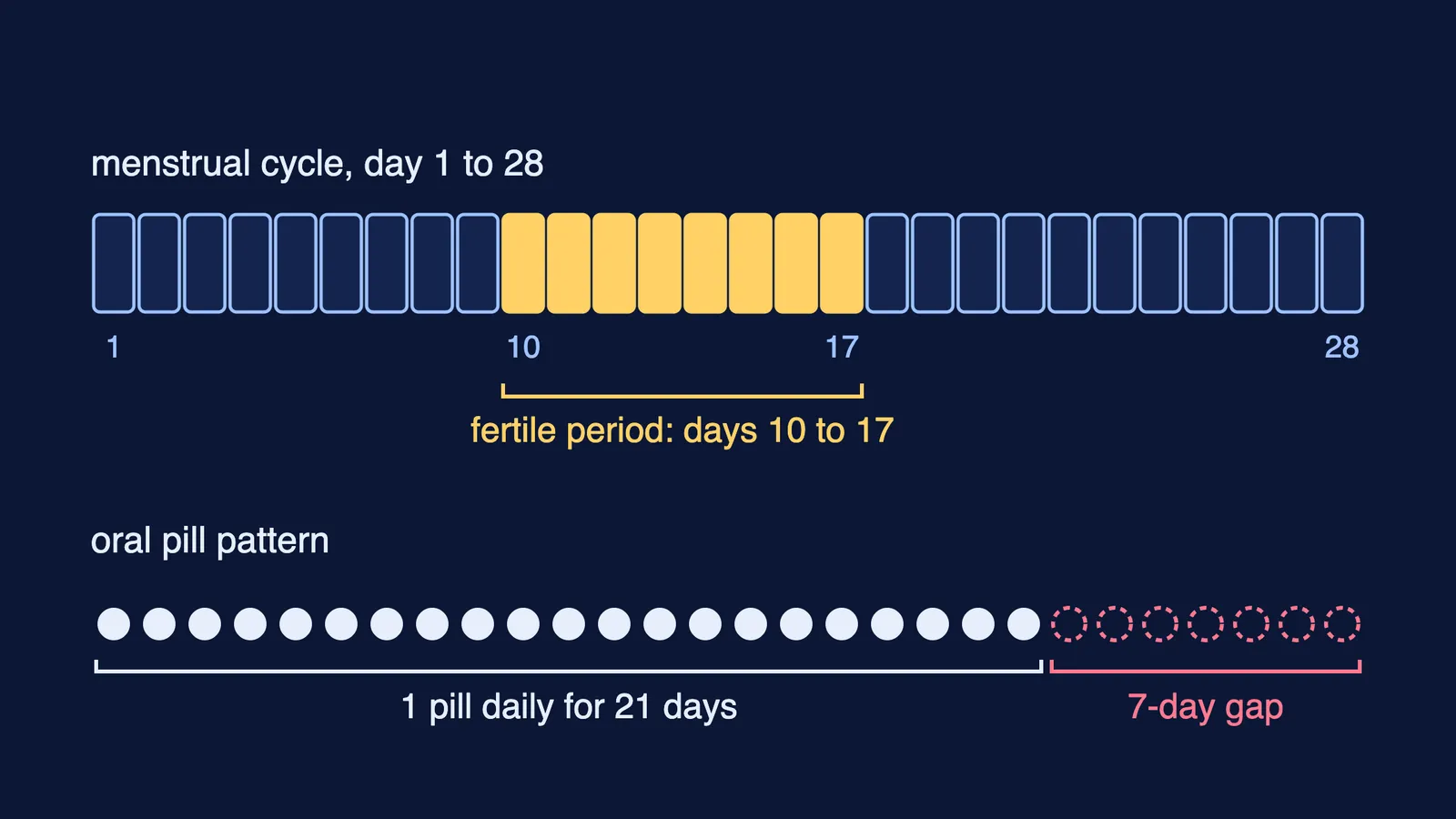
Q1 (easy). Assertion (A): A couple relying on periodic abstinence should avoid coitus on day 14 of the menstrual cycle. Reason (R): Days 10 to 17 are when ovulation can be expected, so the chance of fertilisation is very high then.
Answer: (A). Day 14 falls inside the window NCERT calls the fertile period, and R is exactly why that window is avoided. Trap: thinking the method is about avoiding menstruation days.
Q2 (easy). Assertion (A): Diaphragms, cervical caps and vaults are reusable. Reason (R): They prevent conception by stopping ovulation.
Answer: (C). A is true. R is false: these rubber barriers cover the cervix and block the entry of sperms; stopping ovulation is how pills work. Trap: giving a barrier the mechanism of a hormone.
Q3 (medium). Assertion (A): Most women with an STI seek treatment early because the first symptoms are severe. Reason (R): Social stigma attached to STIs can deter infected people from timely detection and treatment.
Answer: (D). A is false: early symptoms are usually minor, and infected females may often show none at all. R is true. Trap: a true R makes a false A feel safe.
Q4 (medium). Assertion (A): Hepatitis-B can pass from an infected mother to the foetus. Reason (R): Hepatitis-B is one of the STIs that is not completely curable even when detected early.
Answer: (B). Both are true, but whether an infection can be cured says nothing about how it spreads. Trap: both lines sit in the same NCERT paragraph, so they feel linked.
Q5 (hard). Assertion (A): Vasectomy and tubectomy are very poorly reversible, so they are advised only as terminal methods. Reason (R): They block gamete transport rather than gamete formation.
Answer: (B). Both are true, but blocking transport does not explain poor reversibility: a condom also stops sperms reaching the ovum and is fully reversible. Trap: R is the mechanism, and mechanisms often pass for reasons.
Q6 (hard). Assertion (A): After IVF, an embryo with 16 blastomeres is transferred into the uterus, not the fallopian tube. Reason (R): Zygotes and embryos with up to 8 blastomeres go into the fallopian tube (ZIFT); embryos with more than 8 go into the uterus (IUT).
Answer: (A). 16 is more than 8, so the embryo goes to the uterus by the rule in R. Trap: linking "fallopian tube" to every IVF embryo.
Statement I and Statement II questions: Q7 to Q10
Facts below come from the same NCERT Chapter 3 text.
Q7 (easy). Statement I: Oral pills are taken daily for 21 days, starting preferably within the first five days of the menstrual cycle, then repeated after a gap of 7 days. Statement II: Oral contraceptive pills contain only estrogen.
Answer: (C). I is correct. II is wrong: pills contain progestogens alone or progestogen-estrogen combinations. Trap: estrogen is the hormone students remember, so "only estrogen" sounds right.
Q8 (medium). Statement I: Saheli is a steroidal pill that must be taken every day. Statement II: Saheli was developed by scientists at the Central Drug Research Institute (CDRI), Lucknow.
Answer: (D). I is wrong twice: Saheli is non-steroidal and taken once a week. II is correct. Trap: carrying the daily routine of ordinary pills over to Saheli.
Q9 (medium). Statement I: MTPs are considered relatively safe during the first trimester, that is, up to 12 weeks of pregnancy. Statement II: India legalised MTP in 1971, with strict conditions to prevent misuse.
Answer: (A). Both are NCERT statements; second-trimester abortions are much riskier. Trap: assuming MTP is illegal in India, or misplacing the year.
Q10 (hard). Statement I: In GIFT, a zygote is transferred into the fallopian tube of a female who cannot produce ova. Statement II: In IUI, semen is introduced into the fallopian tube.
Answer: (B). I is wrong: GIFT transfers an ovum, a gamete, as the name says; a zygote in the tube is ZIFT. II is wrong: in artificial insemination, semen goes into the vagina or the uterus, and IUI means intra-uterine insemination. Trap: two acronyms that differ by one letter, and a third that names its own site.
How should you use this set?
Attempt all 10 with the answers covered, about a minute each.
For each miss, note what failed: the truth of a line, or the because link.
Find the NCERT sentence behind it and rewrite the item so a different key becomes correct.
Redo the set after a week.
For the format itself, read our strategy for assertion-reason questions. The previous chapter has its own set: assertion-reason questions on human reproduction.
If a miss came from a shaky idea, such as what a hormone-releasing IUD does, rather than a misread, the Fermi Concept Library has every concept in biology, each with its own lesson, so you can fix the gap first.
These questions are for exam practice. For any personal question about contraception or sexual health, NCERT's own advice applies: talk to a qualified doctor.