On this page
Section 3.4 of the NCERT Class 12 Biology chapter on reproductive health is one page, but it holds a list, an exception and three rules. Here they are, with the cause of each infection from World Health Organization (WHO) fact sheets.
Which sexually transmitted infections does NCERT list?
The NCERT Class 12 Biology chapter Reproductive Health defines sexually transmitted infections (STIs) as infections or diseases transmitted through sexual intercourse, also called venereal diseases (VD) or reproductive tract infections (RTI). It names eight common ones:
Gonorrhoea
Syphilis
Genital herpes
Chlamydiasis
Genital warts
Trichomoniasis
Hepatitis B
HIV, leading to AIDS
Some of these, such as hepatitis B and HIV, can also spread through shared injection needles and surgical instruments, blood transfusion, or from an infected mother to the foetus. NCERT adds that incidence is reported to be very high in the 15-24 age group.
Which STIs are curable, and what causes each?
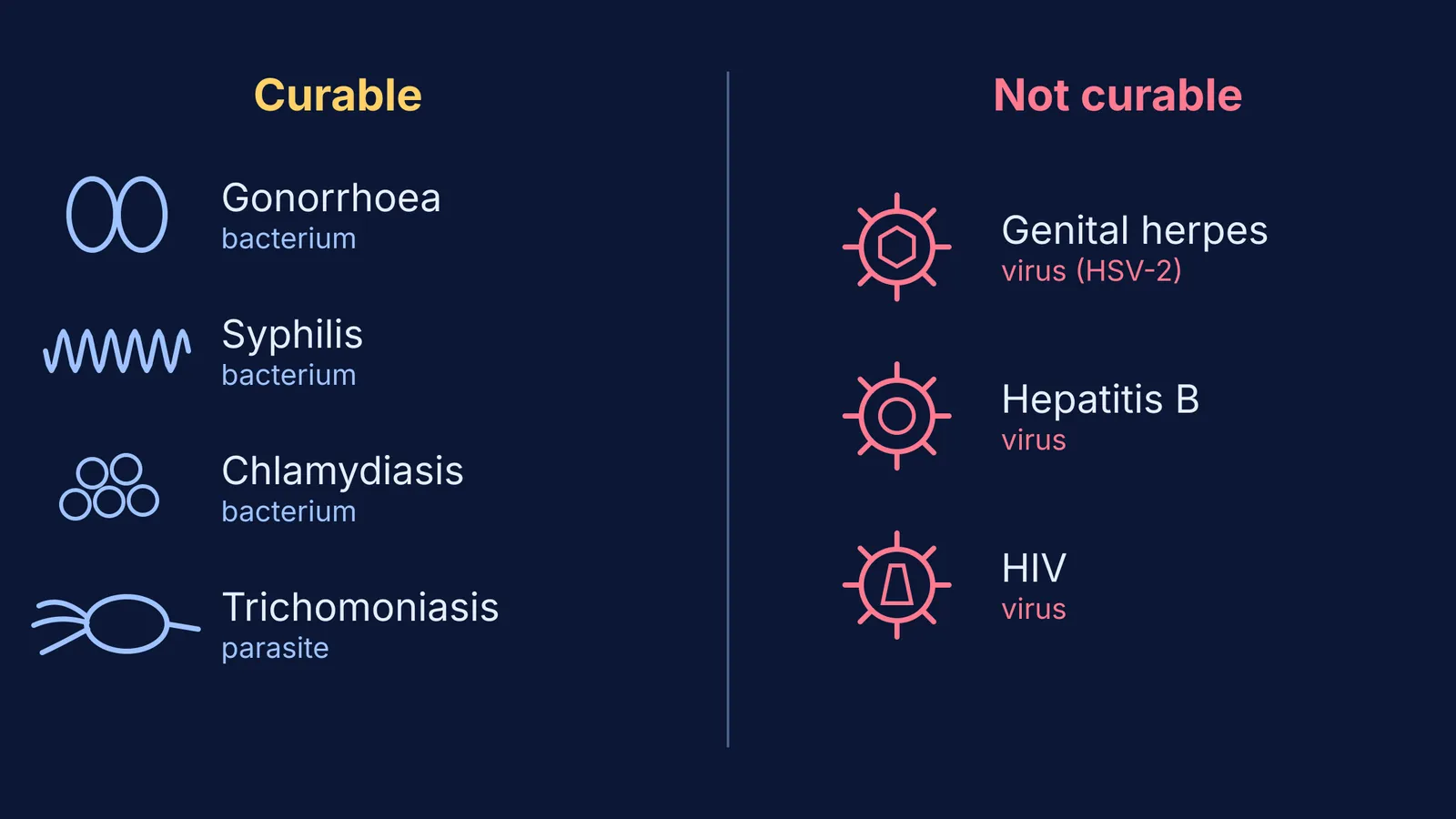
NCERT's rule is one sentence: except for hepatitis B, genital herpes and HIV, the other STIs are completely curable if detected early and treated properly. WHO's fact sheets show the pattern: the STIs WHO calls curable are caused by bacteria or a parasite, and the three exceptions are viruses.
Gonorrhoea: the bacterium *Neisseria gonorrhoeae*. WHO says it is "treatable and curable with antibiotics", though drug resistance is making treatment harder (WHO gonorrhoea fact sheet)).
Syphilis: the bacterium *Treponema pallidum*. In the first stage a round, painless sore called a chancre appears, and early syphilis is treated with a benzathine penicillin injection (WHO syphilis fact sheet).
Genital herpes: mainly herpes simplex virus type 2 (HSV-2). WHO calls it "treatable but not curable": antiviral medicines can shorten and ease symptoms (WHO herpes fact sheet).
Hepatitis B: the hepatitis B virus, which infects the liver. Chronic infection can be treated with oral medicines (WHO hepatitis B fact sheet), but WHO lists it as incurable.
HIV: the human immunodeficiency virus, which targets white blood cells and weakens the immune system. There is no cure, but with treatment and care HIV has become "a manageable chronic health condition" (WHO HIV fact sheet).
WHO's STI fact sheet) groups them the same way: three bacterial STIs (chlamydia, gonorrhoea, syphilis) and one parasitic STI (trichomoniasis) are generally curable with antibiotics, while hepatitis B, herpes, HIV and human papillomavirus (HPV) are incurable viral infections.
To see how one of these viruses works inside the body, read our explainer on how HIV replicates and destroys helper T cells.
How common are STIs?
WHO estimates that more than 1 million curable STIs are acquired every day worldwide by people aged 15-49 (WHO STI fact sheet)). The same fact sheet estimates that 520 million people aged 15-49 have HSV-2, the main cause of genital herpes, and that 8 million adults aged 15-49 were infected with syphilis in 2022.
WHO says most newly acquired curable STIs are asymptomatic, and NCERT notes that infected females may often show no symptoms and remain undetected for long. Without timely detection and treatment, NCERT says complications can follow: pelvic inflammatory disease (PID), abortions, still births, ectopic pregnancies, infertility and even cancer of the reproductive tract.
How can sexually transmitted infections be prevented?
NCERT gives three principles:
Avoid sex with unknown partners or multiple partners.
Always try to use condoms during coitus.
In case of doubt, go to a qualified doctor for early detection, and get complete treatment if diagnosed.
WHO adds two points. When used correctly and consistently, condoms offer one of the most effective methods of protection against STIs, and safe, highly effective vaccines exist for two viral STIs, hepatitis B and HPV (WHO STI fact sheet)). WHO says the hepatitis B vaccine offers nearly 100% protection (WHO hepatitis B fact sheet). Our guide to types of contraceptive methods and how each one works shows where condoms sit among barrier methods.
A five-question recall check
Cover everything above and answer aloud:
Which three STIs does NCERT call not curable? (Hepatitis B, genital herpes, HIV.)
Which two does NCERT name as also spreading through needles and blood transfusion? (Hepatitis B, HIV.)
Correct this statement from the NCERT exercises: "All sexually transmitted diseases are completely curable."
What are the three prevention principles?
Name four complications of untreated STIs.
If you miss question 1 or 2, revisit pathogen types: the Fermi Concept Library has every concept in biology with its own lesson. For practice, the Fermi Problem Library has worked problems with a step-by-step solver that explains the reasoning rather than printing an answer. For the rest of the chapter, see reproductive health for NEET: key facts and question types.
Where can you get help in India?
This article is for exam study, not medical advice; for any symptom or worry, see a qualified doctor. The NACO national AIDS helpline is 1097, toll-free from any mobile or landline, and Tele MANAS offers free mental health support on 14416.