On this page
In Class 12 biology, contraceptive names are easy to memorise and their mechanisms easy to mix up. The fix is one question for every method: which step between ovulation and pregnancy does it block? Here is each family's answer, from the NCERT textbook and World Health Organization figures.
What are the main types of contraceptive methods?
The NCERT Class 12 chapter Reproductive Health groups contraceptives into natural or traditional methods, barriers, IUDs, oral contraceptives, injectables, implants and surgical methods. Think of pregnancy as a chain of four links, with each method cutting one or more of them:
An egg is released (ovulation). Pills, injectables, implants and lactational amenorrhea act here.
Sperm reach the egg. Condoms, diaphragms, withdrawal, periodic abstinence and sterilisation act here.
Sperm fertilise the egg. Copper ions from a copper-T reduce the sperm's fertilising capacity.
The embryo implants in the uterus. Pills and hormone-releasing IUDs can also make the uterus unsuitable for implantation.
How does a copper-T prevent pregnancy?
A copper-T is a small T-shaped device that a doctor or trained nurse places in the uterus through the vagina. NCERT lists CuT, Cu7 and Multiload 375 as copper-releasing IUDs, alongside hormone-releasing IUDs such as LNG-20 (NCERT Reproductive Health).
It works in two ways. IUDs increase phagocytosis of sperm inside the uterus, so white blood cells engulf them. And the copper ions released suppress sperm motility and their fertilising capacity. The WHO puts it in one line: the copper component damages sperm and prevents it from meeting the egg (WHO mechanisms and effectiveness table).
Hormone-releasing IUDs add more: NCERT says they make the uterus unsuitable for implantation and the cervix hostile to sperm.
How do birth control pills work?
Pills contain small doses of progestogens alone, or progestogens combined with estrogen. In the schedule NCERT describes, a pill is taken daily for 21 days, starting preferably within the first five days of the menstrual cycle, followed by a 7-day gap during which menstruation occurs (NCERT Reproductive Health).
The hormones inhibit ovulation and implantation, and change the cervical mucus so sperm cannot easily enter. The WHO table separates the two types: the combined pill prevents the ovaries releasing eggs, while the progestogen-only minipill thickens cervical mucus and also prevents ovulation (WHO mechanisms and effectiveness table).
Saheli, developed at the Central Drug Research Institute in Lucknow, contains a non-steroidal preparation and is taken once a week, according to NCERT.
How do natural, barrier and surgical methods work?
Periodic abstinence: avoiding sex from day 10 to day 17 of the menstrual cycle, when ovulation is expected (NCERT Reproductive Health).
Withdrawal: the male partner withdraws before ejaculation.
Lactational amenorrhea: intense breastfeeding after childbirth keeps ovulation from returning; NCERT says it has been reported effective only up to six months after delivery.
Barriers: condoms, diaphragms, cervical caps and vaults physically stop sperm reaching the egg. Condoms are the only contraceptive method that can prevent both pregnancy and sexually transmitted infections, including HIV (WHO fact sheet).
Surgical methods: vasectomy removes or ties a small part of the vas deferens; tubectomy does the same to the fallopian tubes. NCERT calls both highly effective but says their reversibility is very poor.
How effective is each method?
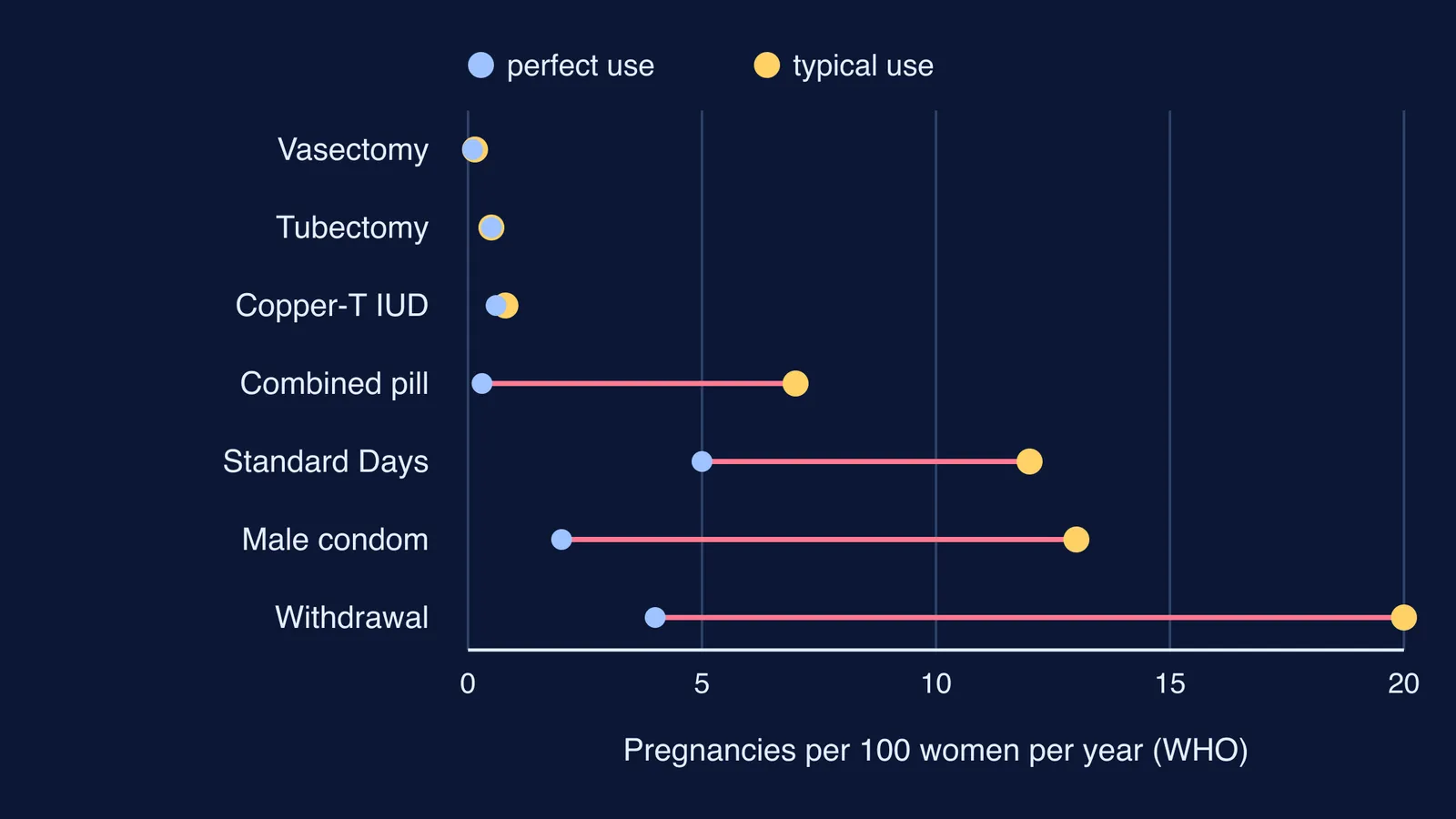
The WHO gives two numbers for each method: pregnancies per 100 women per year with consistent and correct use, and as commonly used (WHO mechanisms and effectiveness table). The gap between them mostly reflects how consistently a method is used.
Vasectomy: 0.1 with correct use, 0.15 as commonly used.
Female sterilisation (tubectomy): 0.5 and 0.5.
Copper IUD: 0.6 and 0.8.
Combined pill: 0.3 and 7.
Standard Days Method (a calendar method): 5 and 12.
Male condom: 2 and 13.
Withdrawal: 4 and 20.
Worked example. Picture 100 women using the combined pill for a year. If every pill is taken on time, the WHO figure is 0.3 pregnancies among them. As pills are actually taken, with missed days, it is 7. A copper-T barely moves (0.6 to 0.8), which fits with there being nothing to remember each day once it is in place.
How should you revise this, and who should you ask?
For exams, make a four-column note for each method: name, the link it breaks, the NCERT keyword (Cu ions, 21 days, day 10 to 17, vas deferens) and whether it is reversible. If the menstrual cycle behind the fertile window feels shaky, the Fermi Concept Library gives every biology concept its own lesson and its place in the map. For practice, the Fermi Problem Library has worked problems with a step-by-step solver that explains the reasoning rather than printing an answer.
For real-life decisions, NCERT is clear that choosing a contraceptive should always be done with qualified medical professionals. A gynaecologist, family doctor or government health centre can explain the options; this article is for understanding only.