On this page
Expanding ZIFT and GIFT is the easy part. Saying where fertilisation happens in each is harder. That one detail separates the assisted reproductive technologies (ART) in Class 12 biology, and it is what multiple-choice questions test.
We use the wording of the NCERT Class 12 Biology chapter on reproductive health (section 3.5, Infertility), the textbook your board exam follows, and the US CDC's ART glossary where it adds detail.
What do IVF, ZIFT, GIFT and ICSI mean?
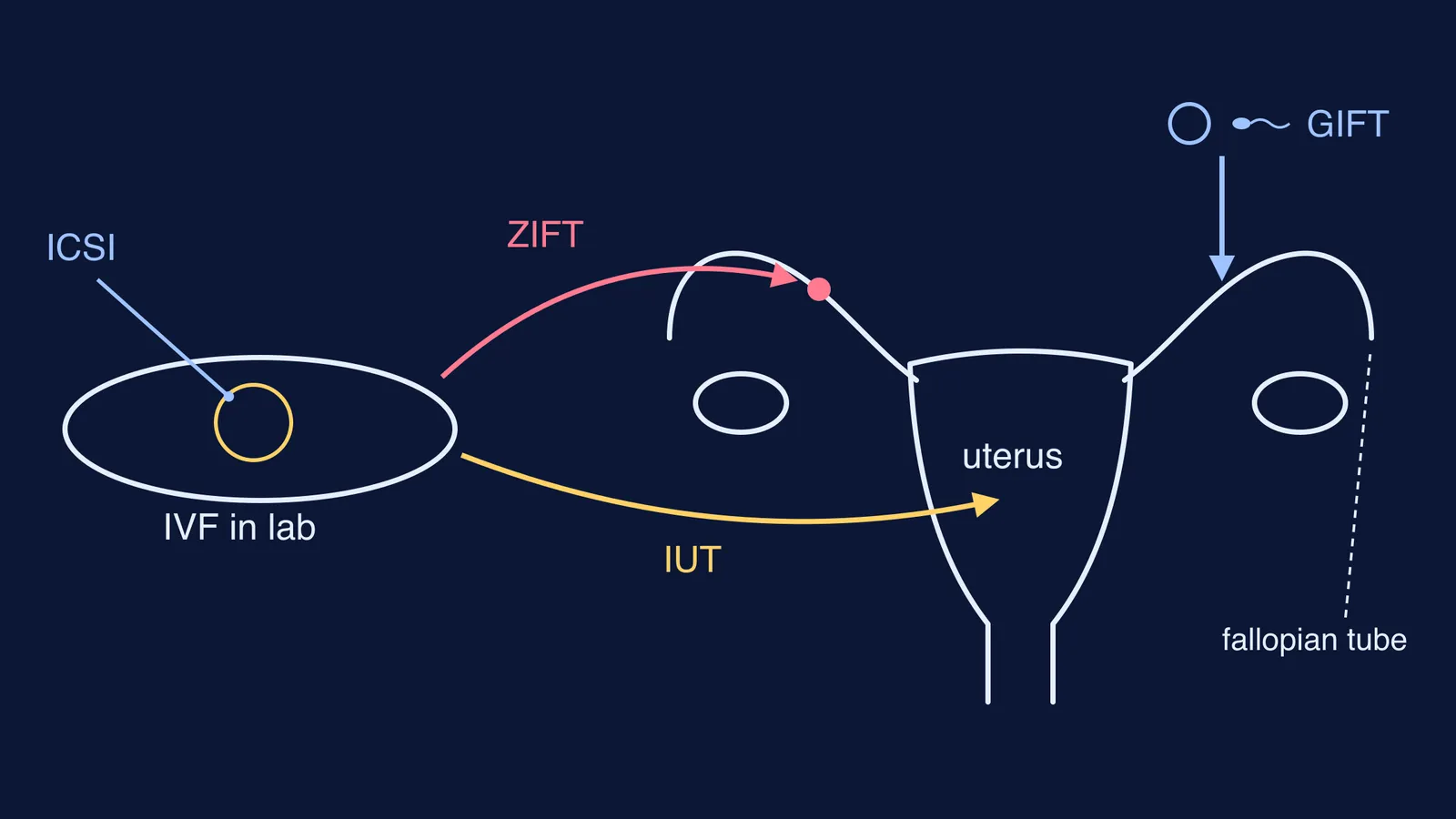
NCERT defines in vitro fertilisation (IVF) as fertilisation outside the body, in conditions almost like those inside the body; followed by embryo transfer (ET), it is popularly called the test tube baby programme (NCERT, Chapter 3). Ova and sperm are collected and made to form a zygote in the laboratory.
ZIFT (zygote intra fallopian transfer) is the transfer of the zygote or an early embryo with up to 8 blastomeres into the fallopian tube, according to the same NCERT page.
IUT (intra uterine transfer) is the transfer of an embryo with more than 8 blastomeres into the uterus (NCERT, Chapter 3). ZIFT and IUT are the two embryo transfer routes after IVF.
GIFT (gamete intra fallopian transfer) places gametes, not a zygote, in the fallopian tube, so fertilisation happens inside the body (CDC ART glossary).
ICSI (intracytoplasmic sperm injection) is a laboratory procedure in which a sperm is injected directly into the ovum to form an embryo (NCERT, Chapter 3). The CDC notes that ICSI is commonly used to treat male infertility.
Where does fertilisation happen in each technique?
Sort every technique with two questions from the NCERT definitions: where do the egg and sperm meet, and what gets moved where?
IVF followed by embryo transfer (ET): meets in the lab; the embryo then goes either to the fallopian tube (ZIFT) or to the uterus (IUT).
ZIFT: meets in the lab; the zygote or early embryo (up to 8 blastomeres) goes to the fallopian tube.
IUT: meets in the lab; the embryo (more than 8 blastomeres) goes to the uterus.
GIFT: meets inside the body; unfertilised gametes go to the fallopian tube.
ICSI: meets in the lab, by injecting one sperm into the egg. ICSI describes how fertilisation is done, not where anything is transferred.
Artificial insemination (AI) and IUI: semen is placed in the vagina or uterus, so fertilisation happens inside the body.
The CDC does not count IUI as ART, because it does not involve the manipulation of eggs (CDC ART glossary).
If the tube itself is fuzzy, our guide to the four parts of the fallopian tube shows where fertilisation normally happens, and from fertilisation to implantation follows the embryo's first week on its way to the uterus.
Why does NCERT describe GIFT differently from the CDC?
NCERT describes GIFT as transferring an ovum collected from a donor into the fallopian tube of another female who cannot produce one but can provide a suitable environment for fertilisation (NCERT, Chapter 3). The CDC glossary describes eggs removed from the woman's own ovary and placed, with sperm, into her fallopian tube by laparoscope (CDC ART glossary).
Both agree on the point exams test: GIFT moves gametes, and fertilisation happens in vivo. In a board or NEET-UG answer, use NCERT's definition, donor ovum included.
How do NEET questions test ZIFT and GIFT?
Which statements are correct by the NCERT definitions? Decide before reading the working.
In ZIFT, an embryo with 16 blastomeres is transferred into the fallopian tube.
In GIFT, fertilisation takes place in the laboratory.
In ICSI, a sperm is injected directly into the ovum.
In embryo transfer techniques, embryos are always transferred into the uterus.
Working:
Wrong. NCERT's limit for ZIFT is up to 8 blastomeres; more than 8 goes to the uterus by IUT.
Wrong. GIFT moves gametes, so fertilisation happens in the fallopian tube.
Correct; this matches NCERT's definition.
Wrong. ZIFT puts the zygote or early embryo in the fallopian tube. NCERT's own exercises (question 12d) ask you to correct this sentence.
Only statement 3 is correct. Notice the pattern: each trap swaps either the place of fertilisation or the destination. Our reproductive health guide for NEET covers the rest of the chapter in the same way.
If blastomeres or early embryo stages still feel vague, the Fermi Concept Library gives each biology concept its own lesson, so you can fill the gap before returning to questions.
Are these techniques regulated in India?
Yes. Parliament passed the Assisted Reproductive Technology (Regulation) Bill in December 2021, and it requires every ART clinic and bank to be registered in a National Registry of Banks and Clinics (PRS Legislative Research).
This post explains textbook biology, not treatment. A family considering fertility treatment should talk to a qualified doctor at a registered clinic.
Next step: write the two questions at the top of your reproductive health notes and sort each technique from memory.