On this page
Human Reproduction questions in NEET-UG pair a cell with a hormone, a cycle day with an event, or a cell count with a rule from meiosis. Here are 8 original single-correct MCQs in that style, and each solution names the option most students fall for.
The NEET (UG)-2026 syllabus lists Human Reproduction under Biology Unit 6, Reproduction: reproductive systems, microscopic anatomy of testis and ovary, gametogenesis, menstrual cycle, fertilisation up to blastocyst and implantation, and an elementary idea of pregnancy, parturition and lactation. Every fact-based option below matches the NCERT Class 12 Biology chapter on Human Reproduction (Reprint 2026-27).
How should you use these human reproduction questions?
Hide the answers and allow yourself about a minute for each question.
For every option, say which NCERT line makes it true or false before you choose.
Read the trap line even when you were right.
Note each trap that caught you and reread that NCERT paragraph the same day.
If you have not read the chapter yet, start with how to prepare Human Reproduction for NEET.
Easy: can you match cells, hormones and layers?
Each tests one line of the NCERT chapter.
Q1 (easy). Which pairing of a testis cell with the pituitary hormone that acts on it is correct?
(A) Leydig cells with FSH (B) Sertoli cells with LH (C) Leydig cells with LH (D) Sertoli cells with GnRH
Answer: (C). NCERT states that LH acts at the Leydig cells and stimulates androgen secretion, while FSH acts on the Sertoli cells. Trap: (B) swaps the two targets; GnRH in (D) is a hypothalamic hormone that acts on the anterior pituitary, not on the testis.
Q2 (easy). Which layer of the uterine wall undergoes cyclical changes during the menstrual cycle, and which layer contracts strongly during delivery?
(A) Endometrium; myometrium (B) Myometrium; endometrium (C) Perimetrium; myometrium (D) Endometrium; perimetrium
Answer: (A). The inner glandular endometrium changes through the cycle; the middle smooth-muscle myometrium contracts at delivery. Trap: (B) reverses them because both names sound alike.
Q3 (easy). Which of these cells is haploid?
(A) Oogonium (B) Primary oocyte (C) Secondary oocyte (D) Primary spermatocyte
Answer: (C). The first meiotic division, completed in the tertiary follicle, gives a large haploid secondary oocyte and a first polar body. Trap: (B) tempts because the primary oocyte has entered meiosis, but it is arrested in prophase I and has not yet halved its chromosomes.
Medium: can you track the cycle and the counts?
These use the timing in section 2.4 and the divisions in section 2.3 of the NCERT chapter.
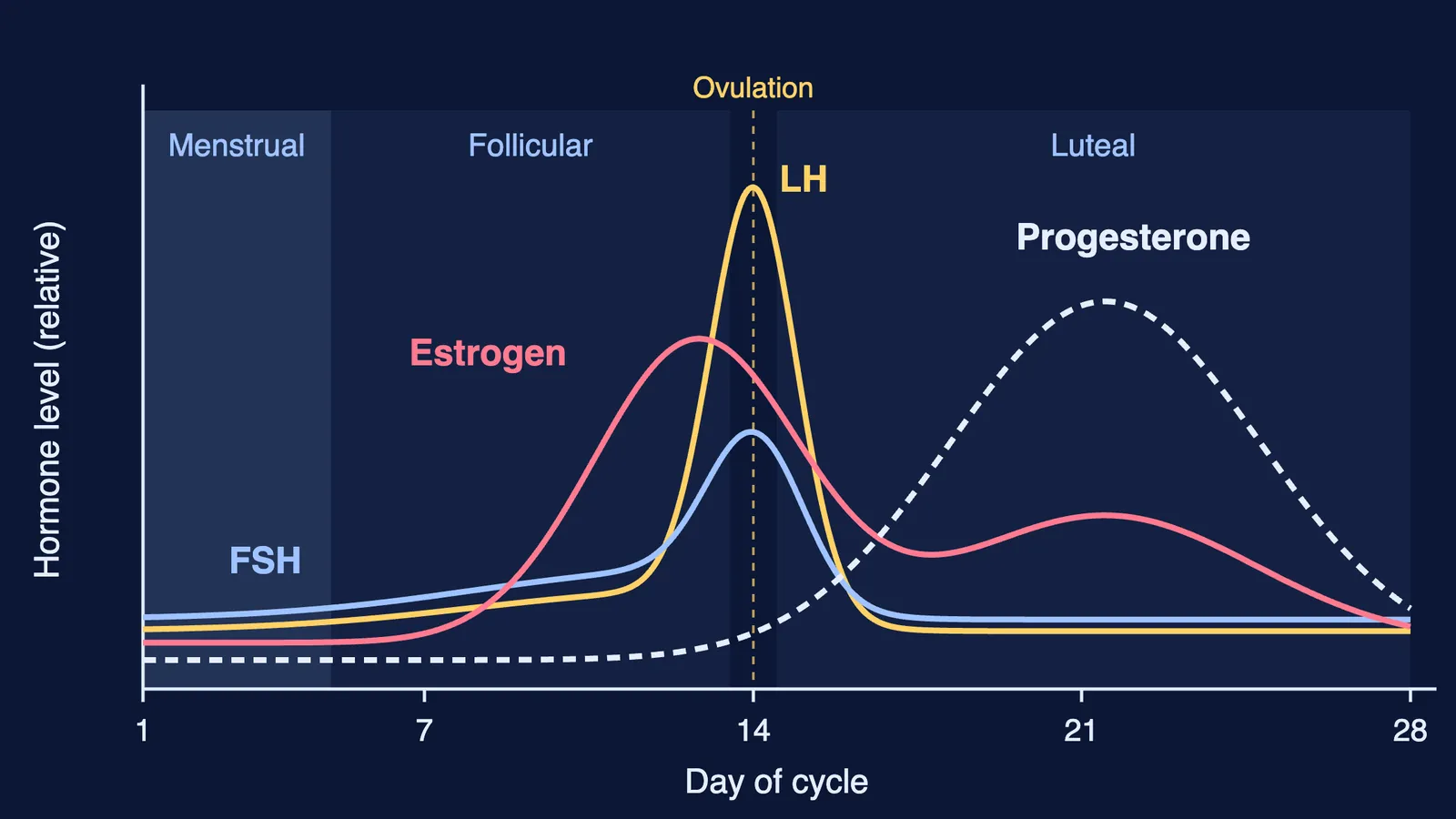
Q4 (medium). In a regular cycle of about 28 days, which statement about the middle of the cycle is correct?
(A) The LH surge around day 14 induces rupture of the Graafian follicle, and progesterone from the corpus luteum rises after it. (B) Progesterone peaks just before day 14 and causes the follicle to rupture. (C) LH and FSH both fall to their lowest levels around day 14. (D) The corpus luteum forms during the follicular phase and releases the ovum.
Answer: (A). NCERT says LH and FSH both peak around day 14, the LH surge induces ovulation, and the corpus luteum then secretes large amounts of progesterone. Trap: (B) puts the progesterone peak before ovulation, but progesterone comes from the corpus luteum, which forms only after it.
Q5 (medium). 35 primary spermatocytes complete spermatogenesis. 35 primary oocytes each complete both meiotic divisions (the second after sperm entry), and assume no first polar body divides. How many sperms, ootids and polar bodies result?
(A) 140, 35, 70 (B) 140, 140, 0 (C) 70, 35, 70 (D) 140, 35, 105
Answer: (A). Each primary spermatocyte gives four spermatids, so 35 × 4 = 140 sperms. Each oocyte gives one ootid plus two polar bodies, so 35 ootids and 70 polar bodies. Trap: (D) lets the first polar body divide, which NCERT says is uncertain and the stem rules out.
Q6 (medium). Arrange these events in order: P, second polar body forms; Q, morula of 8 to 16 blastomeres; R, sperm contacts the zona pellucida; S, trophoblast attaches to the endometrium; T, blastocyst forms.
(A) R, P, Q, T, S (B) P, R, Q, T, S (C) R, P, T, Q, S (D) R, Q, P, T, S
Answer: (A). Sperm entry completes meiosis II, giving the second polar body; cleavage then gives a morula, a blastocyst, and trophoblast attachment at implantation. Trap: (B) assumes the secondary oocyte finishes meiosis II before a sperm arrives, but NCERT says sperm entry induces it.
Hard: can you reason across fertilisation and pregnancy?
These combine two lines of section 2.4 to 2.6.
Q7 (hard). Assertion: Menstruation does not occur during pregnancy. Reason: The corpus luteum degenerates soon after fertilisation.
(A) Both true, and the reason explains the assertion (B) Both true, but the reason does not explain it (C) Assertion true, reason false (D) Both false
Answer: (C). NCERT says all events of the cycle stop during pregnancy. The corpus luteum degenerates in the absence of fertilisation, and that degeneration is what leads to menstruation. Trap: (A) feels right because corpus luteum degeneration is linked to menstruation, but that happens only in the non-pregnant case.
Q8 (hard). Which set of hormones, according to NCERT, is produced in women only during pregnancy?
(A) hCG, hPL and relaxin (B) hCG, estrogens and progestogens (C) hPL, prolactin and oxytocin (D) Relaxin, cortisol and thyroxine
Answer: (A). NCERT names hCG, hPL and relaxin as produced only during pregnancy; NCERT names the ovary as the source of relaxin in the later phase of pregnancy. Trap: (B) lists real placental hormones, but estrogens and progestogens are also made outside pregnancy; during pregnancy their levels increase several-fold.
What should you revise after this set?
If Q4 or Q7 caught you, redraw the hormone curves for one cycle from memory and mark where the corpus luteum appears; comparing it with the oestrous and menstrual cycles side by side helps the phases stick. The next chapter builds on this one, so move on to reproductive health for NEET once these feel easy.
If a process such as oogenesis still feels like a list of names, the Fermi Concept Library has a lesson for every biology concept, each placed in a map of the ideas around it.