On this page
Menstrual and oestrous cycles are two versions of one rhythm. In both, the ovary releases an egg and the uterus thickens its lining, the endometrium. They differ in what happens to that lining when no pregnancy follows, and in whether there is a phase of heat.
What is the difference between the oestrous and menstrual cycle?
An oestrous cycle is a set of recurring changes, driven by reproductive hormones, in female mammals, and it includes oestrus, or heat, when the female is sexually receptive (Estrous cycle, Wikipedia). Animals with oestrous cycles resorb the endometrium if conception does not occur, while mammals with menstrual cycles shed it through menstruation.
Side by side:
Who has it: menstrual cycle in humans, apes and Old World monkeys (Emera et al., BioEssays); oestrous cycle in most other mammals, including cows and dogs.
Lining when there is no pregnancy: menstrual cycle, broken down and shed with bleeding; oestrous cycle, resorbed, with no menstrual bleeding.
Heat: oestrous cycle, a defined phase of sexual receptivity; menstrual cycle, no heat phase to mark.
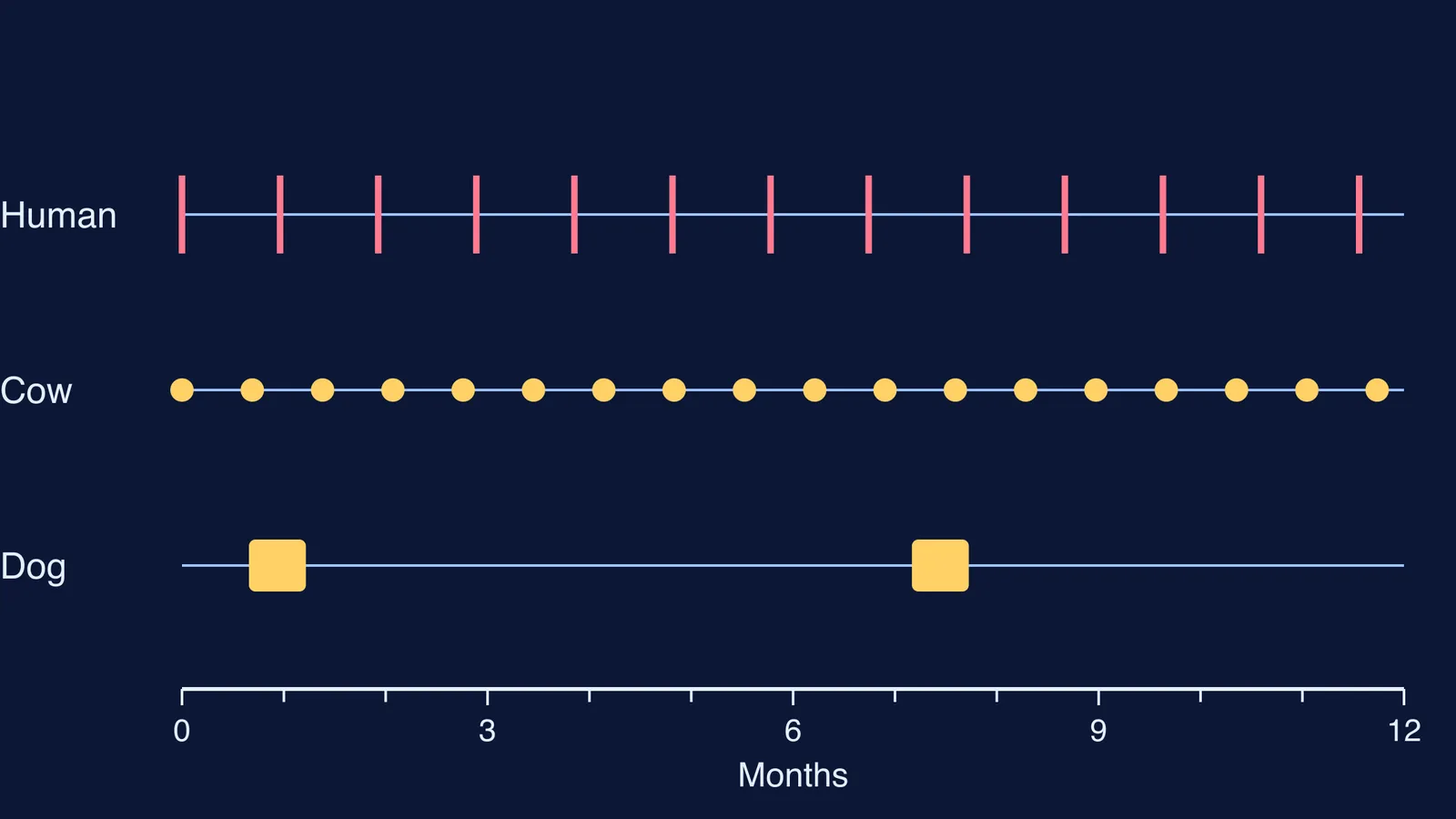
Typical length: human, 29.3 days on average across 612,613 app-tracked ovulatory cycles (Bull et al., npj Digital Medicine); cow, 21 days on average (Mississippi State University Extension); dog, one heat every 5 to 12 months (Concannon, Animal Reproduction Science).
Why do primates menstruate but cows and dogs do not?
One answer comes from a 2011 review by Deena Emera, Roberto Romero and Günter Wagner in BioEssays. In menstruating species, the endometrium transforms into a pregnancy-ready tissue (decidualisation) under the mother's progesterone, whether or not an embryo arrives. In non-menstruating species, this change is triggered by the embryo itself. So when progesterone falls in most non-menstruating mammals, the lining does not break down and bleed. In the authors' model, menstruation follows from preparing in advance: a lining that has already changed is shed if no pregnancy comes.
Humans, apes and Old World monkeys menstruate; lemurs and galagos, which are also primates, do not (Emera et al.). Menstruation is not limited to primates either. Before 2017 it was believed to be limited to 78 higher primates, 4 species of bat and the elephant shrew; that year Nadia Bellofiore and colleagues reported menstruation in the spiny mouse, with a mean cycle of 8.7 days (American Journal of Obstetrics and Gynecology).
The drop in progesterone that sets this off comes from the corpus luteum shrinking. Our explainer on corpus luteum function and the ovarian cycle walks through that step.
What happens in a cow's and a dog's cycle?
A cow's oestrous cycle averages 21 days, with a typical range of 18 to 24 days (Mississippi State University Extension). If she is not pregnant, the uterus releases prostaglandin F2-alpha around day 17, and the corpus luteum regresses over about 3 to 5 days (same source). Progesterone falls, a new follicle matures and she returns to heat without bleeding. Cattle are polyoestrous: they can come into heat several times a year (Estrous cycle, Wikipedia).
Domestic dogs are monoestrous and typically non-seasonal, with a heat of 2 to 3 weeks and gaps of 5 to 12 months, commonly 6 to 7 (Concannon, 2011).
What are seasonal and continuous breeders?
Seasonal breeders mate only at certain times of year, while continuous breeders mate all year round (Seasonal breeder, Wikipedia). The signal is day length, read through melatonin: long winter nights mean longer melatonin release, which switches on reproduction in short-day breeders such as sheep and switches it off in long-day breeders such as hamsters (viviD and Bentley, Molecules). Farmers shift breeding seasons with extra light during short days (sheep, goats and horses) or melatonin during long days (sheep and goats) (Chemineau et al., Reproduction in Domestic Animals).
Keep the labels apart: oestrous versus menstrual is about the lining, seasonal versus continuous is about the calendar. The dog is non-seasonal, yet comes into heat only every several months.
How do you write the difference in an exam answer?
For a 3-mark "differentiate" question, use this frame:
Define each cycle in one line.
Name one animal for each.
Give two differences: what happens to the endometrium, and whether there is heat.
Worked example: "The menstrual cycle occurs in humans, apes and Old World monkeys; the oestrous cycle occurs in most non-primate mammals, such as cows and dogs. In the menstrual cycle, the endometrium breaks down and is shed as menstrual flow if fertilisation does not occur; in the oestrous cycle, it is resorbed without bleeding. Oestrous animals are receptive mainly during heat; the menstrual cycle has no heat phase."
On layout, see our guide to difference questions in CBSE biology. For the hormones behind the human cycle, see the day-by-day menstrual cycle hormone graph.
If decidualisation or the luteal phase is still blurry, the Fermi Concept Library gives each biology concept its own lesson. To practise, the Fermi Problem Library has worked problems with a step-by-step solver that explains the reasoning.
Next step: write the four-row comparison from memory, then check it against the list above.