

On this page
The human menstrual cycle relies on a carefully timed sequence of physical and chemical changes. Right in the middle of the cycle, a mature follicle bursts to release an egg. But the leftover structure does not just vanish. It transforms into a powerful, temporary hormone factory known as the corpus luteum, which controls what happens next.
What is the corpus luteum?
The corpus luteum is a temporary endocrine gland that forms in the ovary immediately after ovulation (StatPearls). The name means "yellow body" in Latin, which describes the pigment that builds up in its cells.
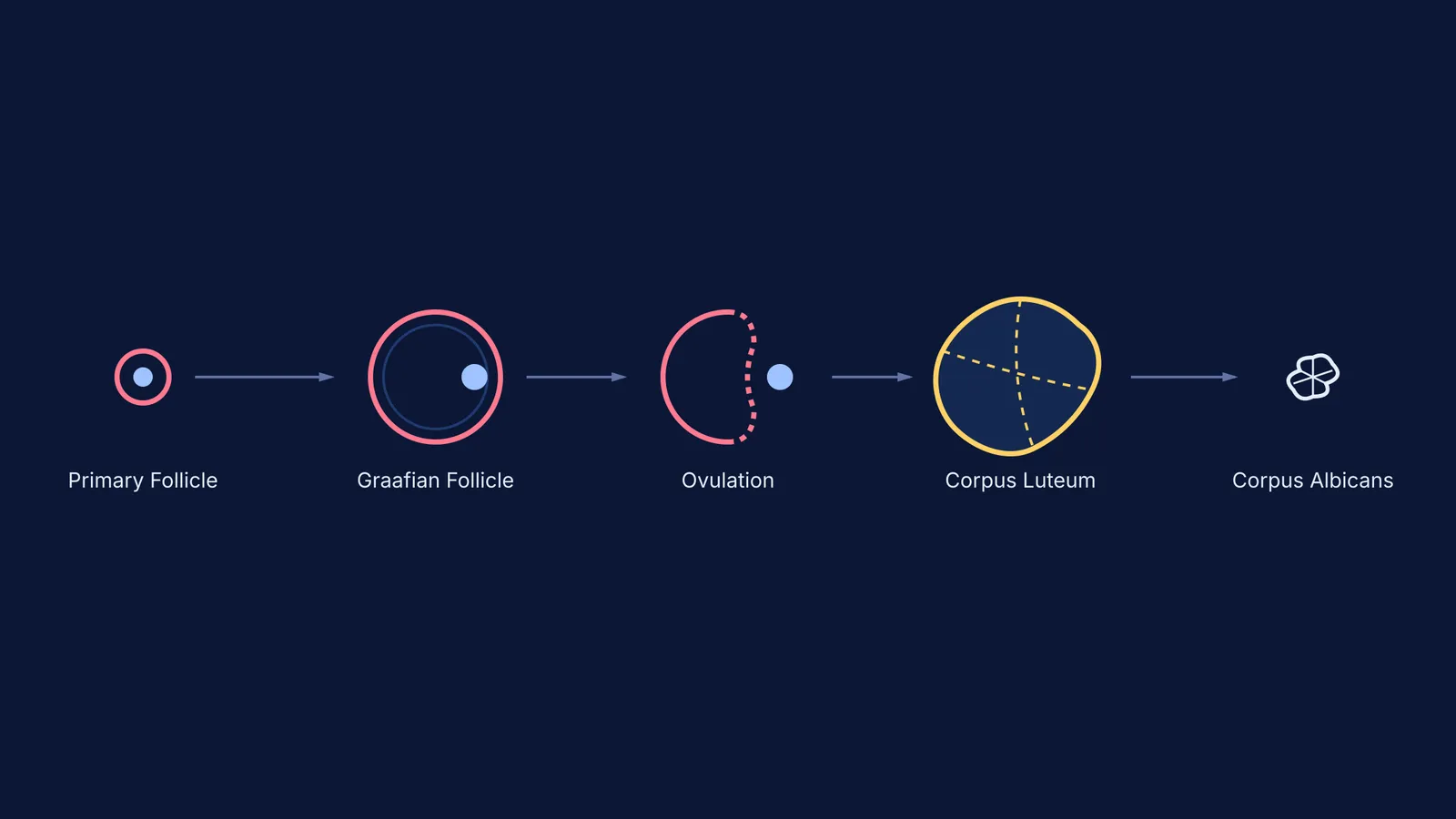
When the Graafian follicle ruptures to release its oocyte, the remaining granulosa and theca cells collapse inward. Triggered by luteinising hormone (LH), they undergo luteinisation—a rapid transformation where they swell and begin producing steroid hormones. To support this massive hormone output, a dense network of new blood vessels grows into the tissue. In fact, a mature corpus luteum has the highest blood flow per unit of tissue of any organ in the body (StatPearls).
If you are trying to picture how these structures change form across the cycle, the Fermi Concept Library covers every concept in biology to help fill those visual gaps.
What is the main function of progesterone?
While the corpus luteum secretes some estradiol and inhibin A, its primary job is to pump out massive amounts of progesterone (StatPearls). This steroid hormone is the master regulator of the luteal phase.
Progesterone travels through the bloodstream to the uterus, where it fundamentally transforms the endometrial lining. It makes the tissue thicker, highly glandular, and heavily vascularised, creating a nutrient-rich bed ready to receive and nourish an embryo. It also causes cervical mucus to become thick and sticky, which blocks further sperm from entering. You can read more about these targeted cellular responses in our guide on how hormones act: membrane receptors vs intracellular receptors.
At the same time, progesterone creates a powerful negative feedback loop in the brain. It inhibits the release of gonadotropin-releasing hormone (GnRH) from the hypothalamus. This stops the pituitary gland from releasing more follicle-stimulating hormone (FSH) and LH, ensuring that no new follicles mature while a pregnancy might be starting. It also raises the body's resting basal temperature slightly.
What happens to the corpus luteum if fertilisation occurs?
If a sperm successfully fertilises the egg, the resulting embryo must signal its presence before the corpus luteum reaches the end of its natural life.
By day 9 after fertilisation, the developing embryo begins secreting human chorionic gonadotropin (hCG) to rescue the corpus luteum (StatPearls). This is the exact same hormone that home pregnancy tests detect in urine. Because hCG is structurally very similar to LH, it binds to the same receptors on the corpus luteum, overriding the signals to degrade and telling it to survive and keep producing progesterone.
This rescued structure, now officially called the corpus luteum graviditatis, remains highly active for the entire first trimester. Around week 12 of pregnancy, the newly formed placenta is finally mature enough to take over the heavy lifting of progesterone production, and the corpus luteum finally shrinks (StatPearls). You can trace the early days of this critical process in from fertilisation to implantation: the first week of pregnancy.
What happens to the corpus luteum without fertilisation?
If the released egg is not fertilised, the corpus luteum has a natural, strict lifespan of approximately 14 days (StatPearls). Because no embryo is present to supply hCG, and the high levels of progesterone have effectively suppressed the body's own LH, the corpus luteum loses its chemical support system.
It stops producing hormones entirely, its cells die off, and it degenerates into a small mass of white fibrous scar tissue known as the corpus albicans (StatPearls).
How can you track the luteal phase for exams?
When answering biology exam questions on human reproduction, it helps to treat the corpus luteum as a predictable physical clock. Here is a framework to keep the facts straight when reading hormone graphs:
The Origin: Always trace its formation back to the Graafian follicle. It only forms after the LH surge causes ovulation to happen.
The Output: Link the corpus luteum exclusively to high progesterone and moderate oestrogen. If a graph shows progesterone steadily rising in the second half of the cycle, the corpus luteum is active and healthy.
The Fork in the Road: Memorise the 14-day rule. Without an embryo's hCG, 14 days is the absolute limit for survival (StatPearls). With hCG, it survives for about 12 weeks.
The Consequence: Connect the death of the corpus luteum directly to the onset of menses. No corpus luteum means no progesterone, which means the endometrium instantly falls away.
Using this strict timeline makes it much easier to predict how hormone graphs shift when a cycle either ends in a successful pregnancy or loops back to the beginning.


