On this page
This chapter is full of look-alike words, such as Sertoli and Leydig or morula and blastocyst. This glossary gives the key terms of NCERT Class 12 Biology Chapter 2, Human Reproduction (2026-27 reprint) in plain words, grouped the way the chapter runs. For the answers, diagrams and traps that go with these words, use our Human Reproduction Class 12 board exam guide.
The CBSE 2026-27 Biology syllabus covers the reproductive systems, gametogenesis, the menstrual cycle, fertilisation, development up to the blastocyst and implantation, and treats pregnancy, placenta, parturition and lactation as an "elementary idea". Contraception, STDs and IVF belong to the next chapter, Reproductive health.
Which parts of the male reproductive system make and carry sperm?
Scrotum: the skin pouch that holds the testes outside the abdomen, keeping them 2 to 2.5 °C cooler than body temperature, which sperm production needs (NCERT).
Seminiferous tubules: the tightly coiled tubes inside each testicular lobule where sperms are made.
Sertoli cells: cells lining the seminiferous tubules that feed the developing germ cells. Don't confuse with: Leydig cells.
Leydig cells (interstitial cells): cells in the spaces between the tubules that make androgens such as testosterone. Don't confuse with: Sertoli cells, which nourish but do not make androgens.
Epididymis: a duct along the back of each testis that receives sperms from the vasa efferentia and passes them to the vas deferens. Example: one of the male accessory ducts, along with the rete testis, vasa efferentia and vas deferens.
Seminal plasma: the fluid from the seminal vesicles, prostate and bulbourethral glands; it contains fructose, calcium and some enzymes. Don't confuse with: semen, which is seminal plasma plus sperms.
What are the main parts of the female reproductive system?
Ovary: the main female sex organ. Each of the two ovaries produces ova and also releases steroid hormones of its own, such as estrogen and progesterone.
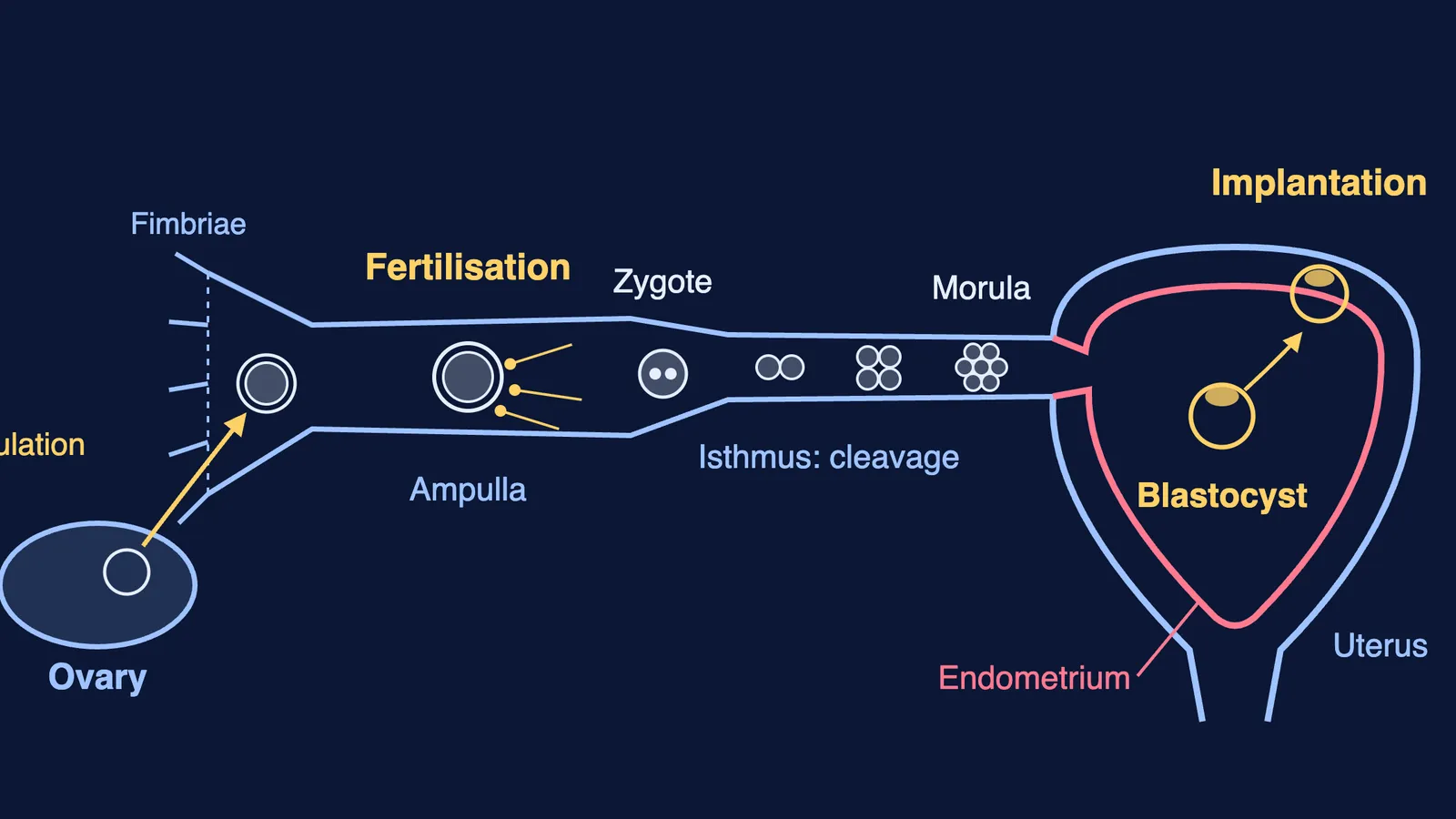
Fimbriae: finger-like edges of the funnel-shaped infundibulum that help catch the ovum after it leaves the ovary.
Ampulla: the wide middle part of the fallopian tube, where fertilisation happens. Don't confuse with: isthmus, the narrow last part that joins the uterus.
Endometrium: the inner glandular lining of the uterus that rebuilds and sheds each cycle and receives the embryo. Don't confuse with: myometrium, the thick smooth-muscle middle layer that contracts during childbirth.
Birth canal: the cervical canal and vagina together, the path the baby takes at delivery.
How do sperms and ova form? Gametogenesis terms
Spermatogenesis: the making of sperms from spermatogonia, starting at puberty. One diploid primary spermatocyte (46 chromosomes) gives four haploid spermatids (23 each) through meiosis (NCERT).
Spermiogenesis: the change of a round spermatid into a tailed sperm. Don't confuse with: spermiation, the release of finished sperms from the seminiferous tubules.
Acrosome: the enzyme-filled cap on the sperm head that helps it get through the layers around the ovum.
Oogenesis: the making of an ovum. It begins before birth: oogonia form in the fetal ovary, enter meiosis and pause in prophase I as primary oocytes.
Graafian follicle: the mature ovarian follicle holding the secondary oocyte, ready to burst. Don't confuse with: primary follicle, a primary oocyte with a single layer of granulosa cells.
Polar body: the tiny cell thrown off in each unequal meiotic division of oogenesis, so that one cell keeps nearly all the cytoplasm.
Zona pellucida: the membrane around the secondary oocyte that a sperm must contact; it then changes to block other sperms.
What happens in each phase of the menstrual cycle?
Menstrual cycle: the repeating reproductive cycle of female primates, on average about 28/29 days in humans (NCERT).
Menarche: the first menstruation, at puberty. Don't confuse with: menopause, when cycles stop, around 50 years of age.
Follicular phase: the days after menstruation when follicles grow into a Graafian follicle and the endometrium rebuilds, driven by rising FSH, LH and estrogen.
LH surge: the sharp mid-cycle peak of luteinising hormone, about day 14, that makes the Graafian follicle burst.
Ovulation: the release of the secondary oocyte from the ruptured Graafian follicle. Don't confuse with: the LH surge, which is the trigger, not the event.
Corpus luteum: the yellow body formed from the empty follicle that secretes progesterone to keep the endometrium ready. If no fertilisation happens, it breaks down and menstruation follows.
What happens from fertilisation to birth?
Insemination: the release of semen into the vagina. Don't confuse with: fertilisation, the fusion of a sperm with the ovum in the ampulla.
Zygote: the diploid cell formed when the sperm and ovum nuclei fuse. Its sex is decided here, by whether the sperm carried an X or a Y chromosome.
Cleavage: the rapid mitotic divisions of the zygote as it moves through the isthmus, making cells called blastomeres.
Morula: the embryo at the 8 to 16 blastomere stage (NCERT). Don't confuse with: blastocyst, the later stage with an outer layer and an inner group of cells.
Trophoblast: the outer cell layer of the blastocyst that attaches to the endometrium. Don't confuse with: inner cell mass, the inner cells that become the embryo and include stem cells.
Implantation: the embedding of the blastocyst in the endometrium, which starts pregnancy.
Placenta: the joint structure of chorionic villi and uterine tissue that passes oxygen and food to the foetus and removes its wastes. It also makes hormones such as hCG and hPL.
Parturition: childbirth, set off by the foetal ejection reflex and driven by oxytocin making the uterine muscle contract harder.
Colostrum: the first milk of lactation, rich in antibodies that help protect the newborn.
How to learn these terms
Learn pairs, not single words: say each "Don't confuse with" pair aloud with one difference.
Sketch the journey above from ovary to uterus and label where each step happens.
Write spermatogenesis and oogenesis side by side with chromosome numbers (46, then 23) and count the cells each produces.
Tie every hormone to its target: LH to Leydig cells and ovulation, FSH to Sertoli cells and follicles, progesterone from the corpus luteum to the endometrium.
Test yourself with statement pairs from our assertion-reason questions on human reproduction.
If one term still will not stick, the Fermi Concept Library gives every concept in biology its own lesson and its place in the map.