On this page
Most values of π you meet in school are approximations, such as 22/7 or 3.14. Viète's formula is exact, uses nothing harder than square roots, and you can check six of its factors with a calculator.
What is Viète's formula for π?
François Viète published the formula in 1593 in his Variorum de rebus mathematicis responsorum, liber VIII, according to the Wikipedia article on Viète's formula. Written out, it is:
2/π = (√2/2) × (√(2 + √2)/2) × (√(2 + √(2 + √2))/2) × …
Each numerator is the square root of 2 plus the numerator before it, and every factor is divided by 2. In symbols: a₁ = √2, aₖ = √(2 + aₖ₋₁), and 2/π is the product of aₖ/2 for k = 1, 2, 3 and onwards.
Viète's product was the first infinite product known in mathematics and the first explicit formula for the exact value of π, as the same article records. In India, Madhava of Sangamagrama (c. 1340–1425) had found very similar infinite series for π earlier, but that work was not known in Europe until much later.
Where do the nested square roots come from?
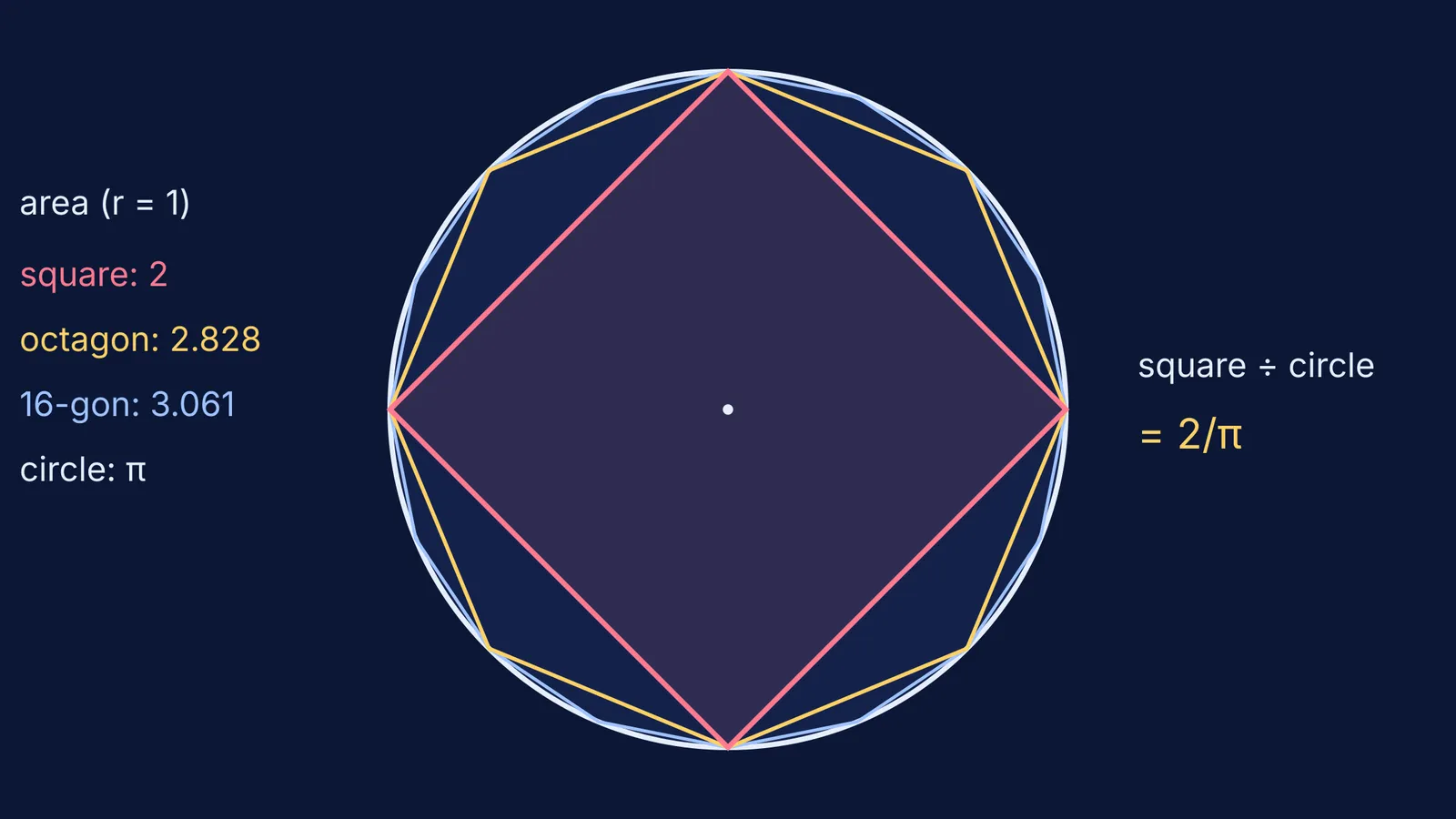
Fit a square inside a circle of radius 1, then keep doubling the sides: octagon, 16-gon, 32-gon. In the limit the polygon becomes the circle. The derivation compares the areas of these polygons, as the Wikipedia derivation explains.
An inscribed regular m-gon is m thin triangles, each with two sides of length 1 and an angle of 2π/m between them, so its area is A(m) = (m/2) sin(2π/m). Now use sin 2x = 2 sin x cos x:
A(m) = m sin(π/m) cos(π/m)
A(2m) = m sin(π/m)
so A(m) ÷ A(2m) = cos(π/m)
The square has area 2 and the circle has area π. Chain the ratios:
2/π = A(4)/A(8) × A(8)/A(16) × A(16)/A(32) × … = cos(π/4) × cos(π/8) × cos(π/16) × …
The middle terms cancel: a telescoping product.
How does the half-angle identity make the square roots?
The half-angle identity cos(θ/2) = √((1 + cos θ)/2) can be rewritten as 2cos(θ/2) = √(2 + 2cos θ). Start with 2cos(π/4) = √2. Then 2cos(π/8) = √(2 + √2), and 2cos(π/16) = √(2 + √(2 + √2)). Divide each by 2 and you have Viète's factors. The nesting is the half-angle identity used again and again.
How fast does Viète's formula converge?
The product of the first n factors gives π to about 0.6n correct digits, according to the Wikipedia article, which cites Rick Kreminski's paper π to thousands of digits from Vieta's formula in Mathematics Magazine (2008). Viète himself used his formula to compute π to nine decimal digits, and Ludolph van Ceulen later reached 35 digits with a closely related method, the same article notes.
You can see the 0.6 for yourself. After n factors, 2 divided by the product equals m sin(π/m) with m = 2ⁿ⁺¹, the area of the inscribed polygon with 2m sides. Since sin x ≈ x − x³/6 for small x, the gap to π is about π³/(6m²). Each new factor doubles m, so the error shrinks by about 4 each time, and log₁₀ 4 ≈ 0.6 digits.
How do you check six factors by hand?
Keep six decimal places. Each row: add 2 to the last a, take the square root, halve it, multiply into the product, then divide 2 by the product to estimate π.
a = √2 = 1.414214; factor 0.707107; product 0.707107; estimate 2.828427
a = √3.414214 = 1.847759; factor 0.923880; product 0.653281; estimate 3.061467
a = √3.847759 = 1.961571; factor 0.980785; product 0.640729; estimate 3.121445
a = √3.961571 = 1.990369; factor 0.995185; product 0.637644; estimate 3.136548
a = √3.990369 = 1.997591; factor 0.998795; product 0.636876; estimate 3.140331
a = √3.997591 = 1.999398; factor 0.999699; product 0.636684; estimate 3.141277
Compared with π = 3.141593, the errors are 0.313, 0.0801, 0.0201, 0.00504, 0.00126 and 0.000315: each about a quarter of the one before, as the estimate above predicts. Six factors give 3.141, four correct digits, in line with 0.6 × 6 ≈ 3.6.
Two checks catch most slips:
Square each a: you should get 2 plus the previous a.
Factor k should match cos(π/2ᵏ⁺¹) on a calculator in radian mode; factor 2 is cos(π/8).
How can you practise this idea?
Redo the derivation with perimeters instead of areas. If the double-angle or half-angle identity is the shaky step, the Fermi Concept Library covers every concept in physics, chemistry, biology, mathematics and computing, so you can rebuild the identity before returning to the product. When a practice problem stalls, the Fermi Problem Library has worked problems with a step-by-step solver that explains the reasoning rather than printing an answer.
Six rows on a calculator are enough to watch π appear.