On this page
Three years before Alfred Werner explained cobalt complexes, he and Arthur Hantzsch tackled a smaller puzzle in organic chemistry. Why did benzaldoxime and the oximes of benzil exist in more forms than their formulas allowed? Their answer, published in the Berichte in 1890, was that nitrogen's bonds are not all in one plane, so a C=N bond can carry cis and trans forms just as a C=C bond does. This post rests on the English abstract of their paper in the Journal of the Chemical Society, not on the German original, and the quotes below come from that abstract.
Who were Hantzsch and Werner in 1890?
The paper is A. Hantzsch and A. Werner, Berichte 23, 11–30 (1890), "Ueber räumliche Anordnung der Atome in stickstoffhaltigen Molekülen", on the spatial arrangement of atoms in nitrogen-containing molecules. Werner's Nobel biography says that as a student at the Zurich Federal Technical High School "he was much influenced by Professor A. Hantzsch", that in 1889 "he then began to cooperate with Professor Hantzsch in research", and that in 1890 he took his degree at the University of Zurich "with a thesis on the spatial arrangements of the atoms in molecules containing nitrogen". His later cobalt work is in Alfred Werner and how coordination compounds got their shape, which starts in 1893.
What puzzle were they trying to solve?
The abstract, on pages 348–350 of the Journal of the Chemical Society Abstracts for 1890, lists the awkward compounds: "the isomeric mono- and di-oximes of benzil, the two benzaldoximes, the two ethyl hydrogen oximidosuccinates", some hydroxamic acids, and two pairs of azo and azoxy compounds.
Two explanations were already on the table:
Auwers and Victor Meyer suggested that van 't Hoff's "second hypothesis" (that groups joined by a single C–C bond cannot give such isomers) "does not hold true in all cases".
Beckmann explained the two benzaldoximes by giving them different structures.
Hantzsch and Werner noticed that every compound on the list contained nitrogen, while spatial ideas had been "for the most part confined to the carbon-atom". They applied van 't Hoff's thinking to nitrogen and left his carbon rules untouched.
What did they propose about nitrogen?
Their starting point, in the abstract's words: "The valencies of the triad nitrogen-atom do not necessarily lie in the same plane as the nitrogen-atom itself." From this they proposed that "in certain compounds the valencies of the nitrogen-atom are directed towards the corners of an irregular tetrahedron, the nitrogen-atom itself occupying the fourth corner."
They drew three predictions from it:
A compound XY:C=N–Z should exist in two forms, like fumaric and maleic acids.
X–N=N–Y should also exist in two forms.
An amine with three different groups, NR₁R₂R₃, "might possibly exist in optically isomeric forms". The abstract adds that such compounds "are not, however, at present known", and that experiments were under way.
Predictions 1 and 2 are now textbook facts, though the modern picture differs from theirs. The oxime nitrogen is sp² hybridised, and the C=N bond, the N–O bond and a lone pair lie in one plane at about 120°. Because the N–OH bond points off to one side of the C=N axis, the OH can sit on either side.
Prediction 3 runs into nitrogen inversion. Simple amines flip through a planar shape too fast to be separated, while quaternary ammonium salts with four different groups can be resolved. That story is in why chiral amines can't be resolved but quaternary salts can.
How do you count geometrical isomers of an oxime?
Use the same steps for any question:
Find each C=N (or N=N) bond.
Check the carbon end. If its two groups are the same, that C=N gives no isomers. Acetone oxime has none. The nitrogen end always differs, because it carries OH and a lone pair.
Each C=N that passes step 2 has 2 forms. Multiply: n such bonds give 2ⁿ drawings.
Remove drawings that are the same molecule turned around. This happens when the molecule has two identical halves.
Syn, anti, E and Z for single oximes are in why oximes show geometrical isomerism.
Worked example: why does benzil dioxime have three isomers?
Question. How many geometrical isomers do (a) benzaldoxime, (b) benzil monoxime, (c) benzil dioxime and (d) PhC(=NOH)–C(=NOH)CH₃ have?
Solution.
(a) Benzaldoxime, PhCH=NOH. The carbon carries Ph and H, which differ. One C=N: 2 isomers.
(b) Benzil monoxime, PhC(=NOH)–C(=O)Ph. The oxime carbon carries Ph and C(=O)Ph, which differ. One C=N: 2 isomers.
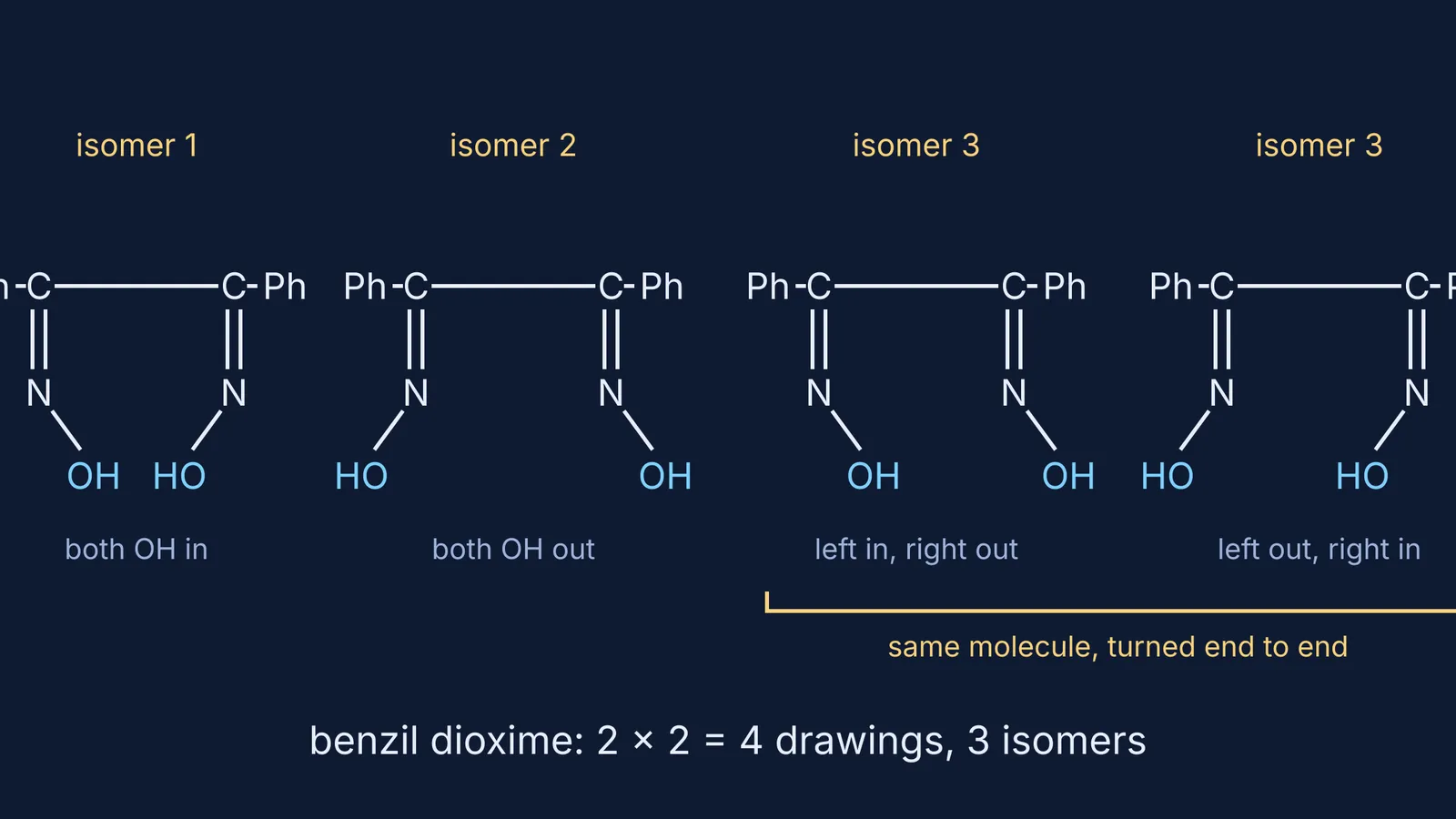
(c) Benzil dioxime, PhC(=NOH)–C(=NOH)Ph. Each oxime carbon carries Ph and the other oxime unit, which differ, so each C=N has 2 forms. Call them "in" (OH toward the other oxime carbon) and "out" (OH toward its own phenyl). That gives 2 × 2 = 4 drawings: in/in, out/out, in/out and out/in.
The two halves of the molecule are identical. Turn the in/out drawing end to end and it becomes out/in. So those two are one compound, and the answer is 4 − 1 = 3.
(d) PhC(=NOH)–C(=NOH)CH₃. Both C=N bonds pass step 2, giving 4 drawings. The halves are different (Ph against CH₃), so turning it end to end makes nothing new. The answer is 4.
Now compare with 1890. The abstract says: "This agrees well with the facts, two benzilmonoximes and three dioximes being known."
They went further and tentatively matched formulas to the known α, β and γ dioximes. They put the γ form as the one with both OH groups facing each other, "as that compound yields an anhydride so readily", and called the β form "the most stable". The abstract uses "probably" for each match. These were 1890 guesses, so do not convert α, β and γ into modern E/Z labels without a modern source.
Did everyone accept the idea in 1890?
No. The same volume of abstracts (pages 720–722) summarises a long critique by Victor Meyer. He argued that on their theory "all unsymmetrical oximes of the formula OH—N:CXY should exist in two isomeric forms; but this is altogether contradicted by experience". He noted that Auwers had tried and failed to find a second form of one such oxime, and that the dioxime of diacetyl showed no isomerism.
Hantzsch and Werner had answered in advance: only a small fraction of possible carbon isomers had been made either, and these isomers form only when nitrogen's three bonds are not in one plane.
Diacetyl dioxime is dimethylglyoxime, the reagent in Lev Chugaev's 1905 test for nickel. By the counting rule it, like benzil dioxime, could have 3 forms. The count gives the number of possible isomers. Whether each one can be isolated is a separate question about stability.
If you want to see why the lone pair fixes the geometry, the Fermi Concept Library gives each concept its own lesson. For more isomer-counting practice, the Fermi Problem Library has a step-by-step solver that explains the reasoning.
Quick checklist
Hantzsch and Werner (1890): nitrogen's three bonds need not lie in one plane.
So C=N and N=N bonds give cis/trans (syn/anti, E/Z) isomers.
Count: one isomer pair per C=N whose carbon has two different groups.
Multiply by 2 per bond, then remove repeats for identical halves.
Benzaldoxime 2, benzil monoxime 2, benzil dioxime 3, an unsymmetrical dioxime 4.