

On this page
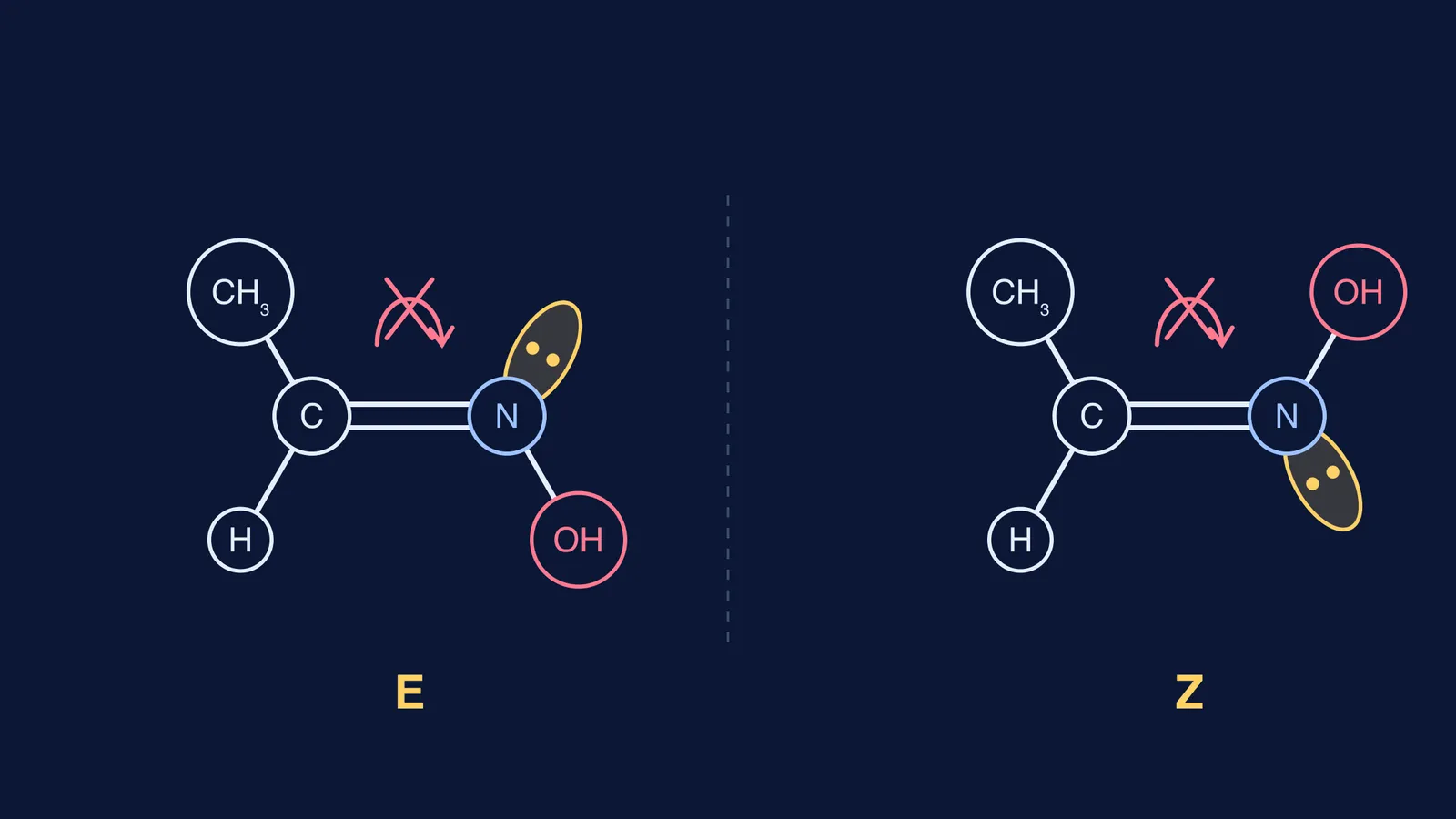
Draw acetaldehyde oxime, CH3CH=N–OH, and you can put the OH on either side of the C=N bond. Those two drawings are different compounds. Here is why, with a rule for spotting which oximes have isomers.
What is an oxime?
An oxime is a compound with the general formula RR'C=N–OH; when R' is hydrogen it is an aldoxime, and when R' is another organic group it is a ketoxime, as the Wikipedia entry on oximes sets out. The same entry notes that oximes are made by condensing an aldehyde or a ketone with hydroxylamine, NH2OH. The C=O of the carbonyl compound becomes C=N–OH.
Why do oximes show geometrical isomerism?
Two things work together.
The C=N bond cannot rotate. Like C=C, it contains a π bond formed by side-by-side p orbitals on carbon and nitrogen. Twisting would pull those orbitals apart and break the π bond, so the groups stay locked on their sides. Our post on why cis and trans but-2-ene can't twist into each other uses the same idea for C=C.
The nitrogen lone pair acts as a group. The nitrogen in an oxime has three things around it, all in one plane: the double bond to carbon, the OH, and one lone pair. So the nitrogen end always carries two different "substituents": OH and a lone pair.
That second point makes oximes easier than alkenes. An alkene needs two different groups on both carbons; an oxime's nitrogen end is unequal automatically, so only the carbon decides.
The two forms are real, separate substances: the Wikipedia entry above notes that both are often stable enough to be separated. A 2004 study by Xu and colleagues in the Journal of the Chinese Chemical Society measured Z and E benzaldoximes converting into each other in different solvents and found that acidic solvents speed this up dramatically; their DFT calculations gave a much lower Z-to-E barrier when acid is present.
Which aldoximes and ketoximes have geometrical isomers?
This matches the condition in the Wikipedia entry: an aldoxime, or a ketoxime with two different R groups. Applied:
Aldoximes, RCH=NOH: the carbon carries R and H. These differ for every aldoxime except formaldoxime, H2C=NOH, where both groups are H. So every aldoxime except formaldoxime shows geometrical isomerism.
Ketoximes, RR'C=NOH: isomers only when R and R' differ. Acetone oxime, (CH3)2C=NOH, has none; butanone oxime, CH3(C2H5)C=NOH, has two.
Ring ketoximes: check whether the two ring arms are the same. Cyclohexanone oxime has identical arms, so it has no geometrical isomers.
Syn and anti or E and Z: which should you use?
Older books use syn and anti. The Wikipedia entry says these were used especially for aldoximes, according to whether the R group was closer to or further from the hydroxyl. The organic chemistry text by Roberts and Caserio, hosted on LibreTexts/19%3A_More_on_Stereochemistry/19.07%3A_EZ_Notation), calls the E,Z system especially useful for oximes and says syn and anti are really no better than cis and trans. Check which reference group your textbook uses for syn and anti, or simply use E and Z.
To assign E or Z:
On the carbon, rank the two groups by the CIP rules (higher atomic number at the first point of difference wins).
On the nitrogen, OH always outranks the lone pair, which has the lowest priority in E,Z naming of imines and oximes, as Bruice's organic chemistry text puts it.
Higher-ranked groups on the same side: Z. On opposite sides: E.
For aldoximes, R always outranks H, so syn in the sense above (R and OH on the same side) is Z. If your book takes the H on carbon as the reference instead, its syn aldoxime is E. If ranking feels shaky, our guide on how to assign E and Z configuration to alkenes walks through the CIP steps.
Worked example, butanone oxime. The carbon carries CH3 and C2H5. Both start with carbon, so go one atom further: ethyl's CH2 carries (C, H, H), methyl carries (H, H, H). Ethyl wins. On nitrogen, OH wins. Ethyl and OH on the same side: (Z)-butanone oxime; opposite sides: (E).
Practice: does this oxime show geometrical isomerism?
Decide yes or no, then name the two forms where they exist.
Formaldoxime, H2C=NOH
Acetaldoxime, CH3CH=NOH
Acetone oxime, (CH3)2C=NOH
Benzaldoxime, C6H5CH=NOH
Acetophenone oxime, C6H5(CH3)C=NOH
Benzophenone oxime, (C6H5)2C=NOH
Cyclohexanone oxime
Draw (E)-acetaldoxime: is the OH on the same side as CH3 or as H?
Answers: 1 no; 2 yes; 3 no; 4 yes; 5 yes, with phenyl outranking methyl; 6 no, because both groups are phenyl; 7 no; 8 the OH sits on the same side as H, opposite the CH3.
If you missed one, check whether the slip was in the rule or in the CIP ranking. The Fermi Concept Library gives each chemistry concept its own lesson, so you can revisit CIP priority on its own. For more practice, the Fermi Problem Library has worked problems with a step-by-step solver that explains the reasoning rather than printing an answer.
Oxime geometry returns in the Beckmann rearrangement, where an oxime becomes an amide.


