

On this page
Ernst Beckmann reported this reaction in 1886 in the journal Berichte der deutschen chemischen Gesellschaft (Beckmann, 1886). It is a standard named reaction in organic chemistry, and questions about it usually test one thing: can you tell which group ends up on nitrogen?
What does the Beckmann rearrangement do?
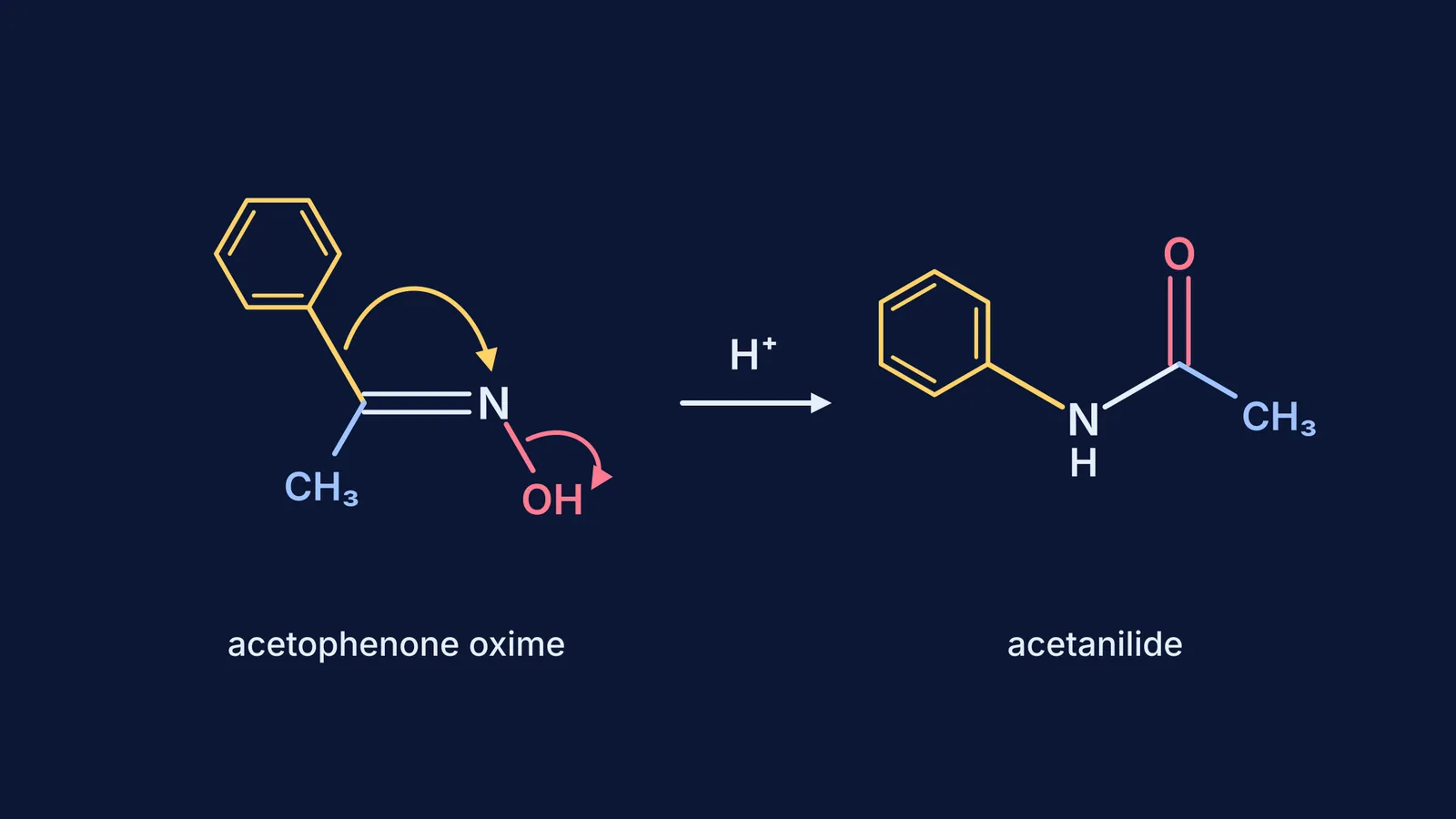
The Beckmann rearrangement is an acid-induced rearrangement of an oxime into an amide (Organic Chemistry Portal). An oxime has a C=N–OH group where the ketone had its C=O. After the reaction, the same atoms are arranged as an amide, –CO–NH–.
Which group migrates in the Beckmann rearrangement?
In a ketoxime, the group that migrates is the one anti-periplanar to the leaving group on nitrogen, meaning it sits on the opposite side of the C=N bond from the OH (Wikipedia: Beckmann rearrangement). Size and stability don't decide it. Geometry does.
The mechanism has four steps:
Acid protonates the OH, turning it into water, a good leaving group.
The group anti to that OH moves from carbon to nitrogen at the same moment as the N–O bond breaks and water leaves, so no free nitrene ever forms (Organic Chemistry Portal).
This gives a nitrilium ion, with the positive charge on a C≡N unit.
Water attacks the carbon, and the imidic acid that forms tautomerises to the amide (Wikipedia: Beckmann rearrangement).
Oximes generally have a high barrier to inversion, so the oxime geometry you start with is normally the one that reacts (Organic Chemistry Portal). Under some conditions the geometry can scramble, and then you get both possible amides (Wikipedia: Beckmann rearrangement).
This is the big difference from the pinacol reaction, where you need other reasoning to predict which group migrates in the pinacol-pinacolone rearrangement. In Beckmann, you just look at where the OH points.
How does acetophenone oxime give acetanilide?
Acetophenone is C6H5–CO–CH3, so its oxime has a phenyl group and a methyl group on the C=N carbon. Work through it like this:
Draw the oxime with the OH on the methyl side, so the phenyl group is anti to it (as in the diagram at the top of this page).
Move the phenyl group from carbon to nitrogen as water leaves. You now have the nitrilium ion CH3–C≡N⁺–C6H5.
Add water to the carbon and tautomerise. You get CH3–CO–NH–C6H5, which is acetanilide.
Now check the other case. If methyl had been anti to OH, methyl would move instead, giving C6H5–CO–NH–CH3, which is N-methylbenzamide.
Both products are real. In a 2009 study of this reaction on zeolite catalysts, Fernández, Corma and colleagues found that acetanilide and N-methylbenzamide both form at 423 K or above over zeolite H-beta, while over silicalite-N only acetanilide forms (Physical Chemistry Chemical Physics, 2009). The two amides are isomers: the nitrogen carries whichever group was anti.
How is caprolactam made from cyclohexanone oxime?
Cyclohexanone oxime is symmetric: both groups on the C=N carbon are ring CH2 carbons, so either one gives the same product. When that carbon moves to nitrogen, the nitrogen is pulled into the ring. The six-membered carbon ring becomes a seven-membered ring containing –NH–CO–. That cyclic amide, a lactam, is ε-caprolactam.
The conversion of cyclohexanone to caprolactam through the oxime is the archetypal Beckmann rearrangement, and caprolactam is the feedstock for nylon 6 (Wikipedia: Beckmann rearrangement). The US EPA describes caprolactam as primarily used to make synthetic fibres, especially nylon 6 (PubChem: caprolactam).
One industrial route uses oleum (fuming sulfuric acid). A 1989 BASF patent describes reacting cyclohexanone oxime with oleum, then adding ammonia, after which crude lactam separates from an almost saturated ammonium sulfate solution (US patent 4804754). So in this route, the acid ends up as ammonium sulfate alongside the caprolactam.
How do you answer a Beckmann question in an exam?
Use this checklist every time:
Find the C=N–OH and mark the OH.
Circle the group on the opposite side of the C=N. Ignore which group is bigger.
Put that group on nitrogen, give the nitrogen an H, and turn the old C=N carbon into C=O carrying the other group.
Check that the product has the same molecular formula as the oxime. For a cyclic oxime, the ring should grow by one atom.
If the question doesn't show the geometry, look for an E or Z label before you decide.
If you keep putting the wrong group on nitrogen, the Fermi Problem Library has worked problems with a step-by-step solver that explains the reasoning rather than printing an answer. If the gap is in the ideas underneath, such as oximes, tautomerism or lactams, the Fermi Concept Library gives each concept its own lesson.
Next, compare the Lossen rearrangement of a hydroxamic acid to an amine, or learn how to test for an amide by boiling with NaOH.


