

On this page
When you treat a vicinal diol—a molecule with adjacent hydroxyl groups—with concentrated mineral acid, it undergoes an intramolecular skeletal rearrangement rather than simple dehydration. In 1860, Wilhelm Rudolph Fittig first reported the reaction in Liebigs Annalen der Chemie while treating 2,3-dimethylbutane-2,3-diol (pinacol) with sulfuric acid, isolating 3,3-dimethylbutan-2-one (pinacolone). Today, this transformation is a staple of competitive exams, yet it remains a frequent trap for students who memorise migratory rules without understanding the mechanism.
Students often memorise migratory aptitude rules in isolation, only to misapply them on test day. To predict the correct ketone or aldehyde every time, you need to understand both the underlying thermodynamic driving force and the strict two-stage sequence governing the reaction.
How does the pinacol-pinacolone rearrangement mechanism work?
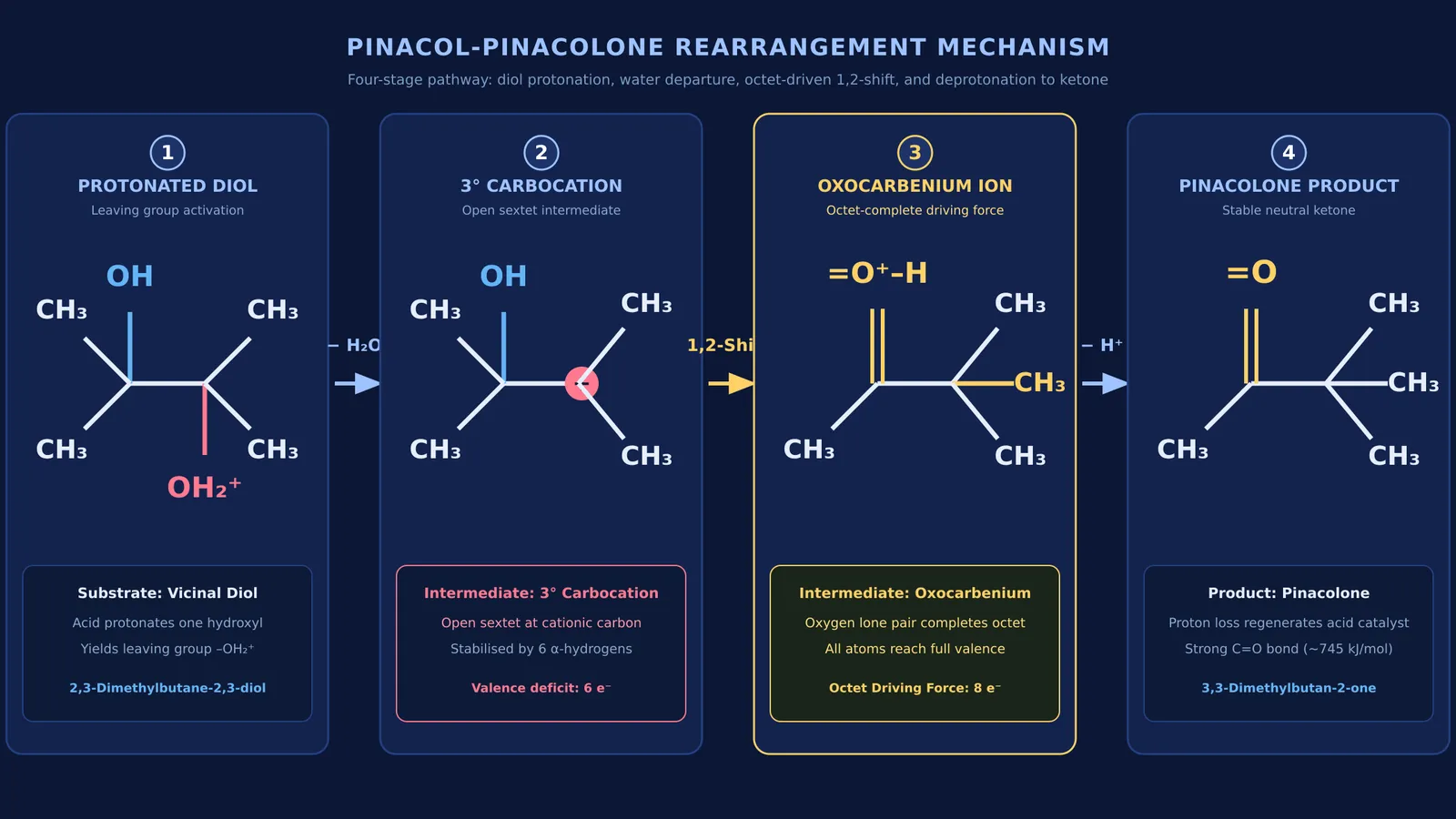
The rearrangement proceeds through four elementary steps:
Protonation: Mineral acid protonates one hydroxyl oxygen, converting –OH into –OH₂⁺. This activation is central to evaluating leaving group ability in organic chemistry.
Carbocation generation: Water departs, leaving behind an open-sextet carbocation intermediate.
1,2-Shift: An adjacent alkyl, aryl, or hydride substituent shifts with its electron pair to the carbocation centre, creating a resonance-stabilised oxocarbenium ion.
Deprotonation: A base removes the proton from oxygen, yielding the neutral ketone and regenerating the acid catalyst.
Why does a tertiary carbocation rearrange into a ketone?
Students often ask why a stable tertiary carbocation would rearrange at all. In pinacol, removing water forms a tertiary carbocation stabilised by hyperconjugation from six alpha hydrogens. Why should a methyl group shift to make another cationic species?
The driving force is octet completion. In the open tertiary carbocation, carbon has only six valence electrons. When the methyl group migrates, the positive charge moves to the carbon bearing the remaining –OH. The oxygen lone pair delocalises into the empty p orbital, forming an oxocarbenium ion (R–C=O⁺–H) where every carbon and oxygen atom attains a complete octet.
As reviewed by Collins (1960), this octet satisfaction provides immense thermodynamic stabilization. The rearrangement is driven by the formation of the carbonyl C=O double bond, which has a bond dissociation energy of approximately 745 kJ/mol compared to about 358 kJ/mol for a C–O single bond in standard organic structures.
How do you predict which group migrates in an unsymmetrical diol?
In an unsymmetrical diol, you must divide the prediction into two sequential decisions:
First, determine which –OH departs. The leaving hydroxyl group is strictly the one whose departure yields the more stable carbocation intermediate (resonance-stabilised benzylic or allylic > tertiary > secondary).
Second, determine which group shifts from the adjacent carbon. Only substituents attached to the carbon retaining the –OH group are eligible to migrate.
In benchmark studies of symmetrical aromatic pinacols, Bachmann and Ferguson (1934) measured intrinsic migratory aptitudes against a phenyl baseline of 1.0. Electron-donating groups accelerate migration by stabilizing positive charge in the phenonium transition state: p-anisyl reached 500 and p-tolyl reached 15.7, while electron-withdrawing p-chlorophenyl fell to 0.66. Steric hindrance in o-anisyl dropped its value to 0.3.
The general migratory hierarchy is: Hydride > Aryl > Tertiary alkyl > Secondary alkyl > Primary alkyl > Methyl. Migration occurs with complete retention of configuration at the migrating carbon, connecting directly to stereochemistry and carbocation mechanisms.
What is the classic migratory aptitude trap in competitive exams?
In entrance exams like JEE Main conducted by the NTA, examiners deliberately test whether students confuse carbocation formation with migratory aptitude.
Take 1,1-diphenyl-2,2-dimethylethylene glycol: Ph₂C(OH)–C(OH)Me₂. A rushed student notices phenyl and methyl groups, recalls that phenyl migrates faster than methyl, and predicts a phenyl shift.
That prediction is wrong because it skips the first rule:
Leaving group: Loss of –OH from the diphenyl carbon gives a doubly benzylic carbocation, Ph₂C⁺–C(OH)Me₂, far more stable than the aliphatic tertiary cation from the other carbon. Water leaves exclusively from the diphenyl carbon.
Migration: The carbocation is at the diphenyl carbon. The adjacent carbon carries only two methyl groups. Therefore, a methyl group must migrate, yielding 3,3-diphenylbutan-2-one [Ph₂MeC–CO–Me]. The phenyl groups never migrate because they already reside on the cationic centre.
When working through multi-step reaction cascades, the Fermi Problem Library offers worked problems with a step-by-step solver that explains the reasoning rather than printing an answer.
A four-step method for solving rearrangement problems
To solve any diol rearrangement systematically, use this four-step checklist:
Inventory substituents: Identify the groups attached to each diol carbon.
Determine carbocation site: Compare the cations formed by removing –OH from each carbon. Form the carbocation at the more stable site (resonance > 3° > 2°).
Pick the migrating group: Look only at the adjacent carbon. Apply the migratory hierarchy: Hydride > electron-rich Aryl > Phenyl > electron-poor Aryl > Alkyl.
Form the carbonyl: Shift the group to the carbocation centre, draw the C=O double bond, and remove H⁺ to finish the ketone or aldehyde.
The Fermi Concept Library covers every concept in physics, chemistry, biology, mathematics and computing, each with its own lesson and its place in the map. If you are revising reaction mechanisms, our guide on analysing named organic reactions from first principles shows how to build lasting intuition without rote memorisation.


