

On this page
The Lossen rearrangement is a classical organic reaction that transforms a hydroxamic acid derivative into an isocyanate, which then hydrolyses to give a primary amine. Like the related Hofmann and Curtius rearrangements, it steps down the carbon chain, yielding an amine with one carbon fewer than the starting material. Wilhelm Lossen discovered this reaction in 1872 (10.1002/jlac.18721610219). Today, this reaction is a powerful tool in organic synthesis, particularly when chemists need to avoid hazardous reagents (Wikipedia).
What is the mechanism of the Lossen rearrangement?
The reaction is an elegant example of a nitrogen-to-carbon migration. It typically follows these steps:
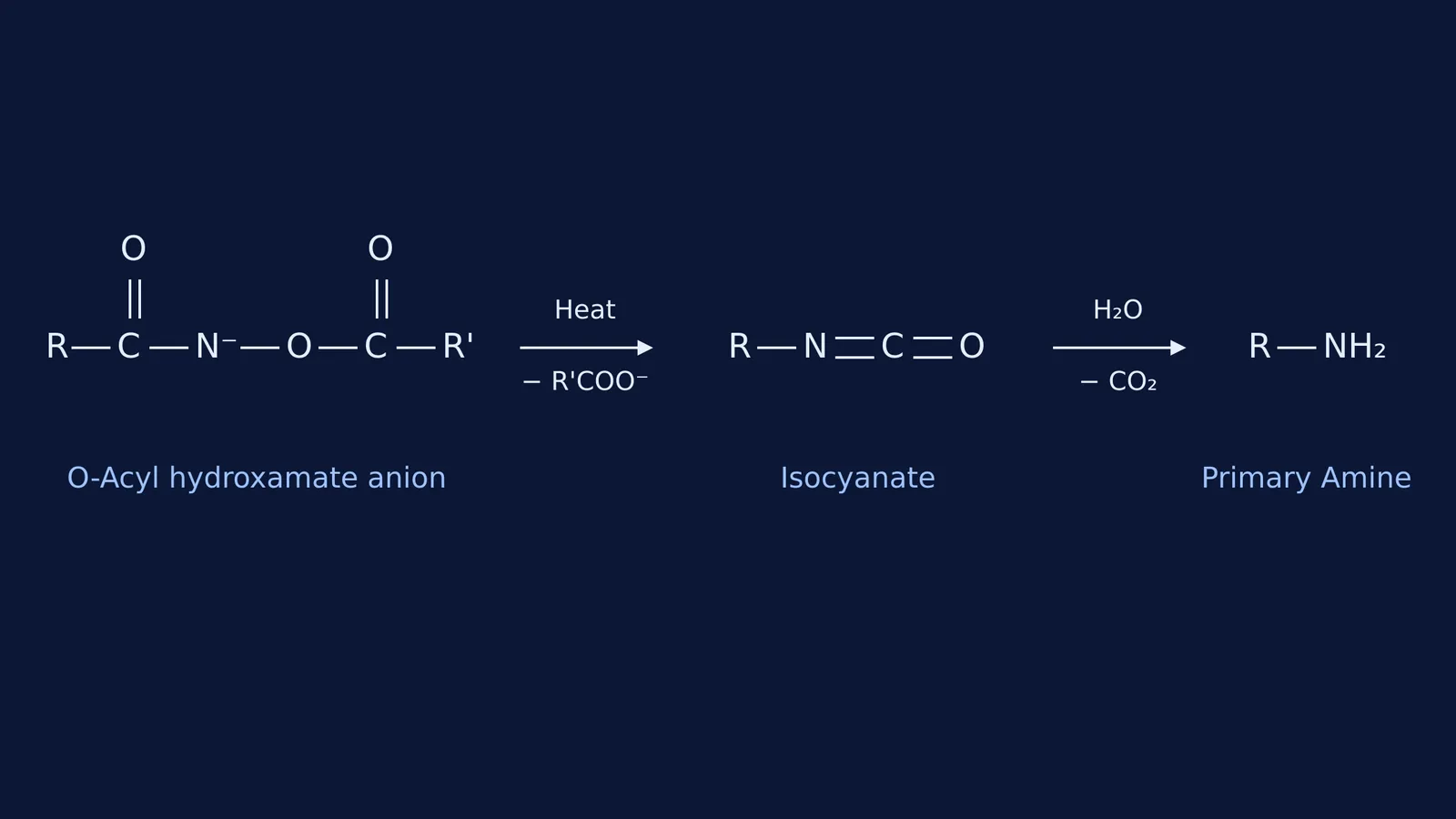
Activation: A hydroxamic acid (R–CO–NH–OH) is first treated with an electrophile—such as an acid chloride or an anhydride—to convert the hydroxyl group into a better leaving group, forming an *O*-acyl hydroxamic acid (R–CO–NH–O–CO–R').
Deprotonation: A base removes the acidic proton from the nitrogen, creating an anion.
Rearrangement: In a concerted step, the R group migrates from the carbonyl carbon to the nitrogen atom. Simultaneously, the carboxylate leaving group (R'COO⁻) departs. This electron cascade forms an intermediate isocyanate (R–N=C=O).
Hydrolysis: If water is present, the isocyanate reacts to form a carbamic acid, which rapidly decarboxylates (loses CO₂) to yield the final primary amine (R–NH₂).
Because the entire migration happens at once (concerted), the stereochemistry of the migrating R group is completely retained. This retention of configuration is a hallmark of the Lossen rearrangement and is incredibly useful when synthesising complex, chiral molecules. For example, if the migrating group is a chiral centre with an (R)-configuration, the resulting amine will also possess the (R)-configuration at that carbon. The migrating group never truly detaches from the rest of the molecule, so there is no opportunity for it to racemise. This makes the reaction highly predictable and reliable for stereoselective synthesis.
If you are struggling to picture the electron flow or memorise the intermediate steps, the Fermi Concept Library allows you to explore the mechanisms of named reactions logically rather than by rote.
How does Lossen compare to the Hofmann and Curtius rearrangements?
The Lossen rearrangement belongs to a family of reactions that generate an electron-deficient nitrogen to trigger a migration. All three major reactions in this family produce an isocyanate intermediate and result in a primary amine with one fewer carbon:
Hofmann rearrangement: Uses a primary amide (R–CO–NH₂) treated with bromine and a strong base.
Curtius rearrangement: Uses an acyl azide (R–CO–N₃). Upon heating, it expels nitrogen gas to form the isocyanate. (See our guide to the Curtius rearrangement: acyl azide to isocyanate).
Lossen rearrangement: Uses an *O*-acyl hydroxamic acid.
The primary advantage of the Lossen rearrangement is safety. The Hofmann rearrangement, while effective, requires the use of bromine and a strong base like sodium hydroxide. These harsh, oxidising conditions can cause unwanted side reactions if there are sensitive functional groups elsewhere in the molecule. The Curtius reaction operates under milder conditions, but it relies on azides, which can be highly explosive and toxic, requiring special safety protocols. In contrast, hydroxamic acids and their *O*-acyl derivatives used in the Lossen rearrangement are stable, crystalline solids that are safe to handle in a typical laboratory.
Does the leaving group affect the Lossen rearrangement?
Yes, the rate of the Lossen rearrangement depends heavily on the nature of the leaving group attached to the oxygen. The better the leaving group, the faster the reaction.
When the leaving group is an *O*-acyl group (like a benzoate), attaching electron-withdrawing groups (such as nitro or chloro groups) to the benzene ring pulls electron density away from the N–O bond. This makes the leaving group a weaker base and therefore a better leaving group, accelerating the migration of the R group. Conversely, electron-donating groups will slow down the reaction by making the leaving group a stronger base.
How to identify a Lossen rearrangement in an exam question?
In competitive exams like JEE and NEET, named reactions often appear hidden in a multi-step synthesis sequence. Here is how to spot the Lossen rearrangement:
The Starting Material: Look for a hydroxamic acid (R–CO–NH–OH) reacting with a reagent like acetic anhydride or p-toluenesulfonyl chloride. This is the activation step.
The Reagents: The next step will feature a base (like NaOH or KOH) and heat.
The Product: If the question asks for the final product after aqueous workup, it will be a primary amine (R–NH₂) with one less carbon. (Learn more about Step down conversion: acetic acid to methylamine).
If you are unsure whether to use the Lossen, Hofmann, or another method to make your amine, revising the conditions is key. (See Choosing the Right Method to Prepare a Primary Amine). Rather than guessing, the Fermi Problem Library provides a step-by-step solver that explains the reasoning behind each reagent choice, ensuring you understand why a specific reaction pathway works.


