

On this page
Primary amines are crucial building blocks in both industrial chemistry and pharmaceutical synthesis. A common challenge in the laboratory and in organic chemistry exams is synthesising a primary amine cleanly. If you simply react an alkyl halide with ammonia (direct ammonolysis), the resulting primary amine acts as a nucleophile and attacks unreacted alkyl halide molecules. This creates a messy, hard-to-separate mixture of primary, secondary, and tertiary amines.
To get a pure primary amine, chemists rely on specific, targeted reactions. But how do you choose the right one? The decision comes down to the carbon skeleton.
Which method to prepare a primary amine: Gabriel, Hofmann or reduction?
The fundamental rule of organic conversions is to match both the functional group and the carbon count. The three primary ways to prepare an aliphatic primary amine cleanly from a halogen or carbonyl compound are (as detailed by Chemistry LibreTexts/24%3A_Amines_and_Heterocycles/24.06%3A_Synthesis_of_Amines)):
Gabriel phthalimide synthesis to keep the carbon count exactly the same.
Hofmann bromamide degradation to step down the carbon chain by one atom.
Reduction of nitriles to step up the carbon chain by one atom.
By comparing the number of carbons in your available starting material to your target product, the correct path reveals itself immediately.
Why use the Gabriel phthalimide synthesis?
If you start with an alkyl halide (such as chloroethane, which has two carbons) and want an amine with the exact same number of carbons (ethylamine), the Gabriel phthalimide synthesis is the preferred route.
The Gabriel phthalimide synthesis is a chemical reaction that converts an alkyl halide into a pure primary aliphatic amine without secondary or tertiary amine impurities. It uses phthalimide as a temporary protector. When treated with ethanolic potassium hydroxide, phthalimide forms a potassium salt that acts as a bulky nucleophile. This salt attacks the alkyl halide. Because the nitrogen atom is protected by two adjacent carbonyl groups, it can only bond with one alkyl group, preventing over-alkylation. Finally, alkaline hydrolysis releases a pure primary aliphatic amine.
Importantly, this method only works for aliphatic chains. Aryl halides do not readily undergo nucleophilic substitution under these conditions, so you cannot prepare aniline (a primary aromatic amine) using the Gabriel route.
When should you use Hofmann bromamide degradation?
Sometimes your starting material is an amide that has one carbon too many. In this case, the Hofmann bromamide degradation allows you to shorten the chain.
The Hofmann bromamide degradation is a step-down reaction where an amide loses its carbonyl carbon as sodium carbonate (Na₂CO₃) to form a primary amine with one fewer carbon. By treating the amide with bromine and a strong base like aqueous sodium hydroxide, the alkyl or aryl group migrates from the carbonyl carbon directly to the nitrogen atom. The original carbonyl carbon is cleanly excised.
For example, if you start with a three-carbon propanamide, the degradation chops out the middle carbonyl carbon, leaving you with a two-carbon ethylamine. Because it cleanly breaks the chain, it is an essential tool for descending a homologous series in multi-step conversions.
How does nitrile reduction step up the carbon chain?
If your starting alkyl halide is one carbon short of your target, you must build a new carbon-carbon bond before forming the amine.
Nitrile reduction is a step-up reaction that adds one carbon to an alkyl chain by first forming a nitrile and then reducing it to a primary amine. The first step is reacting the alkyl halide with potassium cyanide (KCN). Because you are using cyanide as an ambident nucleophile, the carbon atom of the cyanide attacks the alkyl group, forming a nitrile (R−C≡N). This intermediate now contains the extra carbon atom required for your target.
The second step is reduction. Treating the nitrile with a strong reducing agent like lithium aluminium hydride (LiAlH₄), or using hydrogen gas over a nickel catalyst, pushes hydrogen onto both the carbon and the nitrogen. The −C≡N group becomes a −CH₂−NH₂ group, successfully adding a new carbon to the parent chain and yielding the desired primary amine.
A framework for organic conversions
In organic chemistry, matching the method to the target is half the battle. Use this decision checklist when charting your synthesis pathway:
Count the target carbons: Determine the total carbon atoms in your desired primary amine.
Count the starting carbons: Does your starting material have the same number, one extra, or one fewer?
Pick the route: Use Gabriel synthesis for the same carbon count, Hofmann degradation for one extra carbon, or nitrile reduction for one fewer carbon.
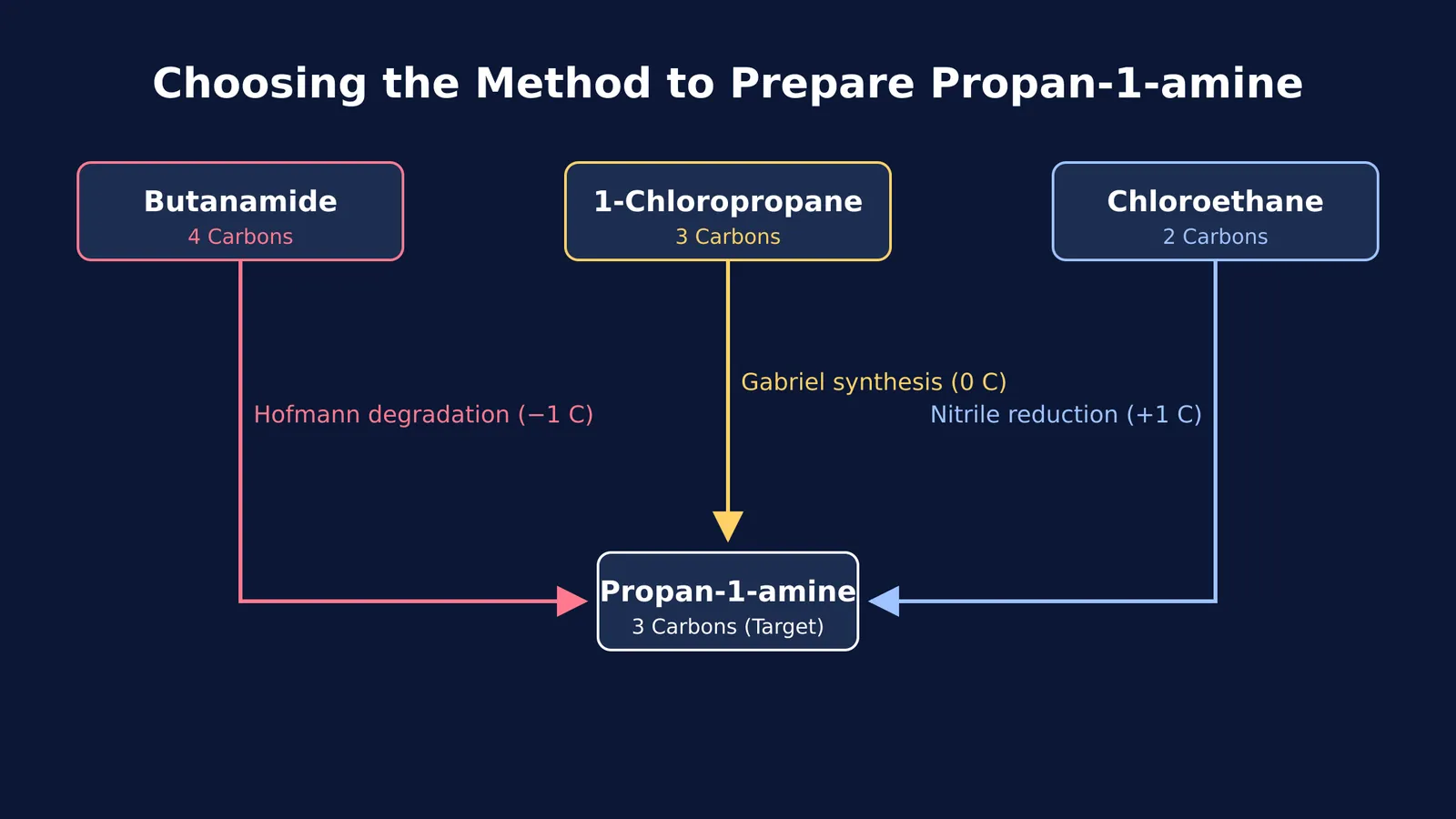
Let us look at a worked example. Suppose your target is propan-1-amine (three carbons):
If your starting material is 1-chloropropane (three carbons), you use the Gabriel synthesis.
If your starting material is butanamide (four carbons), you use the Hofmann degradation.
If your starting material is chloroethane (two carbons), you react it with KCN to make propanenitrile, then reduce it.
If you are stuck on a conversion map, the Fermi Concept Library has every concept in physics, chemistry, biology, mathematics and computing, each with its own lesson and its place in the map.


