

On this page
When you need to shorten a carbon chain by exactly one atom and end up with a primary amine, the Curtius rearrangement is a reliable tool. Like the Hofmann bromamide degradation, this reaction steps down a molecule's carbon count by removing the carbonyl carbon as carbon dioxide.
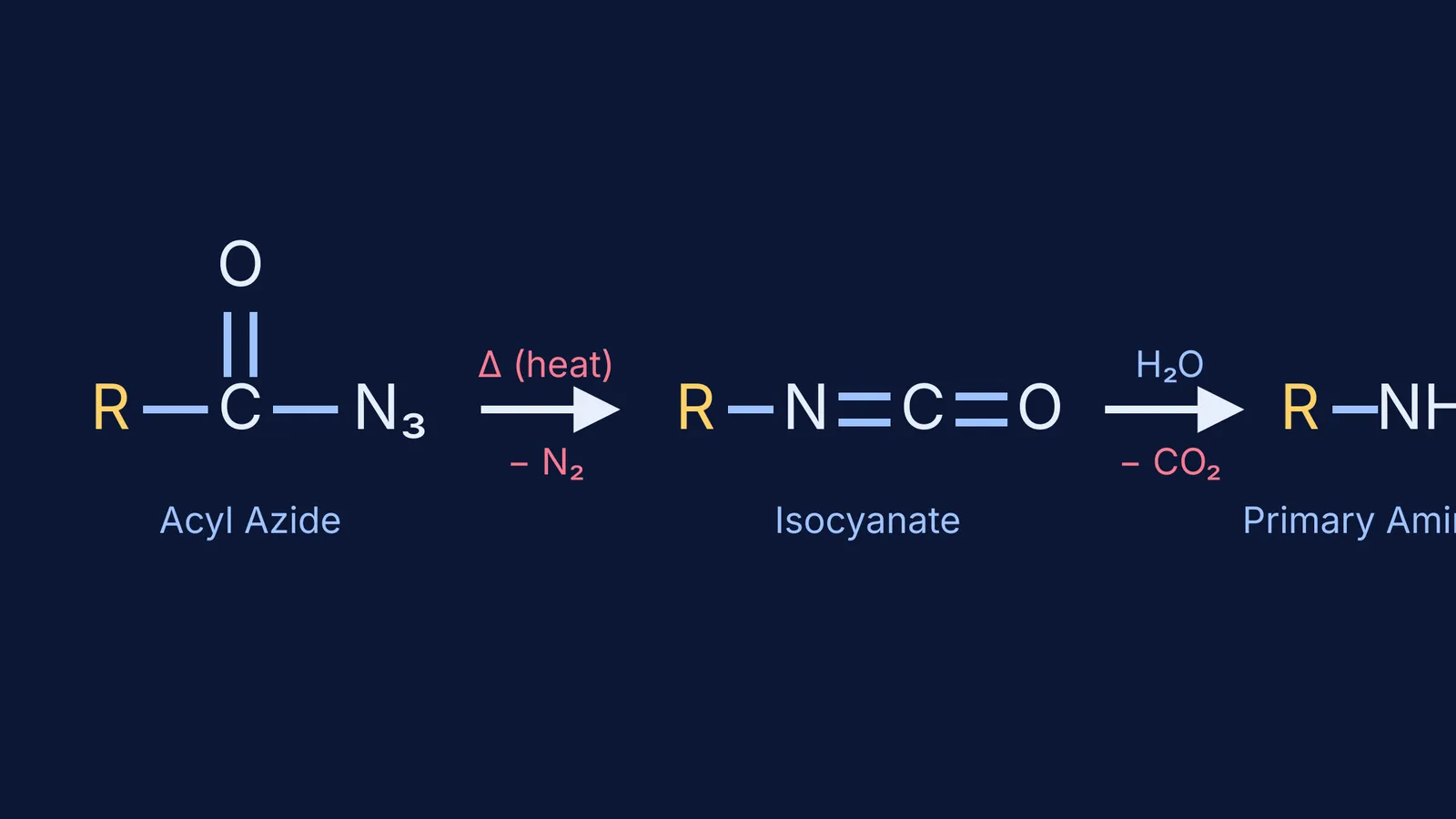
The reaction converts an acyl azide into a primary amine via an isocyanate intermediate. Understanding the sequence of bond breaking and forming will help you tackle complex synthesis questions in exams like JEE Main and NEET-UG without merely memorising the final product.
How does an acyl azide convert to an isocyanate?
The first stage of the Curtius rearrangement involves heat. When you heat an acyl azide (R–CO–N₃), it undergoes a thermal decomposition. The Curtius rearrangement was first defined by Theodor Curtius in 1885. This rearrangement is driven by the stability of the nitrogen gas (N₂) that leaves the molecule.
As the nitrogen molecule breaks away, the alkyl or aryl group (R) attached to the carbonyl carbon migrates to the adjacent nitrogen atom. This migration happens at the same time as the nitrogen leaves, in a concerted mechanism. Because the R-group migrates with its electrons in one smooth step, it retains its stereochemical configuration. The result of this first step is a reactive intermediate called an isocyanate (R–N=C=O).
What happens when water reacts with the isocyanate?
The isocyanate is highly susceptible to attack by nucleophiles. If the rearrangement is carried out in the presence of water, the water molecule attacks the electrophilic carbon of the isocyanate.
This hydration produces an unstable intermediate known as carbamic acid (R–NH–COOH). Carbamic acids spontaneously decarboxylate, meaning they break apart to release carbon dioxide gas (CO₂). Once the carbon dioxide bubbles away, you are left with a primary amine (R–NH₂).
Because the carbonyl carbon from the original acyl azide is lost as CO₂, your final primary amine has one carbon fewer than the starting material. If you need to verify that you have successfully formed a primary amine, you can follow up with the carbylamine test.
How do you apply this in synthesis problems?
Exam questions often test the Curtius rearrangement as part of a multi-step conversion. You will rarely be handed an acyl azide to start with. Instead, you might be given a carboxylic acid or an acid chloride.
Here is a standard sequence you should watch for:
Form the acid chloride: React a carboxylic acid (R–COOH) with thionyl chloride (SOCl₂) to form an acid chloride (R–COCl).
Form the acyl azide: Treat the acid chloride with sodium azide (NaN₃). Nucleophilic substitution replaces the chloride with an azide group, yielding R–CO–N₃.
Rearrange: Heat the acyl azide to trigger the loss of N₂ and the migration of the R-group, forming the isocyanate.
Hydrolyse: Add water to convert the isocyanate into a primary amine and CO₂.
If you substitute the water in the final step with an alcohol, you will form a carbamate (also known as a urethane) instead of an amine. This flexibility makes the reaction highly useful in organic synthesis.
If you find it difficult to map out these multi-step conversions, Fermi's AI tutor can work out what you already know and build a plan for the session, teaching you how to track the carbon count across each step. You can also explore related reaction pathways and practice synthesis problems in the Fermi Concept Library.


