

On this page
What is a descent of series in organic chemistry?
In organic synthesis, stepping down a homologous series means shortening a carbon chain by one or more carbon atoms while installing a target functional group. Most introductory synthetic pathways focus on ascending the series, such as adding a carbon atom via cyanide substitution or a Grignard addition. Removing a carbon atom requires cleaving a strong carbon-carbon single bond under controlled conditions. In examinations like JEE Main, JEE Advanced, and NEET-UG, examiners test these step-down conversions to evaluate whether you understand how reaction intermediates dictate carbon skeleton rearrangements.
Synthetic chemists group descent methods into three main mechanistic families: amine rearrangements, decarboxylation of carboxylate salts, and oxidative bond cleavages. Among these, the most versatile Class 12 laboratory route begins with reactions of carboxylic acids and derivatives, converting an acid into an amide before cleaving the carbonyl carbon. Tracking which carbon atom departs, and in what inorganic form, is the key to solving multi-step conversion roadmaps.
How do you convert acetic acid to methylamine?
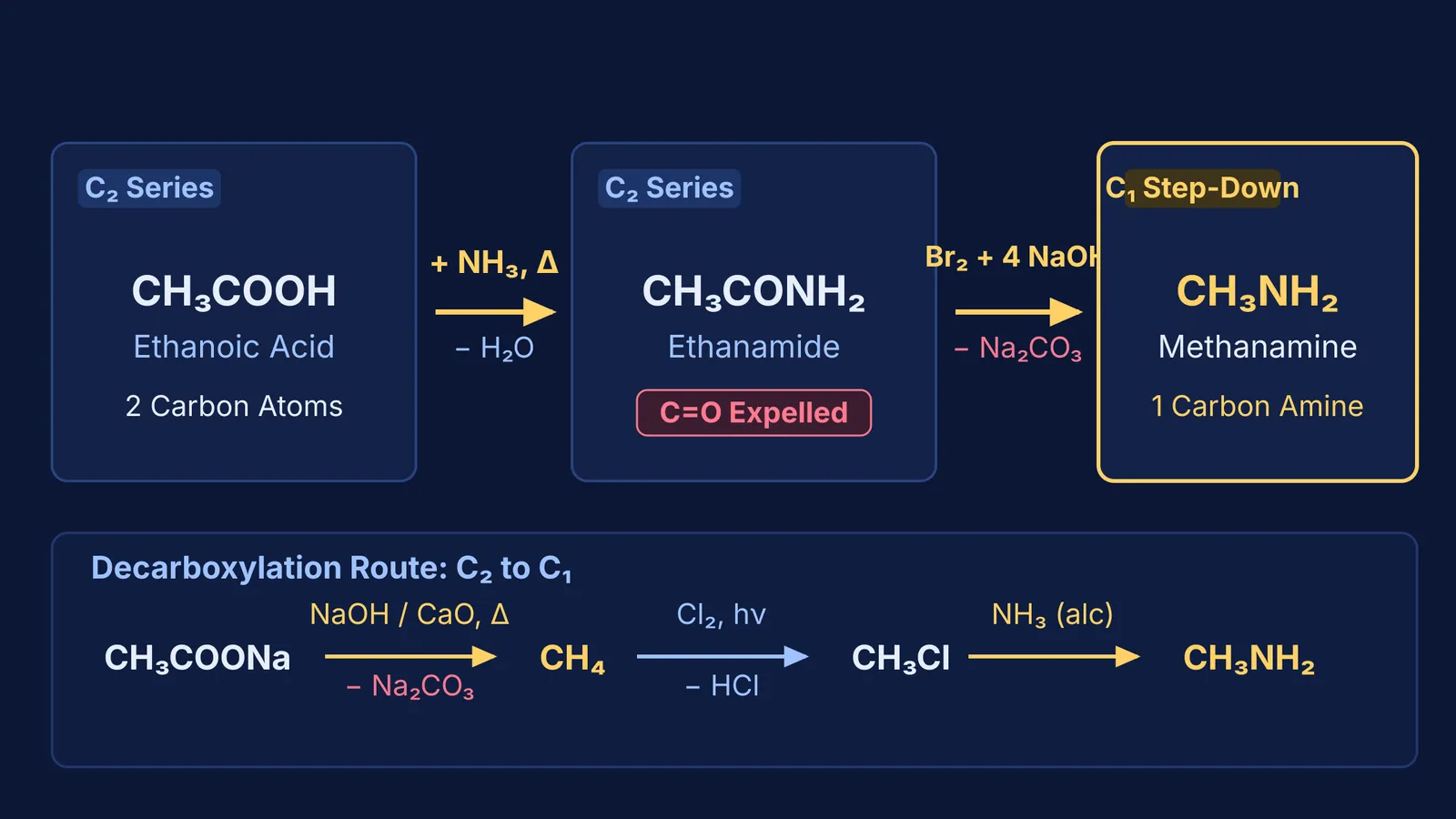
The two-step conversion of acetic acid (ethanoic acid, CH₃COOH) to methylamine (methanamine, CH₃NH₂) reduces a two-carbon carboxylic acid into a one-carbon primary amine. Because acetic acid cannot directly shed its carbonyl carbon, the transformation proceeds through an intermediate primary amide:
Formation of ethanamide: Treat acetic acid with ammonia (NH₃) to form ammonium acetate (CH₃COONH₄). Heating this salt dehydrates it into ethanamide (acetamide, CH₃CONH₂):
CH₃COOH + NH₃ → CH₃COONH₄ → CH₃CONH₂ + H₂O Alternatively, react acetic acid with thionyl chloride (SOCl₂) to form acetyl chloride (CH₃COCl), followed by excess ammonia to produce ethanamide.
Hofmann bromamide degradation: Heat ethanamide with bromine and four equivalents of sodium hydroxide (or potassium hydroxide):
CH₃CONH₂ + Br₂ + 4 NaOH → CH₃NH₂ + Na₂CO₃ + 2 NaBr + 2 H₂O
August Wilhelm von Hofmann first documented this reaction in an 1881 paper in Berichte der deutschen chemischen Gesellschaft, showing that primary amides treated with bromine in alkaline solution yield primary amines with one less carbon. As reviewed by Wallis and Lane (1946), the mechanism proceeds through an N-bromoamide intermediate and an isocyanate (CH₃-N=C=O), which hydrolyzes to methylamine while expelling the carbonyl carbon as sodium carbonate (Na₂CO₃). You can confirm the primary amine with the carbylamine test for primary amines, where heating methylamine with chloroform and alcoholic alkali releases an isocyanide. For full mechanistic steps, review the Hofmann bromamide degradation mechanism.
Which alternative routes step down a carbon chain?
When synthetic targets require an alkane or an alkyl halide rather than an amine, alternative step-down routes provide direct pathways:
Soda-lime decarboxylation: Heating dry sodium acetate with soda lime (a 3:1 mass ratio of NaOH to CaO) expels the carboxylate group as sodium carbonate, a pyrolytic elimination investigated by Oakwood and Miller (1950):
CH₃COONa + NaOH (CaO, heat) → CH₄ + Na₂CO₃ Chlorinating methane under ultraviolet light (CH₄ + Cl₂ / hν → CH₃Cl + HCl) yields chloromethane, completing the step down from two carbons to one.
Borodin-Hunsdiecker decarboxylation: Refluxing silver acetate with bromine in carbon tetrachloride cleaves carbon dioxide via a radical chain mechanism, as analyzed by Jennings and Ziebarth (1969):
CH₃COOAg + Br₂ (CCl₄, reflux) → CH₃Br + AgBr + CO₂ This single step yields methyl bromide, losing one carbon as carbon dioxide gas.
Oxidative chain degradations: In higher homologues, terminal alkenes undergo ozonolysis or vigorous oxidation with hot alkaline KMnO₄ to yield shortened carboxylic acids. For long-chain carboxylic acids, the Barbier-Wieland degradation demonstrated by Wieland et al. (1926) removes one methylene carbon via esterification, double Grignard addition of phenylmagnesium bromide, dehydration, and chromic acid oxidation. Similarly, the Ruff degradation demonstrated by Ruff (1898) oxidatively decarboxylates aldonic acids with hydrogen peroxide and ferric ions to shorten aldose sugars by one unit.
How do you solve step-down problems under exam conditions?
When tackling multi-step organic conversions in timed tests, follow this decision framework:
Count the carbon backbone: If the reactant has n carbons and the product has n − 1 carbons, identify the required reaction family.
Match the functional group: Choose the Hofmann route for amines and alcohols, soda-lime decarboxylation for alkanes, or the Hunsdiecker route for alkyl halides.
Track the departing carbon: The Hofmann degradation releases carbonate (CO₃²⁻), soda-lime decarboxylation releases carbonate (Na₂CO₃), and Hunsdiecker decarboxylation releases carbon dioxide (CO₂).
Check substitution: Secondary and tertiary amides do not undergo the Hofmann rearrangement; the amide must remain primary (RCONH₂).
When practicing complex conversions, the Fermi Problem Library offers worked problems with a step-by-step solver that explains the reasoning behind each reagent choice rather than printing an answer. To systematically review reactions connecting acids, amides, and amines, the Fermi Concept Library covers every concept in physics, chemistry, biology, mathematics and computing. If you want structured guidance mapping synthetic roadmaps, Fermi's AI tutor can work out what you already know and build a plan for the session so you sit down to a clear next step.


