

On this page
In a practical exam you might get a white solid and be asked whether it is an amide. Sodium hydroxide, a Bunsen burner and a strip of red litmus will usually answer that, as long as you look at the tube twice: once cold and once after boiling.
How do you test for an amide group with sodium hydroxide?
The test is a hydrolysis. LibreTexts/Amides/Reactivity_of_Amides/The_Hydrolysis_of_Amides) states that when ethanamide is heated with sodium hydroxide solution, ammonia gas is given off and a solution of sodium ethanoate is left behind.
CH3CONH2 + NaOH → CH3COONa + NH3
Work under your teacher's supervision and wear goggles, because hot sodium hydroxide is corrosive.
Put a small amount of the compound in a test tube and add dilute sodium hydroxide solution.
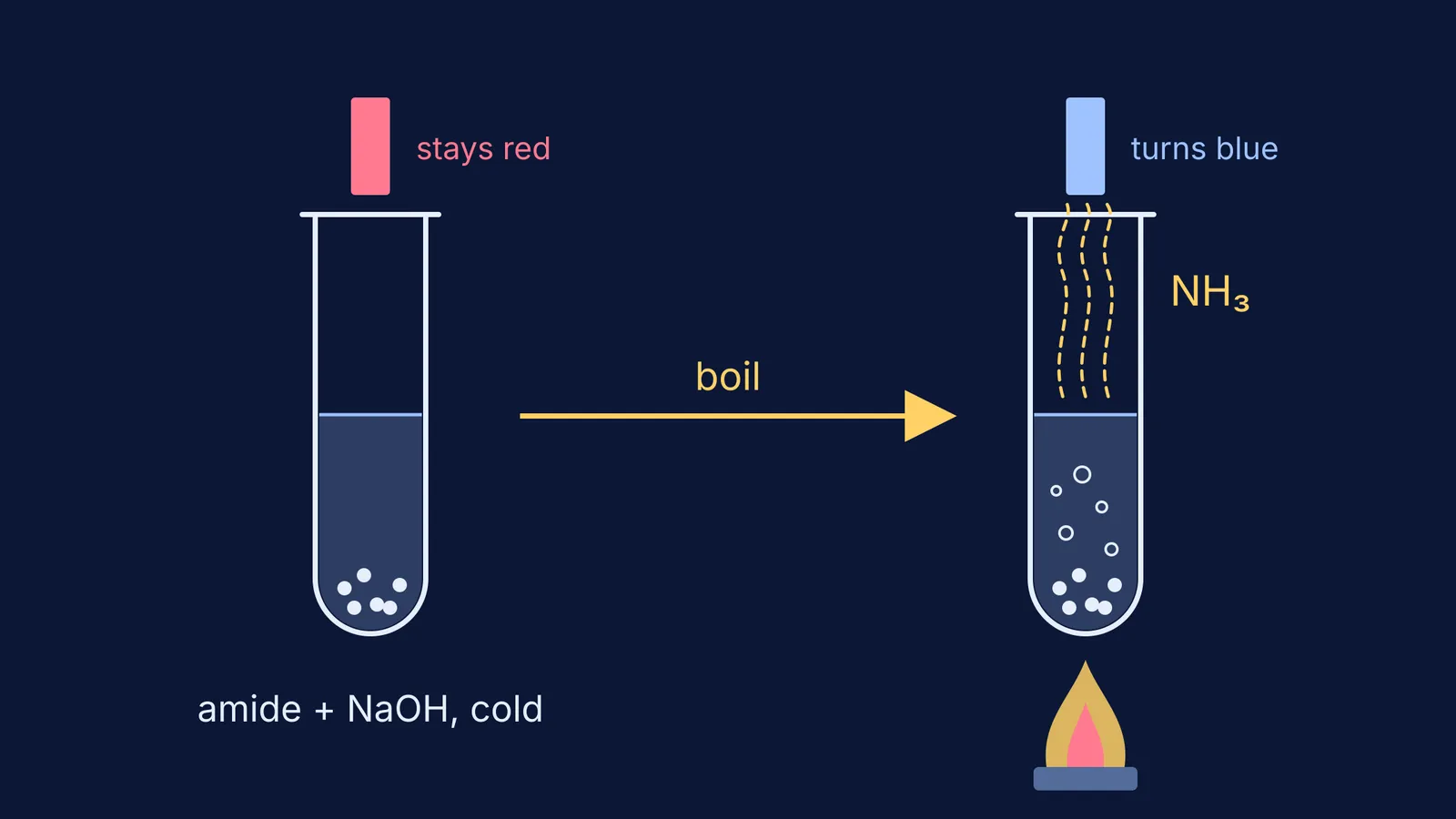
Hold a strip of damp red litmus paper at the mouth of the tube without heating it. Write down what happens.
Heat the tube gently until the liquid boils, with the mouth pointed away from everyone.
Hold fresh damp red litmus at the mouth again. If it turns blue now but did not turn blue in step 2, you probably have an amide.
The paper has to be damp. Ammonia only changes the colour after it dissolves in water, so dry paper can miss it, as this note on the ammonium ion test explains. Never smell the tube directly. If you are told to note the smell, waft the gas towards you with your hand.
Why does the ammonia appear only after boiling?
The C-N bond in an amide does not break easily. The textbook by Roberts and Caserio, hosted on LibreTexts/24%3A_Organonitrogen_Compounds_II_-_Amides_Nitriles_and_Nitro_Compounds/24.04%3A_Hydrolysis_of_Amides), says amides hydrolyse much more slowly than esters and that alkaline hydrolysis needs boiling aqueous sodium or potassium hydroxide.
An ammonium salt is different. Its reaction with hydroxide is a quick proton transfer, NH4+ + OH- → NH3 + H2O, so it needs no boiling. Chemguide puts the rule plainly: if a compound gives off ammonia with sodium hydroxide on heating, but not immediately in the cold, it is an amide. With an ammonium salt, enough ammonia forms in the cold for the smell to be obvious straight away.
How do you tell an amide from an amine or an ammonium salt?
Three kinds of compound can turn red litmus blue in this test, at different points.
Ammonium salt: ammonia appears as soon as cold sodium hydroxide is added (Chemguide).
Small amine: methylamine and ethylamine smell very like ammonia (Chemguide on amines). Amines also make water alkaline, because they take a proton from water and leave hydroxide ions behind (Chemguide). So an amine can turn litmus blue without any heating.
Primary amide (RCONH2): nothing happens in the cold, and ammonia comes off only on boiling.
There are two catches. An N-substituted amide gives a carboxylic acid and an amine when it is hydrolysed, not ammonia (LibreTexts, Roberts and Caserio/24%3A_Organonitrogen_Compounds_II_-_Amides_Nitriles_and_Nitro_Compounds/24.04%3A_Hydrolysis_of_Amides)). And nitriles also give off ammonia when heated with sodium hydroxide (Chemguide on nitriles). So a blue result only on boiling points to an amide, but does not prove one.
If you need a second check, the Virtual Labs page on detecting functional groups gives the biuret reaction for amides: heat the substance gently, then strongly, warm the residue with 10% NaOH, cool it and add a drop of dilute copper sulphate. Ammonia is smelt on heating and a violet colour appears. The same page lists the Hinsberg and azo dye tests for amines, and our post on the Hinsberg test for the isomers of C3H9N works through one of them.
Worked example: three unlabelled tubes
Say tubes A, B and C hold an amine solution, an ammonium salt and an amide, in an unknown order. Run this sequence on each tube and record every result.
Touch a drop of the solution onto red litmus before you add anything. If it turns blue, the tube is likely the amine, since amine solutions are alkaline. Confirm with an amine test.
Add cold dilute NaOH and hold damp red litmus at the mouth. If it turns blue only now, the tube is the ammonium salt.
Boil and test again. If it turns blue only now, the tube is the amide.
A viva answer you could give: "The compound gave no ammonia with cold sodium hydroxide, but on boiling it gave a gas that turned damp red litmus blue. That gas is ammonia from alkaline hydrolysis, so the compound is an amide. An ammonium salt would have given ammonia in the cold." Then write the equation for ethanamide.
To review how ammonia itself is identified, see our guide to testing for chlorine, ammonia and hydrogen chloride gas. The hydrolysis here is just one job sodium hydroxide does, and the four roles of sodium hydroxide in organic reactions covers the others.
If amide hydrolysis still feels like a fact to memorise rather than something you understand, the Fermi Concept Library has a lesson for every concept in chemistry, each placed on a map of related ideas. For practice, the Fermi Problem Library has worked problems with a step-by-step solver that explains the reasoning rather than printing an answer.


