

On this page
Identifying unknown gases in the laboratory is a core skill in chemistry. The standard tests for chlorine, ammonia, and hydrogen chloride rely on distinct colour changes and visible physical reactions.
How to test for chlorine gas?
Chlorine (Cl₂) is a highly reactive, yellow-green gas that belongs to the halogen group. It is denser than air and has a distinct, choking smell. Because it is a powerful oxidising agent, its standard test involves a bleaching reaction that permanently removes the colour from indicators.
To test for chlorine, hold a piece of damp blue litmus paper in the mouth of the test tube. The gas first turns the damp blue litmus paper red (due to its acidity when it reacts with moisture to form hydrochloric acid and hypochlorous acid), and then quickly bleaches it white. It is crucial that the paper is damp; the water allows the gas to dissolve and release the ions that drive the colour change. Without moisture, dry chlorine gas will not bleach the paper.
Alternatively, you can test for chlorine using damp starch-iodide paper. Chlorine displaces iodine from the iodide ions because it is more reactive, and the free iodine then reacts with the starch to turn the paper a deep blue-black.
How to test for ammonia gas?
Ammonia (NH₃) is a colourless gas with a sharp, pungent smell that is often compared to stale window cleaner or smelling salts. In a school laboratory, ammonia stands out because it is a common alkaline gas. It is lighter than air and extremely soluble in water.
To test for ammonia gas, hold damp red litmus paper near the source. Because ammonia is alkaline, it dissolves in the water on the paper to form hydroxide ions, which turns the damp red litmus paper blue. Again, the water is essential for the test to work.
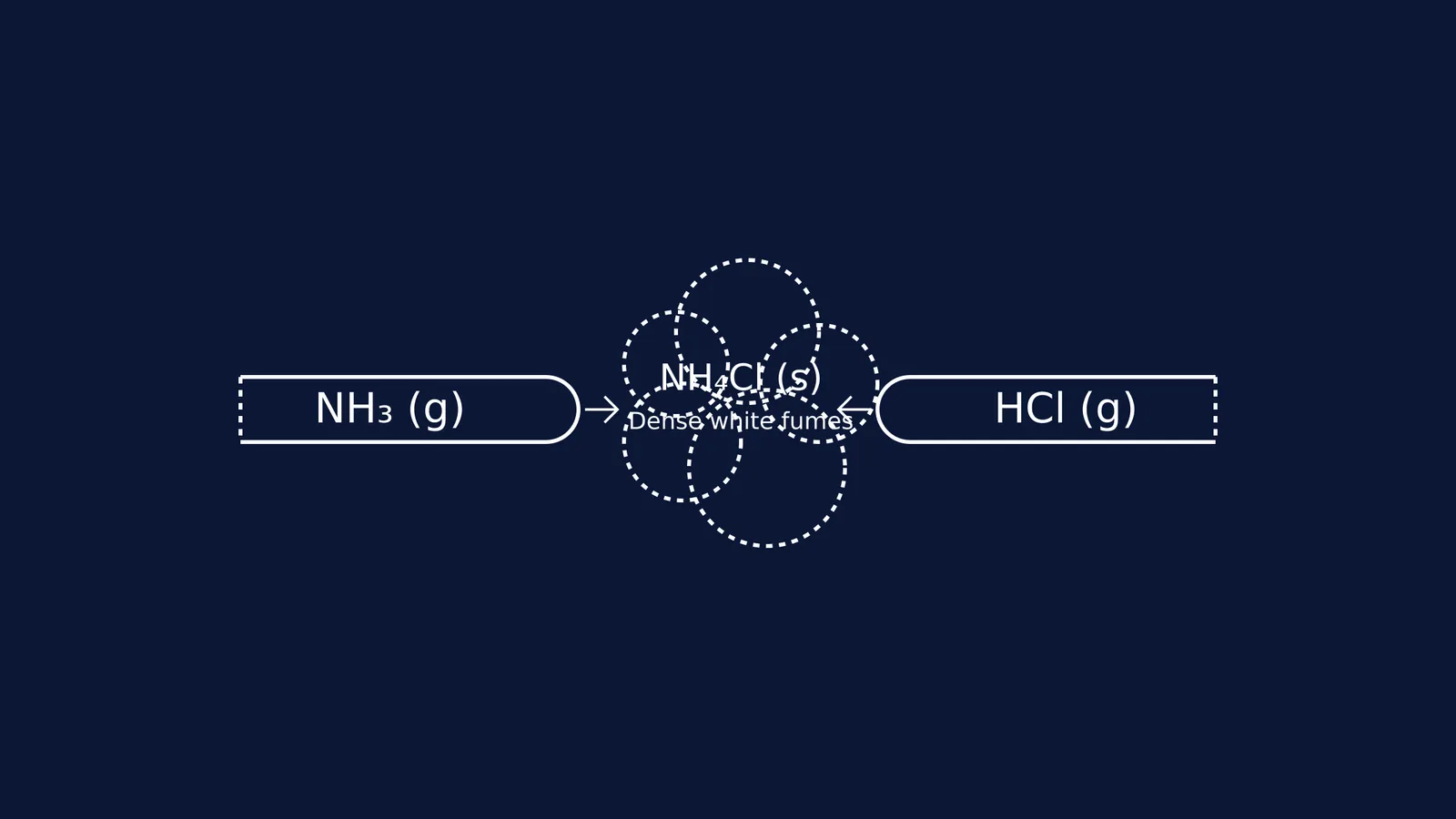
You can also test for ammonia by observing its reaction with hydrogen chloride. Dip a glass rod into concentrated hydrochloric acid and hold it near the ammonia gas. The two gases react instantly to produce a dense white smoke made of solid ammonium chloride particles. This precipitation happens mid-air, creating a very clear visual result.
How to test for hydrogen chloride gas?
Hydrogen chloride (HCl) is a colourless, acidic gas that forms steamy white fumes when it comes into contact with atmospheric water vapour. It is highly soluble in water, where it forms hydrochloric acid.
If you hold damp blue litmus paper in hydrogen chloride gas, the acidic nature of the gas turns the paper red. However, because other acidic gases like carbon dioxide and sulphur dioxide also turn blue litmus red, this is not a definitive test. You need further evidence to confirm that the gas is hydrogen chloride.
The most distinctive confirmatory test for hydrogen chloride is the exact reverse of the ammonia test. Dip a glass rod into a concentrated ammonia solution and hold it near the hydrogen chloride gas. The resulting reaction produces a thick, dense white smoke of ammonium chloride. The solid particles remain suspended in the air, creating the characteristic fumes.
If you find yourself stuck remembering which gas does what, the Fermi Concept Library gives each concept its place in the map. When you are looking for guidance on acid-base or redox reactions, Fermi's AI tutor can work out what you already know and build a plan for the session, so you sit down to a clear next step in your revision.
How to identify an unknown gas systematically?
When identifying an unknown gas in a practical exam, just like when running the carbylamine test for primary amines or the bromination of phenol, a systematic approach prevents mistakes. It is easy to confuse similar-looking results, so follow this sequence to rule out options one by one:
Look and smell: Is it coloured? (A yellow-green tint strongly suggests chlorine). Does it have a choking or pungent smell? (Waft the air carefully towards your nose, rather than sniffing directly from the tube).
Litmus test: Use both damp blue and damp red litmus paper. If blue turns white, it is chlorine. If red turns blue, it is ammonia. If blue turns red but is not bleached, it is an acidic gas like hydrogen chloride.
Fume test: If you suspect ammonia or hydrogen chloride, use a glass rod dipped in the opposite concentrated solution to check for dense white fumes. This will confirm your initial suspicions and complete the identification.


