

On this page
When you are given the molecular formula C3H9N, your first task in organic chemistry is to draw all possible structural isomers. Because amines are derivatives of ammonia, the nitrogen atom can bond to one, two, or three carbon atoms, giving us primary (1°), secondary (2°), and tertiary (3°) amines.
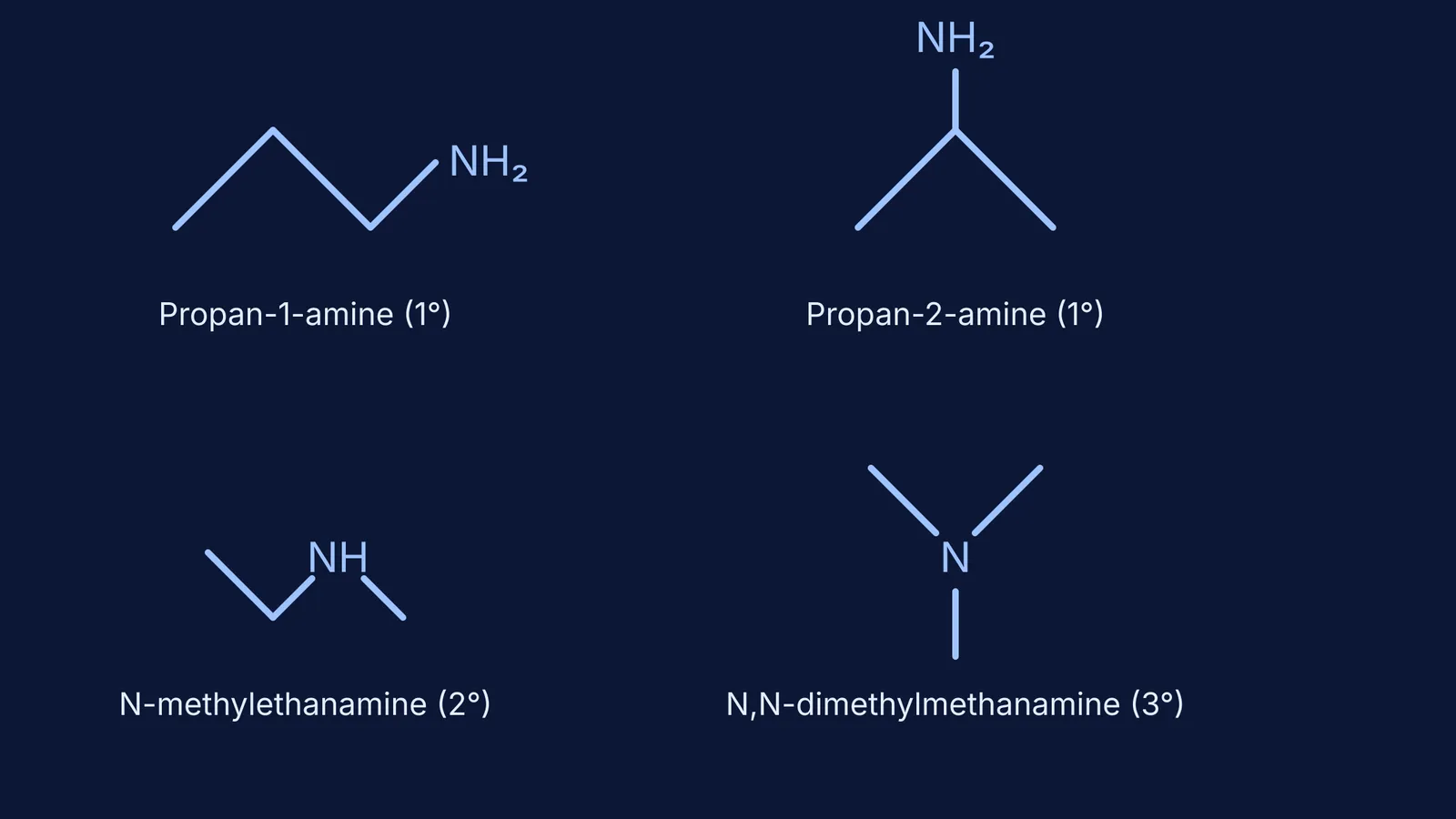
The molecular formula C3H9N may refer to exactly four structural isomers: propan-1-amine, propan-2-amine, N-methylethanamine, and N,N-dimethylmethanamine (Wikipedia). Let's break down how to draw them and how to distinguish them in the lab.
How do you draw structural isomers of amines systematically?
When asked to find the isomers for a formula like C3H9N, guessing randomly will often lead to missing a structure or drawing the same molecule twice. Instead, you can follow a systematic framework, much like drawing structural isomers for alkanes.
First, determine the degrees of unsaturation. For C3H9N, the formula fits the saturated amine general formula C_n H_{2n+3} N. There are zero rings and zero double bonds, meaning all connections are single bonds.
Next, divide the task by the type of amine:
Start with primary (1°) amines: This means the nitrogen is bonded to only one carbon atom, leaving a continuous propyl group (C3H7). The propyl group has two isomers: a straight chain (n-propyl) and a branched chain (isopropyl). Attaching the -NH2 group gives propan-1-amine and propan-2-amine.
Move to secondary (2°) amines: Here, the nitrogen must sit between two carbon groups. With three carbons total, the only possible split is a one-carbon group and a two-carbon group. This yields a methyl group on one side and an ethyl group on the other, creating N-methylethanamine.
Finish with tertiary (3°) amines: The nitrogen must be bonded to three separate carbon atoms. Since we only have three carbons available, each must be a methyl group. This leaves us with exactly one option: N,N-dimethylmethanamine.
If you want to practice identifying structural isomers step-by-step, the Fermi Concept Library has a lesson for every concept in chemistry to help you map out every possibility without missing carbon chains.
How does Hinsberg's test sort primary, secondary and tertiary amines?
Once you have these isomers in front of you, how do you tell them apart in the lab? The standard chemical method for the detection of primary, secondary and tertiary amines uses Hinsberg's reagent. First described by Oscar Hinsberg in 1890 (Wikipedia), the test involves shaking the amine with benzenesulfonyl chloride and an aqueous alkali like KOH or NaOH.
Here is exactly how the isomers of C3H9N react:
Primary amines (Propan-1-amine and Propan-2-amine): They react with benzenesulfonyl chloride to form a soluble sulfonamide salt in the presence of aqueous alkali. Because this specific sulfonamide still has one highly acidic hydrogen atom attached to the nitrogen, it dissolves to form a salt. When you subsequently add a dilute acid to the test tube, the sulfonamide precipitates out as a solid. Alternatively, you can confirm they are primary amines using the carbylamine test.
Secondary amines (N-methylethanamine): This amine also reacts with the benzenesulfonyl chloride reagent to directly form an insoluble sulfonamide. Since the nitrogen atom in a secondary amine uses its two bonds for carbon groups and one for the sulfonyl group, there is no acidic hydrogen left. Consequently, this sulfonamide does not dissolve in the alkali and forms a precipitate immediately.
Tertiary amines (N,N-dimethylmethanamine): Tertiary amines will not react with the original reagent (benzene sulfonyl chloride) and will remain insoluble. If you add dilute acid to the mixture, the unreacted tertiary amine reacts with the acid and turns into a soluble ammonium salt.
Why does the acidic hydrogen dictate solubility?
The entire mechanism of the Hinsberg reaction hinges on the presence of an acidic hydrogen on the nitrogen atom after the initial sulfonamide forms. The sulfonyl group is strongly electron-withdrawing. When attached to a nitrogen atom, it pulls electron density away, making any remaining N-H bond highly polarized.
In primary amines, one N-H bond remains after reaction, and this proton is easily removed by a strong base like NaOH, forming a water-soluble salt. In secondary amines, the single initial N-H bond is consumed to form the sulfonamide, leaving a neutral, water-insoluble compound.
What is a diagnostic checklist for the lab?
When facing an unknown amine in a practical exam or a JEE/NEET question, follow this simple sequence to interpret your results:
Add the reagents: Mix your unknown amine with benzenesulfonyl chloride and aqueous alkali, then shake well.
Check for a clear solution: If the mixture becomes a clear, soluble salt solution, you have a primary amine. To verify, add dilute acid; a solid precipitate should appear.
Check for an immediate precipitate: If a solid forms immediately and refuses to dissolve in the basic solution, you have a secondary amine.
Check for an unreacted layer: If the organic layer remains unreacted but suddenly dissolves when you add dilute acid to form an ammonium salt, you have a tertiary amine.
Understanding how the structure of an amine dictates its chemical reactivity is a core skill in organic chemistry. By mastering the isomers of C3H9N and applying them to the Hinsberg test, you build a solid foundation for distinguishing complex nitrogen compounds.


