

On this page
Why does sodium hydroxide behave differently across reactions?
In organic chemistry, sodium hydroxide (NaOH) appears across dozens of reaction schemes, yet its behavior varies dramatically with reaction conditions. The hydroxide ion (OH⁻) carries unshared electron pairs and negative charge on oxygen, allowing it to act either as a Brønsted base (abstracting a proton) or as a Lewis nucleophile (attacking an electron-deficient carbon).
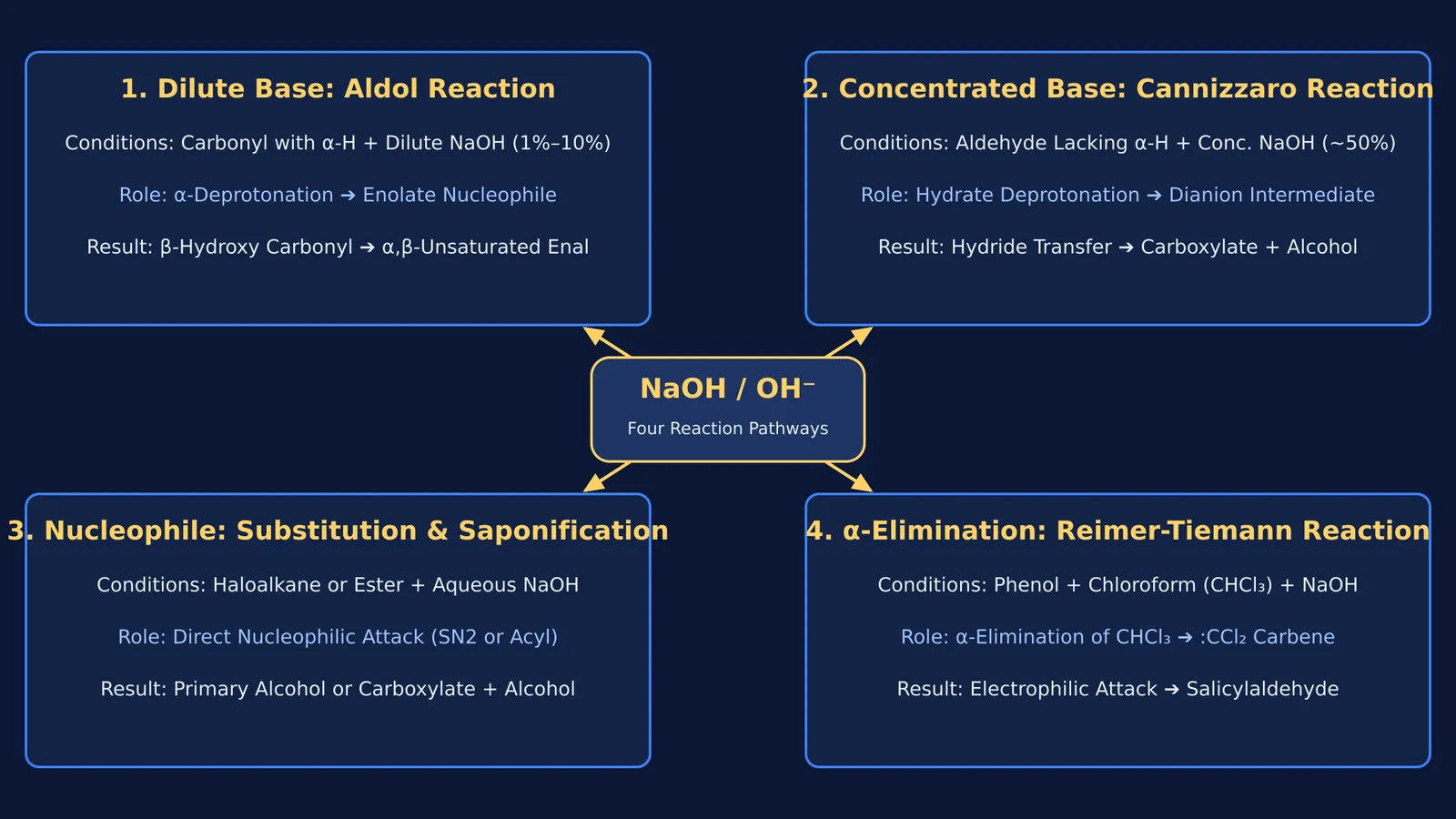
Which role dominates depends on three factors: alkali concentration, solvent environment, and substrate structure. Water heavily solvates hydroxide, stabilizing the ion and dampening basicity compared to alkoxides. Changing concentration shifts thermodynamic and kinetic equilibria, enabling reactive intermediates that cannot form in dilute conditions. Mastering these reactions requires recognizing four distinct operational pathways.
When does dilute sodium hydroxide trigger aldol condensation?
When an aldehyde or ketone contains an acidic alpha-hydrogen (α-hydrogen), sodium hydroxide acts primarily as a Brønsted base. In dilute aqueous solutions (typically 1% to 10% NaOH by mass, as evaluated by Crouch and colleagues (2007)), hydroxide removes an α-proton to generate a resonance-stabilized enolate ion. Because dilute base deprotonates only a small equilibrium fraction of carbonyl molecules, the resulting enolate attacks an adjacent neutral carbonyl as a carbon nucleophile.
This addition forms a β-hydroxy carbonyl compound (an aldol), which dehydrates on gentle heating to yield an α,β-unsaturated carbonyl. Maintaining dilute basic conditions is essential; excessive alkali concentrations or overheating promote unwanted polyaldol resinification. For example, treating ethanal (CH₃CHO) with dilute alkali forms 3-hydroxybutanal, yielding but-2-enal upon warming.
Why does the Cannizzaro reaction require concentrated sodium hydroxide?
When an aldehyde lacks α-hydrogens—such as benzaldehyde (C₆H₅CHO) or formaldehyde (HCHO)—enolate formation cannot occur. Instead, hydroxide attacks the carbonyl carbon directly, generating an unstable tetrahedral monoanion hydrate. In dilute alkali, this addition rapidly reverses because hydride (H⁻) is an exceptionally poor leaving group.
Driving the transformation requires concentrated sodium hydroxide, typically a 50% aqueous solution (~19 M NaOH). In this highly alkaline medium, a second hydroxide deprotonates the hydroxyl group of the monoanion to form a reactive dianion [RCH(O⁻)₂]. In their classic kinetic investigation, Swain and colleagues (1979) demonstrated that direct carbon-to-carbon hydride transfer serves as the rate-determining step, ruling out ester intermediates.
This hydride shift oxidizes one aldehyde to a carboxylate salt and reduces the second to an alcohol. For crossed aldehyde variants, review our Cannizzaro reaction guide. When analyzing these reaction networks, understanding why high alkalinity enables dianion formation is vital; the Fermi Concept Library maps every concept in physics, chemistry, biology, mathematics and computing, each with its own lesson and its place in the map.
How does aqueous sodium hydroxide drive substitution and saponification?
With primary and unhindered secondary haloalkanes, aqueous sodium hydroxide acts as a nucleophile, displacing halides via bimolecular nucleophilic substitution (SN2) to produce alcohols. Classic kinetic measurements on optically active halides by Hughes, Ingold, and Masterman (1937) established that this bimolecular substitution follows second-order kinetics with complete Walden inversion.
Aqueous conditions favor substitution because water solvates hydroxide, reducing its effective basicity. By contrast, alcoholic media generate ethoxide, which acts as a strong base favoring E2 elimination, as detailed in our aqueous versus alcoholic KOH guide.
In carboxylic esters, aqueous sodium hydroxide executes saponification through nucleophilic acyl substitution. Hydroxide attacks the carbonyl carbon to form a tetrahedral intermediate, which expels alkoxide. Rapid proton transfer from the resulting carboxylic acid to alkoxide yields a carboxylate salt and an alcohol, driving the reaction irreversibly to completion. As documented by Terry and Stieglitz (1927), the saponification of ethyl acetate follows second-order kinetics with a rate constant near 6.5 L/(mol·min) at 25 °C.
What happens when sodium hydroxide meets chloroform in the Reimer-Tiemann reaction?
Pairing sodium hydroxide with chloroform (CHCl₃) and phenol creates a unique pathway. Rather than direct substitution, hydroxide deprotonates chloroform to yield the trichloromethyl carbanion (:CCl₃⁻), which undergoes α-elimination of chloride to form neutral dichlorocarbene (:CCl₂), as established in mechanistic reviews by Wynberg (1960).
Neutral dichlorocarbene possesses an empty p-orbital, making it a strong electrophile. Sodium hydroxide simultaneously deprotonates phenol to form resonance-stabilized phenoxide, which attacks the carbene at the ortho position. Subsequent alkaline hydrolysis of the resulting dichloromethyl group generates salicylaldehyde after acidification. For practical reaction conditions, see our guide on Reimer-Tiemann and Kolbe reactions of phenol.
How can you predict which pathway sodium hydroxide will take?
To determine the pathway of sodium hydroxide in any given reaction, apply this four-step diagnostic logic:
Look for chloroform: With CHCl₃ and phenol, expect α-elimination forming dichlorocarbene for Reimer-Tiemann ortho-formylation.
Check for sp³ carbons with leaving groups: With haloalkanes or esters in water, expect nucleophilic attack yielding alcohols or carboxylate salts.
Check carbonyls for α-hydrogens: With aldehydes or ketones bearing α-hydrogens in dilute alkali, expect enolate formation leading to aldol condensation.
Check carbonyls lacking α-hydrogens: With aldehydes without α-protons in concentrated alkali, expect dianion formation driving Cannizzaro disproportionation.
Practicing this diagnostic logic helps prevent misidentifying reaction products. The Fermi Problem Library provides worked problems with a step-by-step solver that explains the reasoning rather than printing an answer.


