

On this page
Draw an amine with three different groups on nitrogen, such as N-ethyl-N-methylpropan-1-amine. Count the lone pair as a fourth group and the nitrogen looks exactly like a chiral carbon. Its mirror image cannot be laid on top of it. Yet nobody has ever bottled one enantiomer of this amine. Swap the lone pair for a fourth carbon group, as in a quaternary ammonium salt, and the enantiomers can be separated. This post explains why, using one idea: nitrogen inversion. (For the basics of chirality and R/S, see stereoisomerism step by step.)
Is a nitrogen with three different groups a stereocentre?
At any one instant, yes. In an amine the nitrogen is sp³ hybridised and pyramidal. Three positions hold the groups and the fourth holds the lone pair. If all three groups are different, the molecule has no plane of symmetry, and it has a non-superimposable mirror image.
So on paper, N-ethyl-N-methylpropan-1-amine is chiral. The trouble is that the two mirror images do not stay apart. They turn into each other far faster than any chemist can separate them.
What is nitrogen inversion in amines?
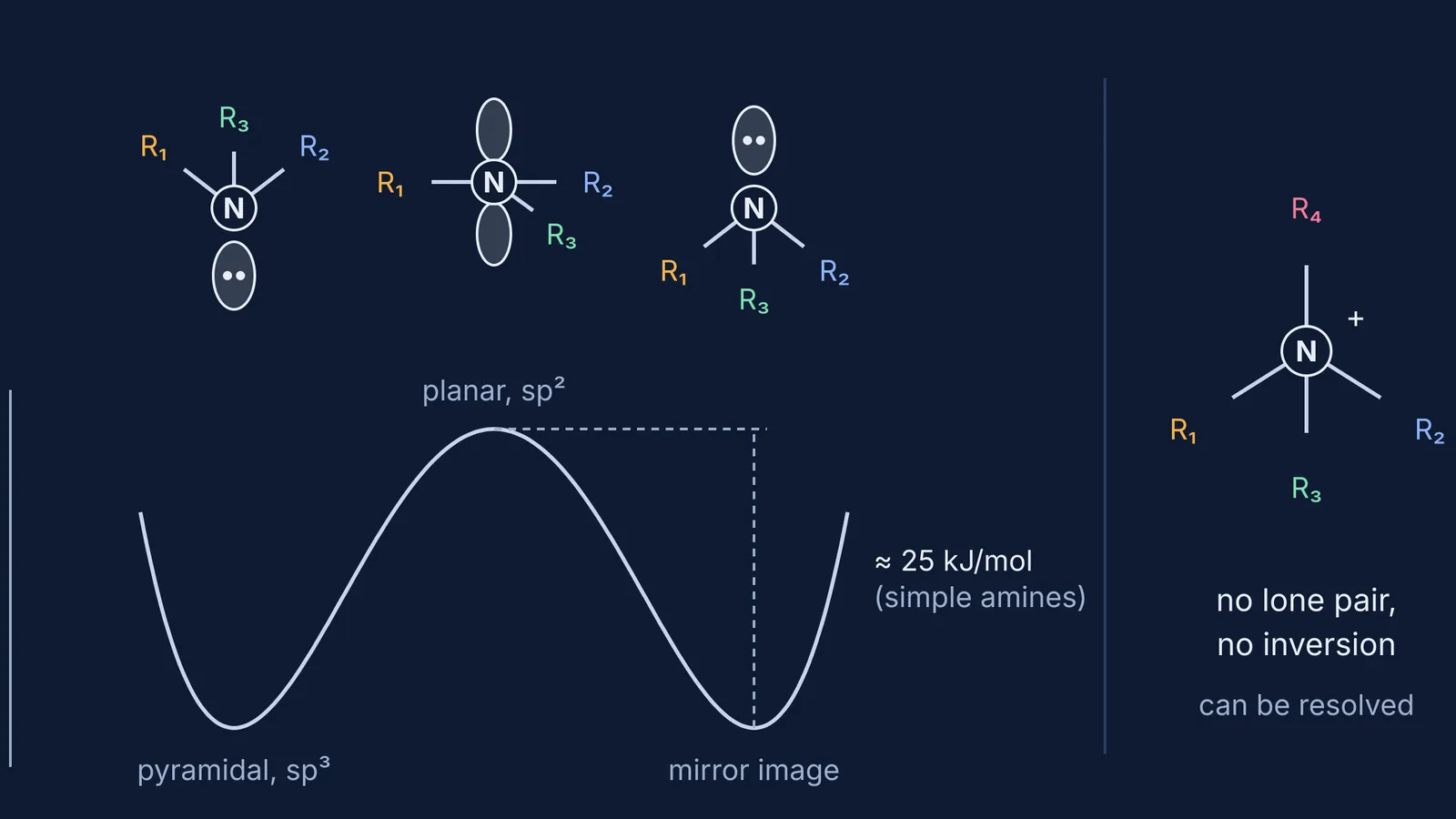
Nitrogen inversion is the amine flipping inside out, like an umbrella in a strong wind.
The three groups move towards a flat arrangement, and the lone pair moves towards the other side.
At the halfway point the molecule is planar. Nitrogen is sp² hybridised, the three groups lie at 120° in one plane, and the lone pair sits in a p orbital above and below that plane. This is the transition state.
The groups carry on through and the molecule becomes pyramidal again, now with the lone pair on the opposite face.
The new pyramid is the mirror image of the old one. No bond breaks, so nothing stops the process except a small energy barrier.
How fast does an amine invert?
The barrier is small. For ammonia it is about 24 kJ/mol, and for simple trialkylamines it is typically around 25 kJ/mol (values for different amines vary, roughly 20 to 40 kJ/mol). Compare that with RT at 298 K, which is about 2.5 kJ/mol.
You can estimate the rate with the Arrhenius-type expression k = A e^(−Eₐ/RT), taking A ≈ 6 × 10¹² s⁻¹ (the usual frequency factor for a one-molecule step at room temperature):
Eₐ/RT = 25,000 ÷ (8.314 × 298) ≈ 10.1.
e^(−10.1) ≈ 4.2 × 10⁻⁵.
k ≈ 6.2 × 10¹² × 4.2 × 10⁻⁵ ≈ 2.6 × 10⁸ s⁻¹.
Each molecule flips about 260 million times a second. Any sample enriched in one enantiomer would be racemic within nanoseconds. A rough rule from the same equation: to keep enantiomers apart for hours at room temperature, the barrier needs to be about 100 kJ/mol. That gives a flip half-life of about 10 hours. A simple amine has about a quarter of that barrier.
Why can quaternary ammonium salts be resolved?
In a quaternary ammonium ion, R₁R₂R₃R₄N⁺, nitrogen uses its lone pair to form a fourth N–C bond. There is no lone pair left to swing through to the other side. To invert, the ion would have to break and remake a bond, which needs far more energy than is available at room temperature.
So a quaternary ammonium ion with four different groups behaves just like a carbon with four different groups. It is configurationally stable and can be resolved. The usual method is the one used for any racemate: pair it with a single enantiomer of a chiral anion, separate the two diastereomeric salts by crystallisation, then swap the anion back. That method is explained in racemic mixture and resolution.
Does a protonated amine count as a quaternary salt?
No, and this is a common trap. In R₁R₂R₃NH⁺ the fourth group is a hydrogen. In solution that proton comes off and goes back on constantly. Each time it is off, the free amine inverts. So a salt like ethylmethylpropylammonium chloride racemises in solution. "Quaternary" means four carbon groups on nitrogen.
Are there chiral amines that can be resolved?
Yes, when something stops the nitrogen from flattening.
Nitrogen locked in a ring system. In Tröger's base both nitrogens sit at the bridgeheads of a rigid bicyclic cage. They cannot become planar without tearing the cage, so the enantiomers have been separated.
Small rings. In an aziridine (a three-membered ring) the planar transition state would need 120° angles while the ring holds about 60°. The barrier rises sharply, so inversion is much slower than in open-chain amines.
Amine oxides. In R₁R₂R₃N⁺–O⁻ the lone pair is used in the N–O bond, so they behave like quaternary salts.
Phosphines. Phosphorus, one row down, has much higher inversion barriers, roughly 120 to 150 kJ/mol. At 130 kJ/mol the same estimate gives a half-life of about 200 years. That is why chiral phosphines can be bottled and used as ligands in asymmetric catalysis.
Worked example: which of these can be resolved?
Question. Decide which can be resolved into enantiomers: (a) N-ethyl-N-methylpropan-1-amine, (b) N-benzyl-N-ethyl-N-methylpropan-1-aminium iodide (its N-benzyl quaternary salt), (c) butan-2-amine.
(a) N-ethyl-N-methylpropan-1-amine, CH₃CH₂CH₂–N(CH₃)(CH₂CH₃).
Groups on N: methyl, ethyl, propyl and a lone pair. All different, so N is a stereocentre at any instant.
Any carbon stereocentres? No. Every carbon has at least two identical groups.
Can N invert? Yes. It has a lone pair and sits in an open chain.
Answer: cannot be resolved. It racemises by inversion about 10⁸ times a second.
(b) The quaternary salt [PhCH₂–N(CH₃)(CH₂CH₃)(CH₂CH₂CH₃)]⁺ I⁻.
Groups on N: benzyl, methyl, ethyl, propyl. Four different carbon groups.
Lone pair? None. It is used in the fourth N–C bond.
Can N invert? No.
Answer: can be resolved, for example as diastereomeric salts with a chiral anion.
(c) Butan-2-amine, CH₃CH(NH₂)CH₂CH₃.
Find the stereocentre: C2 carries H, NH₂, CH₃ and C₂H₅. Four different groups, so C2 is chiral.
Is the nitrogen a stereocentre? No. NH₂ has two identical hydrogens, so its inversion changes nothing.
Does inversion at N affect C2? No. Inversion moves groups on nitrogen, not on carbon.
Answer: can be resolved. It is the one chiral isomer of C₄H₁₁N, listed in all eight amine isomers of C4H11N.
The test is never "are there four different groups?" alone. It is "four different groups that cannot swap places".
If pictures of wedges and pyramids still feel slippery, the Concept Library covers stereochemistry concept by concept, and the Fermi Problem Library has a step-by-step solver that explains the reasoning on questions like these.
Quick checklist
A pyramidal amine with three different groups is chiral at any instant.
Nitrogen inversion passes through a planar sp² transition state with a barrier of about 25 kJ/mol.
At room temperature this means roughly 10⁸ flips per second, so the enantiomers cannot be separated.
Quaternary ammonium ions with four different carbon groups have no lone pair, cannot invert and can be resolved.
R₃NH⁺ salts do not count: proton exchange lets the free amine invert.
Amines with a chiral carbon, such as butan-2-amine, can be resolved.
Exceptions that block inversion: rigid bridgeheads (Tröger's base), strained rings, amine oxides, and the much slower phosphines.


