On this page
Your textbook says a racemic mixture is optically inactive, and a few pages later it asks you to "resolve" one. Both ideas rest on the same fact: two mirror-image molecules behave identically until something chiral tells them apart.
What is a racemic mixture?
A racemate is "an equimolar mixture of a pair of enantiomers" that "does not exhibit optical activity", in the words of the IUPAC stereochemistry terminology. The same IUPAC glossary defines enantiomers as a pair of molecules that are mirror images of each other and non-superposable.
You will see a racemate written with a (±) prefix, for example (±)-lactic acid, or described as a 50:50 mixture, as in this LibreTexts organic chemistry chapter/05%3A_Stereochemistry_at_Tetrahedral_Centers/5.08%3A_Racemic_Mixtures_and_the_Resolution_of_Enantiomers). For a refresher, see our guide on how to tell if structures are enantiomers, diastereomers or identical.
Why does a racemic mixture not rotate plane-polarised light?
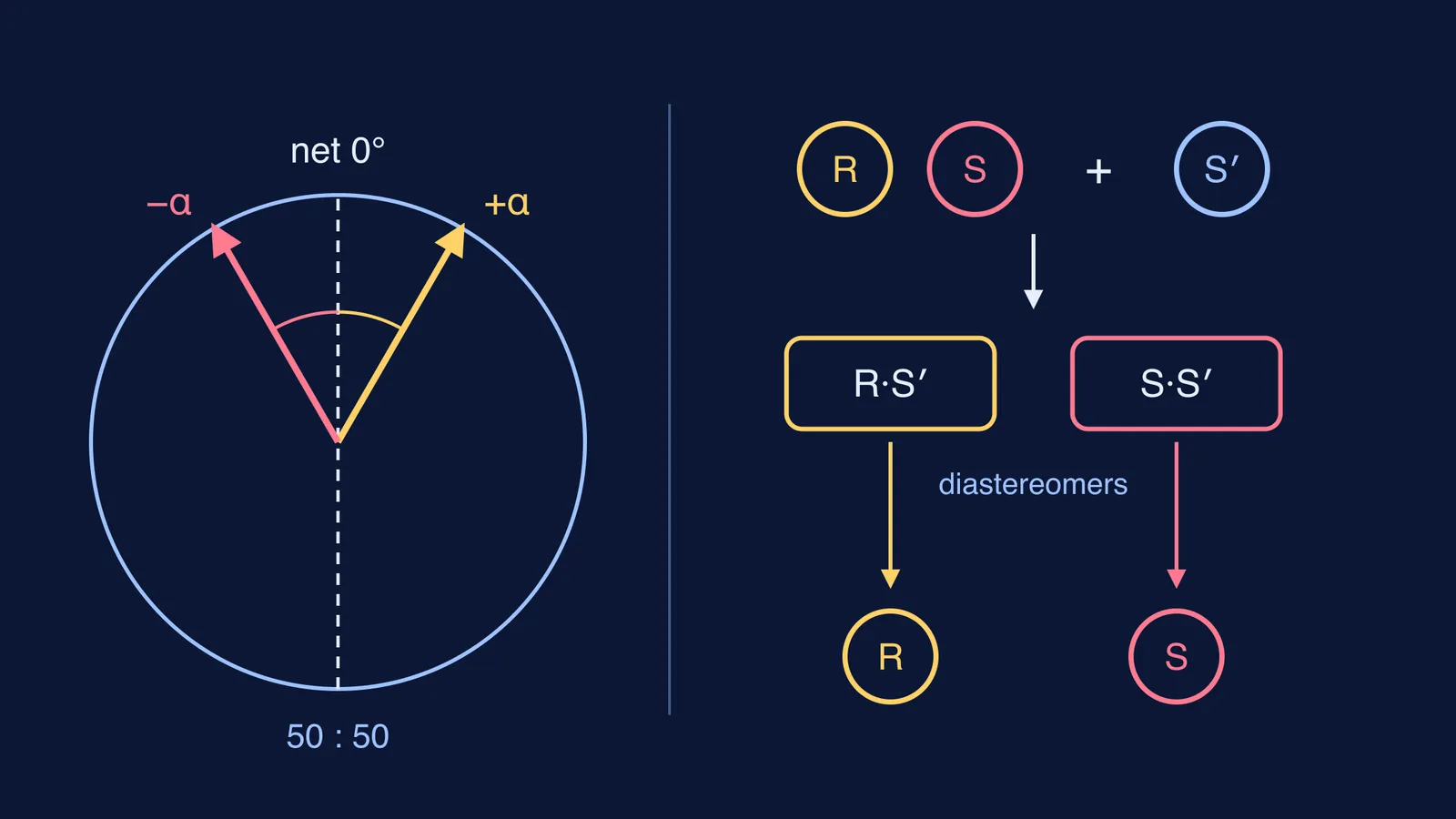
Each enantiomer rotates plane-polarised light by the same angle in opposite directions, so in a 50:50 mixture the two effects cancel, as the LibreTexts chapter/05%3A_Stereochemistry_at_Tetrahedral_Centers/5.08%3A_Racemic_Mixtures_and_the_Resolution_of_Enantiomers) explains. If the (+) form turns the plane by +α, the (−) form turns it by −α, and the sample as a whole reads zero.
Every molecule in the flask is still chiral; the polarimeter reads zero only because there are equal numbers of each. In a meso compound, by contrast, each molecule is itself achiral.
If the mixture is not exactly 50:50, the reading is no longer zero. Our post on enantiomeric excess and optical purity shows that calculation.
How is a racemic mixture resolved?
Resolution is "the separation of a racemate into the component enantiomers", according to IUPAC. The hard part is that enantiomers have identical physical properties, such as solubility and melting point, so simple crystallisation or distillation seldom separates them, as the LibreTexts chapter/05%3A_Stereochemistry_at_Tetrahedral_Centers/5.08%3A_Racemic_Mixtures_and_the_Resolution_of_Enantiomers) notes.
The classic fix is to turn them into diastereomers. IUPAC defines diastereomers as stereoisomers not related as mirror images, and notes that they differ in physical properties. So the method has three steps, as set out in the LibreTexts chapter:
React the racemate with one pure enantiomer of a chiral reagent, called the resolving agent. This gives two diastereomers.
Separate the diastereomers by a physical method, usually crystallisation, because their solubilities differ.
Reverse the first reaction on each diastereomer to get back each pure enantiomer, along with the resolving agent.
The same chapter lists common resolving agents. To resolve a racemic acid, chemists use chiral bases such as brucine, strychnine, quinine or 1-phenylethanamine. To resolve a racemic base, they use chiral acids such as (+)-tartaric acid, (−)-malic acid, (−)-mandelic acid or (+)-camphor-10-sulfonic acid.
A worked example you can write in an exam
Take racemic lactic acid, a 50:50 mix of (R)- and (S)-lactic acid. Add pure (S)-1-phenylethanamine, a chiral base.
Acid plus base gives two salts: (R)-acid·(S)-base and (S)-acid·(S)-base.
These salts are not mirror images. The mirror image of (R,S) is (S,R), and you have (S,S) instead. So they are diastereomers.
Being diastereomers, they have different solubilities. Cool the solution and the less soluble salt crystallises first. Filter it off.
Add a strong acid such as HCl to each salt. This puts the proton back on the lactic acid and frees the amine. One portion gives (R)-lactic acid, the other gives (S)-lactic acid.
In an answer, name both salts with both configurations, use the word "diastereomers", and say why it matters: different physical properties.
Two points students often miss. A racemate is half of each form, so one resolution gives at most half the starting material as the enantiomer you want. And the resolving agent must be a single pure enantiomer; a racemic one would give four salts forming two enantiomeric pairs, and you would be back where you started.
If a step like this keeps tripping you up, the Fermi Problem Library has worked problems with a step-by-step solver that explains the reasoning rather than printing an answer.
How did Pasteur resolve a racemate by hand, and why does it still matter?
The classical resolution was done by hand. Louis Pasteur crystallised sodium ammonium tartrate, a salt of racemic tartaric acid, below 27 °C and separated the mirror-image crystals with the aid of a microscope, as the LibreTexts chapter/05%3A_Stereochemistry_at_Tetrahedral_Centers/5.08%3A_Racemic_Mixtures_and_the_Resolution_of_Enantiomers) records. Our profile of how Pasteur discovered molecular chirality with crystals tells that story.
It still matters because the two enantiomers of a drug can act differently in the body. The US Food and Drug Administration's 1992 policy statement on stereoisomeric drugs asks drug developers to characterise the activity of the individual enantiomers and to know the isomeric composition of the material they test.
A quick checklist before your next test
Can you define racemate, enantiomer and diastereomer in one line each?
Can you explain why a racemate reads zero, and how that differs from meso?
Can you write the three steps of resolution and name one chiral acid and one chiral base?
If any line feels shaky, the Fermi Concept Library has a lesson for every concept in chemistry, each with its place in the map.