

On this page
Why does mental rotation often fail?
When comparing two chemical structures on paper, trying to mentally spin and flip them in three dimensions is a common way to make mistakes. A single bond rotation can make two identical molecules look completely different, or make two enantiomers look like they might superimpose. The more chiral centres a molecule has, the more difficult it becomes to keep track of every bond angle in your head.
Instead of relying on visual gymnastics, there is a systematic way to find the relationship: assign the absolute configuration (R or S) to every chiral centre using the Cahn-Ingold-Prelog (CIP) priority rules. By simply comparing these labels, you can definitively classify the structures. The Fermi Concept Library can help you practise the CIP rules if you need to brush up on assigning priorities to different functional groups based on atomic number.
How do you compare R/S configurations?
Once you have the R/S labels for every chiral centre in both molecules, compare them directly. The rules, as defined by standard IUPAC conventions and detailed in chemistry references (Wikipedia), are straightforward. Ensure that you are comparing the exact same carbon atom in both structures by numbering the carbon chain correctly.
1. Identical molecules: no centres inverted
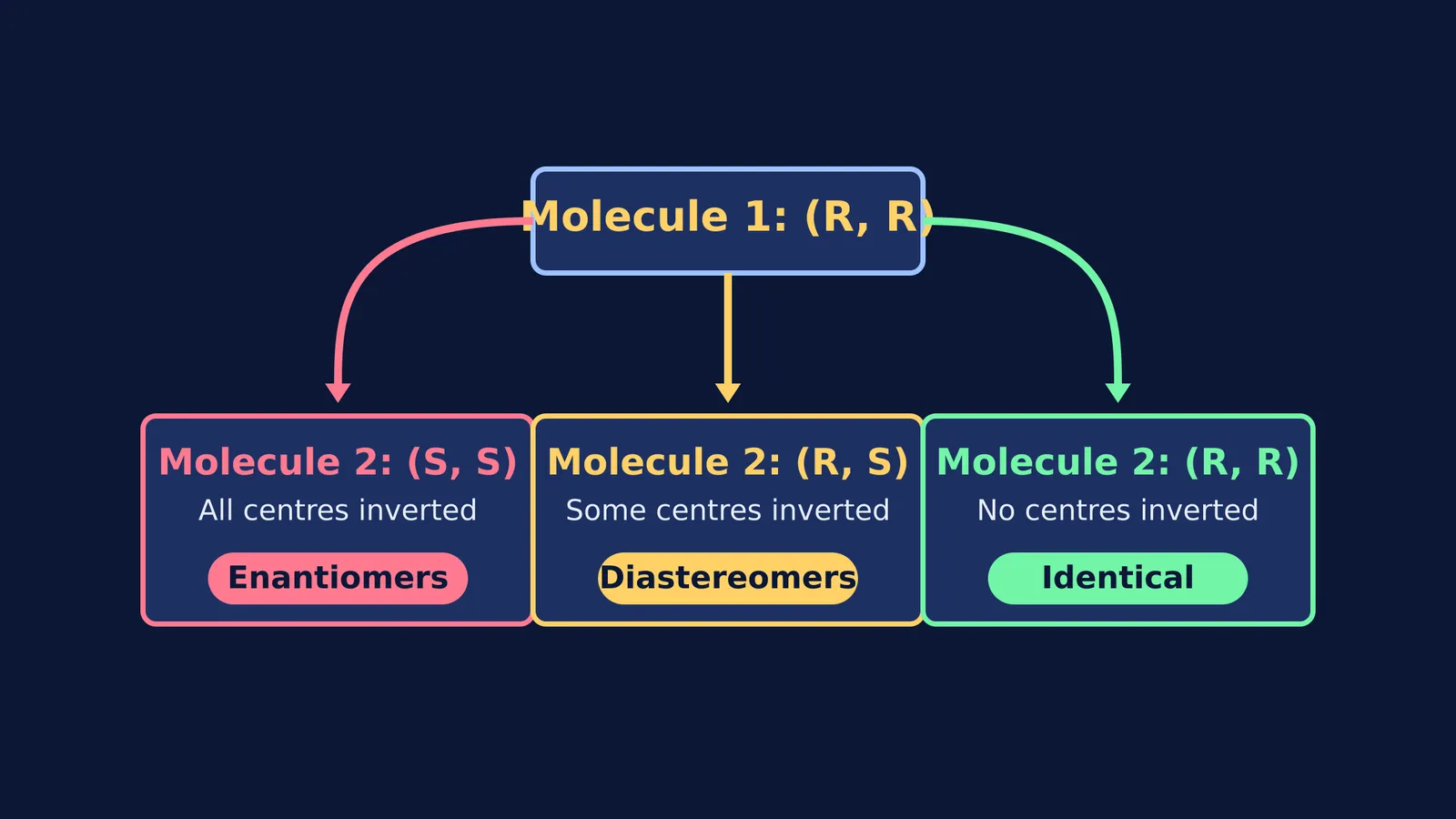
If every chiral centre in the first molecule has the exact same configuration as the corresponding centre in the second molecule, the two structures are identical. For example, if you determine that both structures have a (2R, 3R) configuration, they represent the exact same compound. This remains true no matter how differently they might be drawn on the page, even if one is drawn as a Fischer projection and the other as a skeletal zig-zag structure.
2. Enantiomers: all centres inverted
Enantiomers are non-superimposable mirror images of each other. In terms of absolute configuration, this means that every single chiral centre must be inverted. If your first molecule is (2R, 3R) and the second is (2S, 3S), they are enantiomers. This rule holds for any number of chiral centres. For three chiral centres, going from (2R, 3S, 4R) to (2S, 3R, 4S) also means they are enantiomers.
3. Diastereomers: some centres inverted
Diastereomers are stereoisomers that are not mirror images of each other. In terms of R/S naming, this happens when at least one chiral centre is inverted, but at least one chiral centre stays exactly the same. If your first molecule is (2R, 3R) and the second is (2R, 3S), they are diastereomers. Because their configurations are only partially inverted, they have different physical properties like boiling points.
For more on sorting different types of isomers, see our guide to stereoisomerism step by step: chirality, meso, R/S and E/Z and how to count stereoisomers from the number of chiral centres.
What is the meso compound exception?
There is one important trap to watch out for when using this method: meso compounds. A meso compound has multiple chiral centres but also possesses an internal plane of symmetry, making the overall molecule achiral.
If you have a meso compound, such as *meso*-tartaric acid with a (2R, 3S) configuration, its theoretical mirror image will have a (2S, 3R) configuration. According to the basic rule, all centres are inverted, so you might guess they are enantiomers. However, because of the internal symmetry, the (2R, 3S) and (2S, 3R) forms are actually superimposable. They are the exact same molecule. Always check for a plane of symmetry if a molecule has opposite configurations.
How do you check for stereoisomers step by step?
Next time you face an exam question asking for the exact relationship between two drawn structures, follow this logical plan:
Check connectivity: Ensure they are actually stereoisomers. If the atoms are connected differently (for example, 1-chlorobutane versus 2-chlorobutane), they are constitutional isomers, not stereoisomers. You can read more about telling these apart in our post on C4H10O isomers: telling the four alcohols and three ethers apart.
Assign R/S: Use CIP rules to carefully assign R or S to every single chiral centre on both molecules.
Compare the results:
Are they the same at all centres? They are identical (or constitutional isomers if the connectivity differs).
Are they inverted at all centres? Check for a meso plane of symmetry. If there is no symmetry, they are enantiomers. If there is a plane of symmetry, they are identical.
Are they inverted at some centres, but the same at others? They are diastereomers.
If you keep getting stuck on assigning priorities or visualising the lowest priority group, Fermi's AI tutor can work out what you already know and build a plan for the session, guiding you through the rules.


