

On this page
Your left and right hands are mirror images, yet you cannot stack one exactly on the other. In 1848 Louis Pasteur showed, with a microscope and a pair of tweezers, that some molecules work the same way. That idea now sits at the centre of the stereochemistry you study for Class 12 and JEE.
What puzzle was Pasteur trying to solve?
Around 1820 the industrial chemist Philippe Kestner unexpectedly made a second acid while refining the tartaric acid salt left over from wine-making. It became known as paratartaric (or racemic) acid. According to a 2021 history in the journal Chirality by Ghislaine Vantomme and Jeanne Crassous, the German chemist and crystallographer Eilhard Mitscherlich reported that crystals grown from the two salts looked identical, yet in solution they did not behave the same way towards polarised light.
The salt of ordinary tartaric acid rotated the plane of polarised light; the paratartrate did not. Jean-Baptiste Biot had shown that tartaric acid from wine rotates polarised light clockwise/05%3A_Stereochemistry_at_Tetrahedral_Centers/5.04%3A_Pasteur's_Discovery_of_Enantiomers), which chemists call dextrorotatory. Same composition, same-looking crystals, different behaviour: something did not add up.
How did Pasteur discover molecular chirality with crystals?
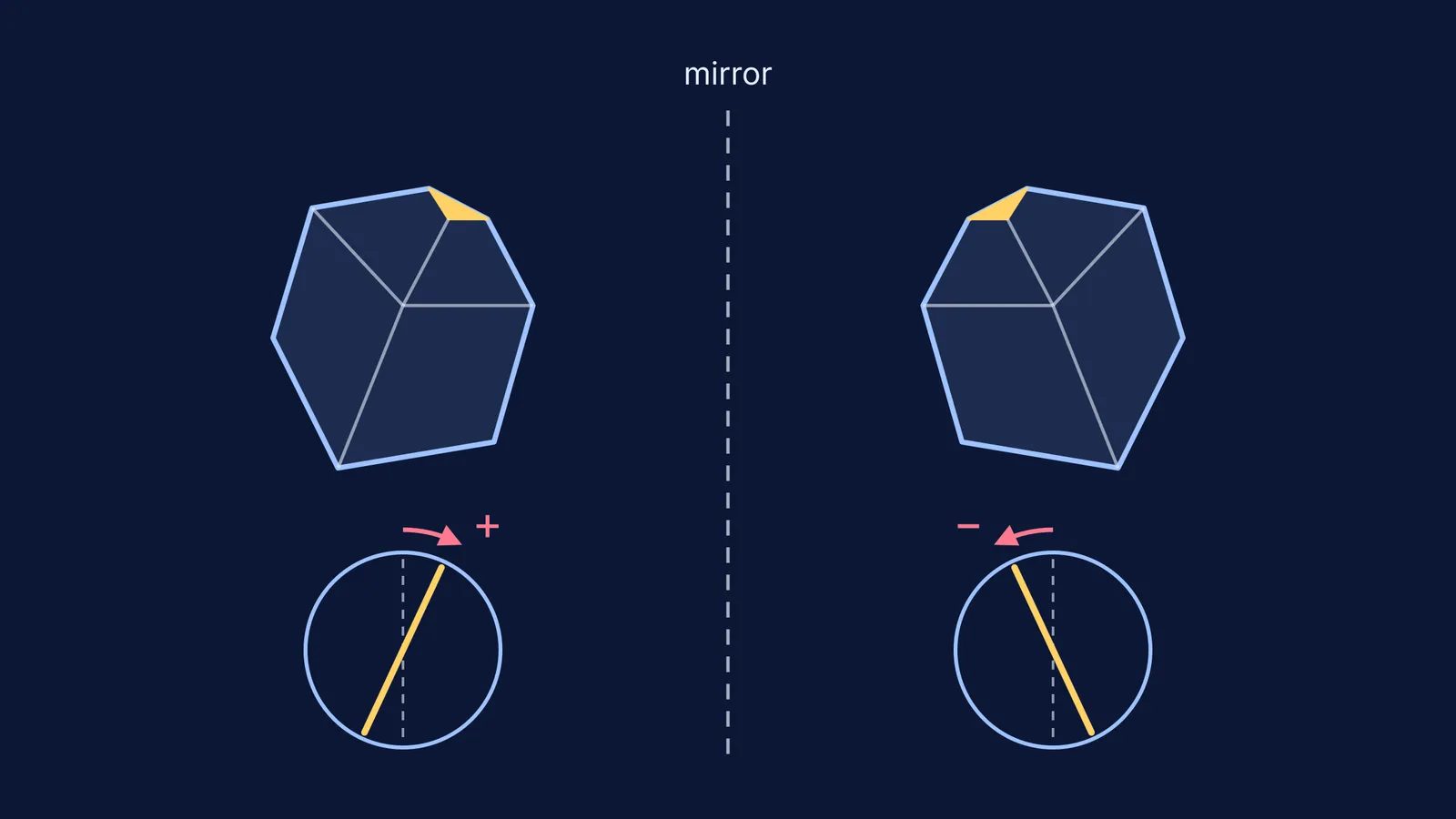
Pasteur was an agrégé préparateur at the École Normale Supérieure, only 8 months past his two doctorates, when he looked closely at crystals of the sodium ammonium salt of paratartaric acid, Vantomme and Crassous write. Each crystal had a tiny extra facet on one edge. On some crystals it leaned to the right, on others to the left, and the two kinds were mirror images of each other.
He separated them by hand with tweezers, which the same paper calls the first artificial chiral resolution. Then he dissolved each pile separately and checked the solutions in a polarimeter:
The right-leaning crystals gave a solution that turned the plane of polarised light to the right.
The left-leaning crystals gave a solution that turned it to the left.
The two rotations were equal in size/05%3A_Stereochemistry_at_Tetrahedral_Centers/5.04%3A_Pasteur's_Discovery_of_Enantiomers), and the right-handed pile was the known tartaric acid from wine.
The left-handed pile was new. By sorting the crystals, Pasteur was the first to produce a pure sample of levotartaric acid. Paratartaric acid was not a separate inactive substance after all: it was a 50:50 mix of two mirror-image forms whose rotations cancel.
Was Pasteur just lucky?
Partly. The 2021 Chirality paper notes that at 20 °C the salt crystallises as separate left and right crystals, but at 30 °C it forms a racemate, mixed crystals with no visible handedness, because of a change that sets in at 28 °C. The crystals also had to be grown in the morning, before the day's warmth partly redissolved them.
But luck needed a trained eye. The paper's abstract quotes Pasteur's own line: "in the fields of observation, chance only favors the prepared minds". When Pasteur later repeated the experiment with Biot, the older scientist reportedly told him that he had loved science so much that this touched his very heart.
What does chirality actually mean?
Lord Kelvin coined it in an 1893 lecture at Oxford, defining a figure as chiral "if its image in a plane mirror, ideally realized, cannot be brought to coincide with itself." The root is the Greek word for hand.
For your syllabus, three definitions do most of the work:
Enantiomers are a pair of molecules that are non-superimposable mirror images, like Pasteur's two tartaric acids.
Dextrorotatory (+) and laevorotatory (−) describe which way a solution turns the plane of polarised light.
A racemic mixture holds equal amounts of both enantiomers and shows no net rotation.
If polarised light feels shaky, read how Étienne-Louis Malus discovered polarisation by reflection.
How do you tell if a molecule is chiral?
You can usually spot chirality on paper with three steps:
Find every carbon with four single bonds.
For each one, list its four groups. If all four are different, it is a chiral centre.
If the molecule has one chiral centre, it is chiral. With two or more, look for an internal mirror plane before deciding.
Worked example: in butan-2-ol, carbon 2 carries H, OH, CH3 and C2H5. Four different groups, so the molecule is chiral and exists as two enantiomers. In propan-2-ol, the central carbon carries two identical CH3 groups, so it is not chiral and does not rotate polarised light.
Tartaric acid is the tricky case: it has two chiral centres, and besides the two enantiomers there is a meso form that is optically inactive because an internal mirror plane cuts it in half. For the counting rules, see our guide to counting stereoisomers from the number of chiral centres.
This is hard mainly because molecules are 3D and the page is flat. The Fermi Simulation Lab has interactive simulations for ideas that are easier to see than to read, and the Fermi Concept Library gives each chemistry concept its own lesson, so you can go back to optical activity before tackling R and S naming.
Pasteur went on to study fermentation and germs; read how in Louis Pasteur: fermentation, germ theory and vaccines.


