

On this page
"Write all the isomeric amines of C4H11N and classify them" is a common question in Class 12 chemistry and JEE Main revision. It is easy to find six or seven and stop. The full answer is eight, and a simple counting method helps make sure you never miss one.
How many amine isomers does C4H11N have?
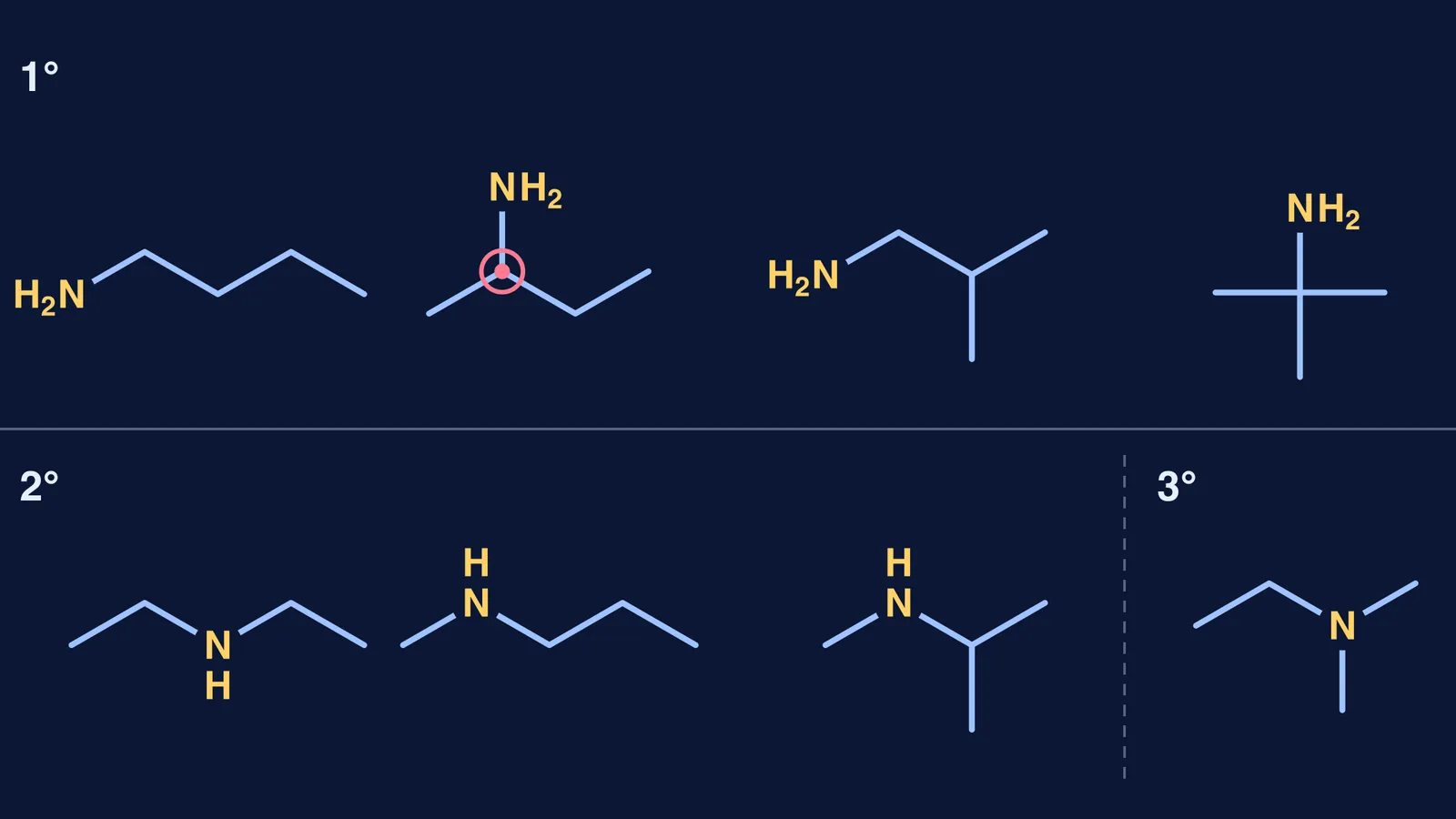
The formula C4H11N has no rings or double bonds (four carbons can hold at most 2 × 4 + 3 = 11 hydrogens with one nitrogen), so every isomer is a saturated amine. That gives eight structural isomers: four primary, three secondary and one tertiary. You can check each name against the PubChem list of C4H11N compounds. Its results include all eight under these IUPAC names, alongside isotope-labelled, charged and mixture entries that are not separate isomers.
A primary amine is RNH2, a secondary amine is R2NH and a tertiary amine is R3N: the label counts the carbon groups on nitrogen, as the OpenStax Organic Chemistry section on naming amines defines it. The same section notes that this is not how alcohols and alkyl halides are classified, where "tertiary" refers to the carbon atom, not the nitrogen.
What are the four primary amines of C4H11N?
Each primary amine is a butyl group joined to NH2, so there is one per butyl group:
Butan-1-amine, CH3CH2CH2CH2NH2 (n-butylamine), PubChem CID 8007
Butan-2-amine, CH3CH2CH(NH2)CH3 (sec-butylamine), PubChem CID 24874
2-Methylpropan-1-amine, (CH3)2CHCH2NH2 (isobutylamine), PubChem CID 6558
2-Methylpropan-2-amine, (CH3)3CNH2 (tert-butylamine), PubChem CID 6385
These are the same four carbon skeletons you meet in the four structural isomers of C4H9Cl, with NH2 in place of Cl.
What are the secondary and tertiary amines of C4H11N?
The secondary amines split the four carbons into two groups on nitrogen, and the tertiary amine splits them into three:
N-Ethylethanamine, CH3CH2NHCH2CH3 (diethylamine), secondary, PubChem CID 8021
N-Methylpropan-1-amine, CH3NHCH2CH2CH3, secondary, PubChem CID 12315
N-Methylpropan-2-amine, CH3NHCH(CH3)2, secondary, PubChem CID 78485
N,N-Dimethylethanamine, (CH3)2NCH2CH3, tertiary, PubChem CID 11723
In the IUPAC names, the longest carbon chain on nitrogen becomes the parent amine and the smaller groups get an N- prefix. If that rule is shaky, the guide to naming primary, secondary and tertiary amines walks through it.
Which C4H11N amine is chiral?
Only butan-2-amine has a chiral carbon. Carbon 2 carries four different groups: H, CH3, C2H5 and NH2. PubChem lists the two enantiomers as separate compounds, (R)-butan-2-amine and (S)-butan-2-amine. So the answer is eight structural isomers, or nine if the question asks you to count stereoisomers too. Read the question carefully for that word.
What about N-methylpropan-1-amine, whose nitrogen holds H, CH3, a propyl group and a lone pair? Its two mirror-image forms cannot usually be separated. OpenStax explains that amines flip through a planar shape in a pyramidal inversion. The energy barrier is about 25 kJ/mol, low enough that the two forms rapidly interconvert.
A counting method that never misses an isomer
Think of it as sharing four carbons among at most three groups on nitrogen. There are only four ways to split 4:
4 → one butyl group. There are 4 butyl groups, so 4 primary amines.
3 + 1 → propyl or isopropyl, plus methyl. That gives 2 secondary amines.
2 + 2 → two ethyl groups. That gives 1 secondary amine.
2 + 1 + 1 → ethyl, methyl, methyl. That gives 1 tertiary amine.
Add them up: 4 + 2 + 1 + 1 = 8. A split like 1 + 1 + 1 + 1 is impossible, because nitrogen can only hold three groups. Use the same split for any amine formula. For C3H9N, 3, 2 + 1 and 1 + 1 + 1 give 2 + 1 + 1 = 4 amines.
Before you hand in an answer, run this check:
Did every structure have exactly 4 carbons and 1 nitrogen?
Is any structure a duplicate drawn differently? Name each one; two identical names mean a repeat.
Did you classify by groups on nitrogen, not by the carbon?
Did you mark the chiral carbon in butan-2-amine?
If you got the count wrong because you started drawing without a system, the step-by-step solver in the Fermi Problem Library explains the reasoning behind each step rather than just printing an answer. If classification itself is the gap, the Fermi Concept Library gives each chemistry concept its own lesson and its place in the map.
Once you can draw all eight, a common next question is how to tell them apart in the lab. Hinsberg's reagent for separating 1°, 2° and 3° amines is the test to learn next.


