

On this page
How do you find all structural isomers of C4H9Cl?
When finding all structural isomers of a haloalkane, first determine its degree of unsaturation, also known as the index of hydrogen deficiency. For a monohaloalkane with molecular formula CₙH₂ₙ₊₁X, replacing the halogen with a hydrogen atom gives the saturated parent alkane CₙH₂ₙ₊₂. For C4H9Cl, replacing chlorine gives butane (C4H10), confirming zero double bonds and zero rings. According to the IUPAC Compendium of Chemical Terminology, constitutional isomers are compounds sharing the same molecular formula whose atoms differ in connectivity.
Because the degree of unsaturation is zero, all structural isomers must be open-chain haloalkanes. You can enumerate them systematically in two steps:
Draw all unique parent carbon skeletons for four carbon atoms: straight-chain butane and branched 2-methylpropane (commonly known as isobutane).
Attach a chlorine atom at each chemically non-equivalent carbon position.
On the straight-chain butane skeleton (C1-C2-C3-C4), positions C1 and C4 are chemically equivalent, while positions C2 and C3 are chemically equivalent. Substituting chlorine at C1 yields 1-chlorobutane; substituting at C2 yields 2-chlorobutane. On 2-methylpropane, the three methyl carbons are equivalent, while the central tertiary carbon is unique. Substituting at an outer methyl carbon gives 1-chloro-2-methylpropane, while substituting at the central carbon gives 2-chloro-2-methylpropane. This produces exactly four structural isomers.
What are the IUPAC names and structures of the four butyl chlorides?
As outlined in NCERT Class 12 Chemistry, the four butyl chlorides are classified by the degree of substitution of the carbon atom attached directly to chlorine:
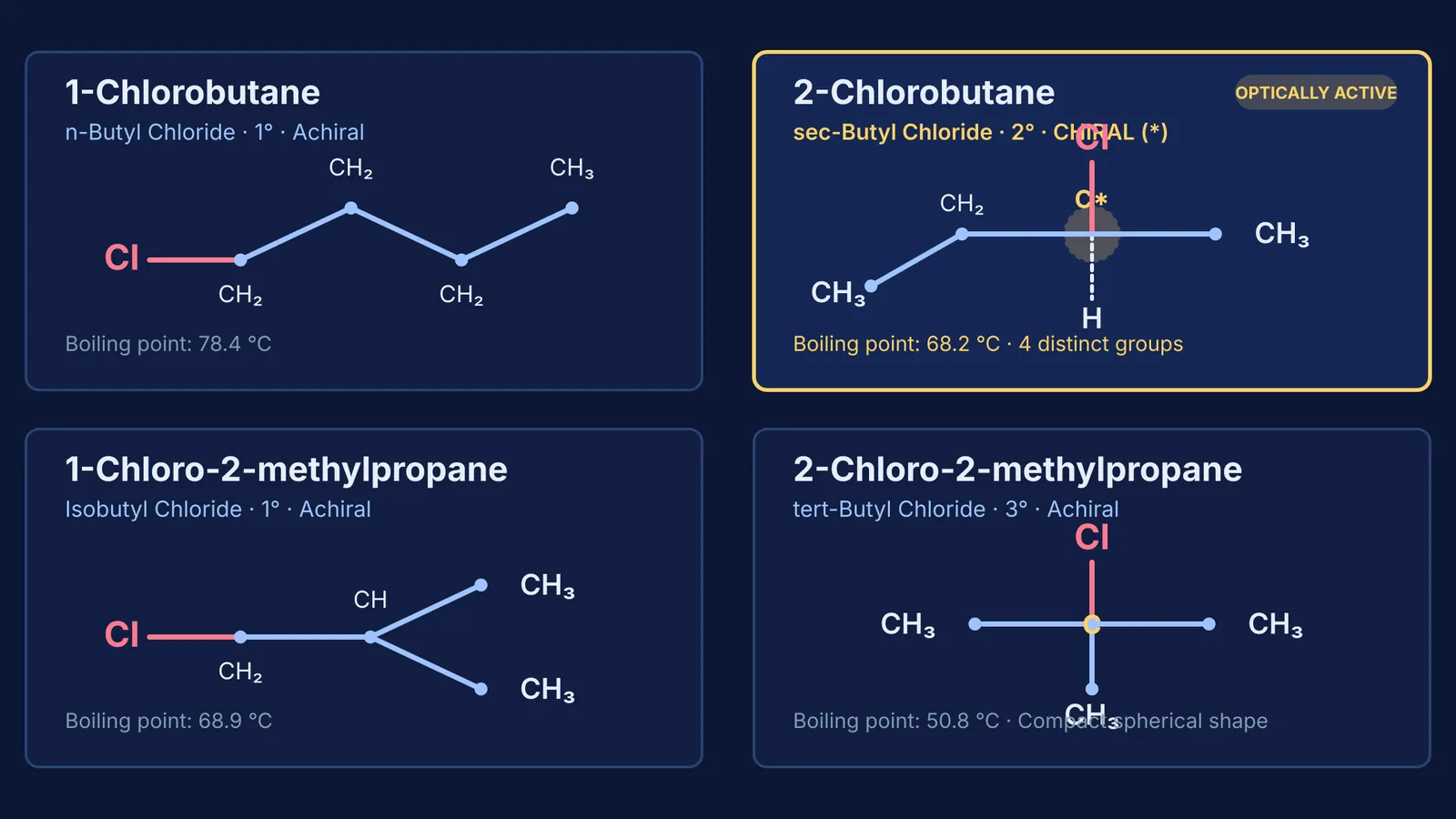
1-Chlorobutane (n-butyl chloride): CH3-CH2-CH2-CH2-Cl, a primary (1°) alkyl halide.
2-Chlorobutane (sec-butyl chloride): CH3-CH2-CH(Cl)-CH3, a secondary (2°) alkyl halide.
1-Chloro-2-methylpropane (isobutyl chloride): (CH3)2CH-CH2-Cl, a primary (1°) alkyl halide with a branched skeleton.
2-Chloro-2-methylpropane (tert-butyl chloride): (CH3)3C-Cl, a tertiary (3°) alkyl halide.
This structural variety mirrors the pattern observed when distinguishing the isomers of C4H10O, where four isomeric alcohols share these exact carbon skeletons.
Why is 2-chlorobutane the only chiral isomer?
Under the IUPAC definition of chirality, an object or molecule is chiral if it cannot be superimposed onto its mirror image. In their historical analysis of the tetrahedral carbon atom, Ramberg and Somsen (2001) highlight how Jacobus Henricus van 't Hoff established in 1874 that optical activity arises when four distinct groups bind to a central carbon at 109.5° angles.
Evaluating the four butyl chlorides reveals why three of them are achiral:
In 1-chlorobutane, carbon-1 is bonded to two identical hydrogen atoms.
In 1-chloro-2-methylpropane, carbon-1 carries two hydrogens, and carbon-2 carries two identical methyl groups.
In 2-chloro-2-methylpropane, the central tertiary carbon carries three identical methyl groups.
In 2-chlorobutane, carbon-2 is bonded to four distinct substituents: a chlorine atom (-Cl), a hydrogen atom (-H), a methyl group (-CH3), and an ethyl group (-CH2CH3).
Because carbon-2 lacks any internal plane or inversion centre of symmetry, it forms an asymmetric stereocentre. As detailed in the IUPAC Gold Book for enantiomers, 2-chlorobutane exists as two non-superimposable mirror-image forms: (2R)-2-chlorobutane and (2S)-2-chlorobutane. These enantiomers rotate plane-polarized light in equal and opposite directions. When stereoisomers are included, C4H9Cl has five isomers in total: three achiral constitutional isomers plus the two enantiomeric forms of 2-chlorobutane. For more practice identifying asymmetric carbons, see our guide on counting stereoisomers from chiral centres.
How does branching affect the physical and chemical properties of butyl chlorides?
The physical properties of the butyl chlorides reflect their molecular shape. According to data from the NIST Chemistry WebBook for 1-chlorobutane, unbranched 1-chlorobutane boils at 78.4 °C. The NIST entry for 2-chlorobutane records a lower boiling point of 68.2 °C, while isobutyl chloride boils at 68.9 °C. The highly compact tert-butyl chloride boils at approximately 50.8 °C. Branching makes the molecule more spherical, reducing its surface contact area, weakening London dispersion forces, and depressing the boiling point.
Branching also governs chemical reactivity. As detailed in our overview of SN1 and SN2 mechanisms in haloalkanes, unhindered 1-chlorobutane undergoes nucleophilic substitution almost entirely via the bimolecular SN2 pathway. In contrast, steric crowding prevents backside attack in tert-butyl chloride, driving it to react via unimolecular SN1 ionization through a stable tertiary carbocation intermediate.
How can you systematically solve isomer problems in exams?
To answer haloalkane isomer questions reliably under timed exam conditions:
Compute the degree of unsaturation to verify rings and pi bonds.
Map all unique parent carbon skeletons before attaching halogens.
Test each non-equivalent carbon for halogen placement, naming each structure to avoid duplicates.
Screen every carbon atom in each constitutional isomer for four different substituents to tally stereocentres.
Students often confuse constitutional connectivity with stereoisomerism or misidentify symmetry on skeletal formulas. The Fermi Problem Library has worked problems with a step-by-step solver that explains the reasoning rather than printing an answer, walking through molecular symmetry and isomer counting. For mastering three-dimensional configurations and stereochemical projections, the Fermi Concept Library covers every concept in physics, chemistry, biology, mathematics and computing, each with its own lesson and its place in the map.


