On this page
Distil the oil from coriander (dhania) seed and most of what you collect is one molecule: linalool. It is also a tidy exam molecule: one stereocentre, two enantiomers (PubChem lists the (S)-(+) form as "coriandrol"), and a tertiary allylic OH that reacts at once in the Lucas test. Here is how to name it, label its stereocentre, and turn a polarimeter reading into enantiomeric excess.
What is linalool's IUPAC name?
PubChem's linalool record gives the formula C₁₀H₁₈O and the name 3,7-dimethylocta-1,6-dien-3-ol. Build it in four steps.
The longest chain holding the C–OH carbon and both C=C bonds has eight carbons: "octa".
Number from the vinyl end, which puts OH on C3 rather than C6.
The double bonds start at C1 and C6: "octa-1,6-dien".
Methyls sit on C3 and C7: "3,7-dimethyl". The suffix "-3-ol" goes last.
C3 carries four different groups, OH, CH=CH₂, CH₃ and CH₂CH₂CH=C(CH₃)₂, so it is the only stereocentre. Neither C=C shows geometrical isomerism: C1 has two H atoms and C7 two methyls.
How do you assign R or S to linalool's stereocentre?
Rank the groups on C3 by the Cahn–Ingold–Prelog rules.
OH. Oxygen has the highest atomic number, so OH is priority 1.
CH=CH₂ against CH₂CH₂CH=C(CH₃)₂. Both attach through carbon, so the first atoms tie. Now list what each of those carbons carries. The vinyl carbon has a double bond, which counts as a duplicated carbon, so its set is (C, C, H). The CH₂ of the long chain carries (C, H, H). At the first point of difference C beats H. Vinyl is priority 2 and the long chain is priority 3.
CH₃. Its set is (H, H, H), so it is priority 4.
The trap is to rank the long chain higher because it is bigger. CIP stops at the first point of difference, so size further out never matters.
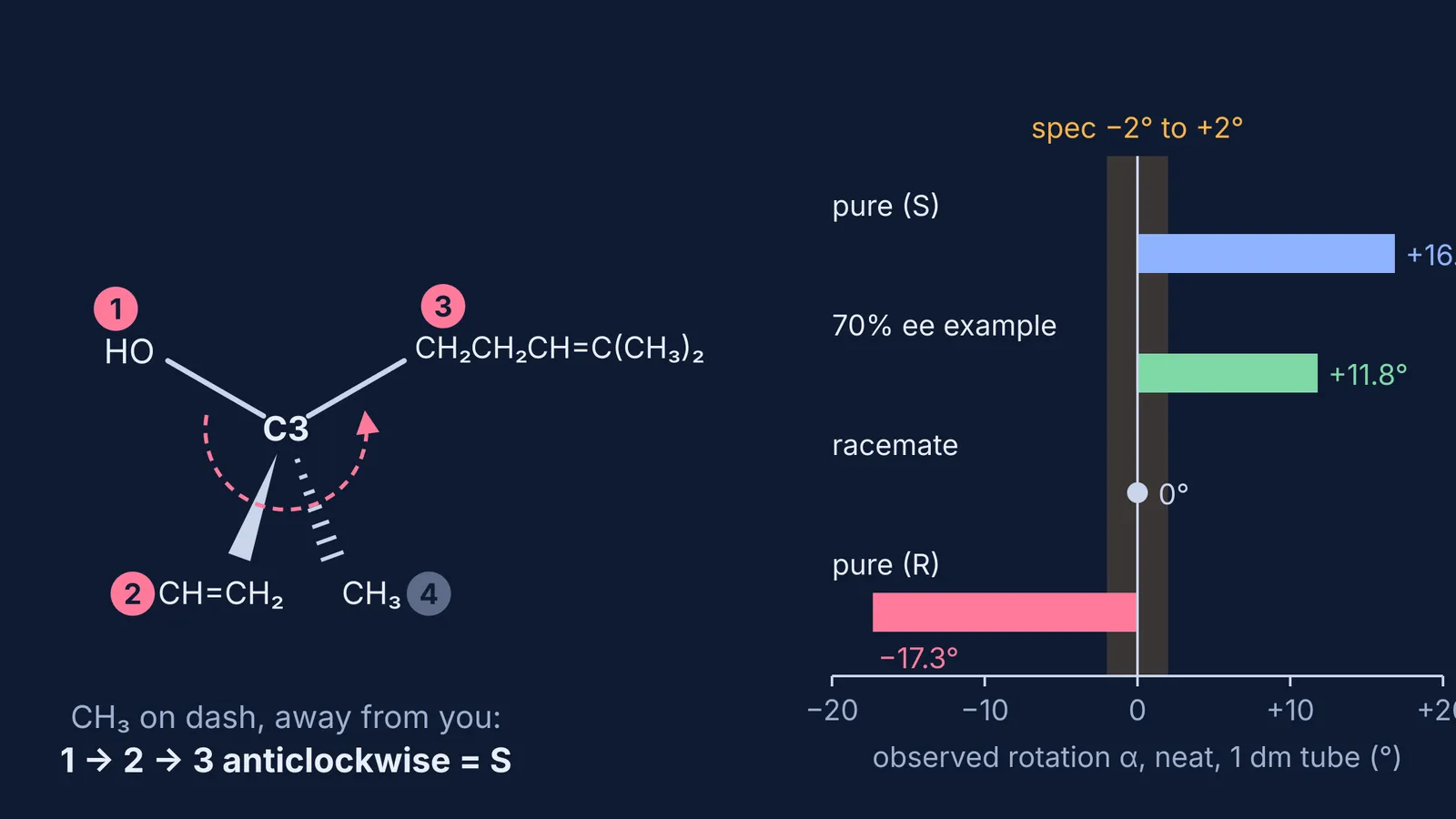
Now look at the drawing at the top of this post. CH₃ is on the dashed bond, pointing away from you. Trace OH (1) → CH=CH₂ (2) → chain (3). The path runs anticlockwise, so this enantiomer is S. PubChem's (S)-linalool record names it (3S)-3,7-dimethylocta-1,6-dien-3-ol and lists "(S)-(+)-linalool" and "coriandrol" among its synonyms. Its mirror image is (R)-(−)-linalool.
S comes from ranking rules; + comes from a polarimeter. One does not predict the other, as our post on D/L, R/S and (+)/(−) labels explains.
Which linalool does coriander make, and how much does it rotate light?
The Hazardous Substances Data Bank (HSDB) notes on PubChem's linalool page list coriander among natural sources of the d-form, as "coriander (60–70%)". Read that carefully. The 60–70% is how much of the oil is d-linalool. It is not the enantiomeric purity. We did not find a measured ee for coriander linalool, so the worked example below uses an invented reading.
The same HSDB notes give:
d-linalool: specific rotation +19.3° at 20 °C (sodium D line), density 0.8733 g/mL.
l-linalool: specific rotation −20.1° at 20 °C.
Commercial linalool: "angular rotation: −2 deg to +2 deg".
Pure enantiomers rotate by equal amounts in opposite directions, so the gap between 19.3 and 20.1 most likely reflects sample purity. Treat both as approximate.
HSDB adds that linalool can be made from myrcene, which is achiral. Without a chiral reagent or catalyst, that route gives a racemate, which reads 0°.
Worked example: from a polarimeter reading to ee
For a neat liquid, specific rotation is [α] = α ÷ (l × d), with l in decimetres and d in g/mL.
Question. Linalool distilled from a coriander oil is placed neat in a 1 dm tube at 20 °C and reads α = +11.8°. Take d = 0.8733 g/mL and [α] = +19.3° for the pure (S) enantiomer. Find the ee and the percentage of each enantiomer.
Specific rotation of the sample: [α] = 11.8 ÷ (1 × 0.8733) = +13.5°.
Optical purity = 13.5 ÷ 19.3 × 100 = 70%, so ee = 70%.
The sign is +, so the (S) enantiomer is in excess.
% (S) = (100 + 70) ÷ 2 = 85%, and % (R) = (100 − 70) ÷ 2 = 15%.
Sense check: pure (S)-linalool in the same tube would read 19.3 × 1 × 0.8733 = +16.9°, and a racemate would read 0°. The sample's +11.8° sits between them, as it must.
Using 20.1° as the reference gives about 67%, so say which value you used. If the formulas are new, our guide to enantiomeric excess and specific rotation builds them from scratch.
Now compare the commercial specification. It does not state the tube length, but if the reading were taken neat in a 1 dm tube, 2° would mean |[α]| ≤ 2 ÷ 0.8733 = 2.3°, an ee of about 12% at most. That is close to racemic, while +11.8° clearly is not. This is how a polarimeter tells a racemic linalool from an enantiomer-rich one.
How much linalool is in coriander seed?
A 2023 review in Molecules on coriander essential oil gives seed oil yields of 0.18–1.40% (v/w) across studies. Its table of varieties lists four from India:
Sudha: 0.32% oil, 85.3% linalool
Sindhu: 0.32% oil, 81.3% linalool
Sadhna: 0.29% oil, 79.2% linalool
Swathi: 0.34% oil, 73.2% linalool
Turkish varieties in the same table reach 91.77%. GC percentages are peak areas, close to but not the same as mass percentages.
A quick estimate for 1 kg of Sudha seed, treating both figures as mass percentages:
Oil = 1000 g × 0.32 ÷ 100 = 3.2 g.
Linalool = 3.2 g × 0.853 = 2.7 g.
Roughly 2.7 g of linalool per kilogram of seed.
What does the Lucas test show for linalool?
Linalool's OH sits on a carbon bonded to three other carbons, so it is a tertiary alcohol. That carbon is also next to a C=C, so the alcohol is allylic as well. Lucas reagent (concentrated HCl with anhydrous ZnCl₂) reacts by an SN1 path through a carbocation. That cation is tertiary and allylic, so expect immediate turbidity at room temperature.
C₁₀H₁₇OH + HCl → C₁₀H₁₇Cl + H₂O (anhydrous ZnCl₂)
Each side has 10 C, 19 H, 1 O and 1 Cl.
Two caveats. The allylic cation shares its positive charge between C3 and C1, so chloride can attach at either end, giving a mixture of chlorides; the cloudiness looks the same. And the test is meant for small alcohols that dissolve in the reagent first. HSDB calls linalool practically insoluble in water, so some cloudiness may simply be undissolved alcohol. Our post on the Lucas test for primary, secondary and tertiary alcohols covers the timings and this limitation.
For more R/S, ee and Lucas test questions in the JEE pattern, try Fermi Test Prep for JEE Main and Advanced preparation, with an AI tutor.
Quick checklist
Linalool is 3,7-dimethylocta-1,6-dien-3-ol, C₁₀H₁₈O, with one stereocentre at C3.
CIP order at C3: OH > CH=CH₂ > CH₂CH₂CH=C(CH₃)₂ > CH₃.
(S)-linalool is the (+) enantiomer, also called coriandrol.
HSDB values: d-form +19.3°, l-form −20.1°. Treat both as approximate.
For a neat liquid, [α] = α ÷ (l × d). Then ee = [α] sample ÷ [α] pure × 100.
Linalool is tertiary and allylic, so Lucas reagent turns turbid at once.