

On this page
You have three colourless liquids, the labels are gone, and the question is a Class 12 chemistry classic: which one is the primary alcohol, which is secondary and which is tertiary? Two quick tests settle it. The Lucas test sorts alcohols by how fast they turn cloudy, and oxidation sorts them by what they become.
How does the Lucas test distinguish primary, secondary and tertiary alcohols?
Lucas reagent is concentrated hydrochloric acid with anhydrous zinc chloride. The NCERT Class 12 chemistry textbook, Unit 7 explains that alcohols dissolve in the reagent but the alkyl chlorides they form do not, so the solution turns turbid. The chemist Howard J. Lucas described the test in the Journal of the American Chemical Society in 1930.
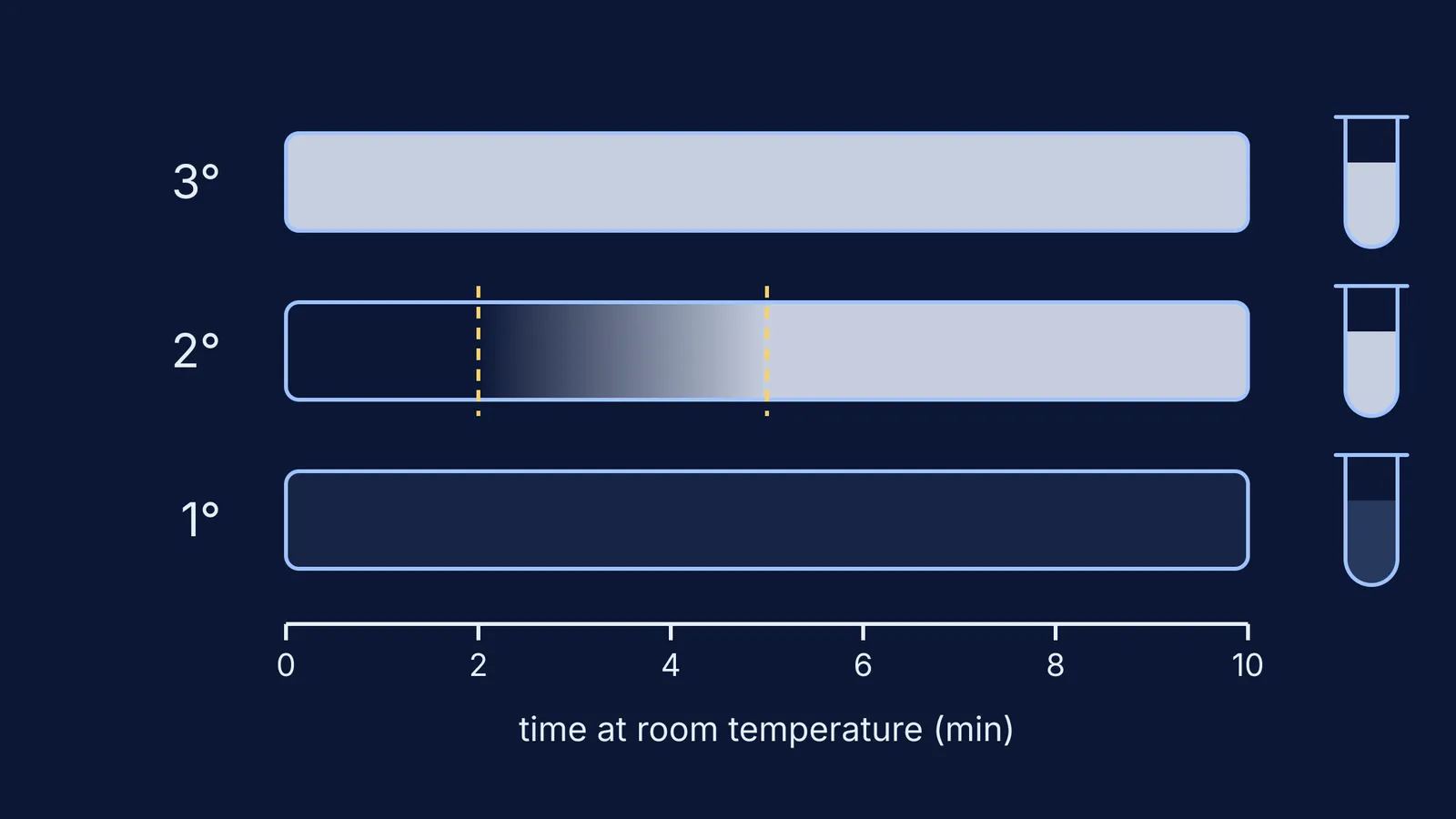
Here are the timings at room temperature:
Tertiary (3°): turbid immediately, as NCERT states.
Secondary (2°): cloudy, or a separate layer, after 2 to 5 minutes, according to this Utah Tech University lab handout on chemical tests. The Wikipedia article on Lucas' reagent puts it at "within five or so minutes".
Primary (1°): no turbidity at room temperature (NCERT). Wikipedia adds that an oily layer may form on heating.
Why that order? The reaction goes through a carbocation, by an SN1 path, as the Utah Tech handout notes. In its section on dehydration, NCERT says tertiary carbocations are more stable, so they form more easily than secondary and primary ones. The faster the carbocation forms, the sooner the alkyl chloride appears and the solution clouds.
What does oxidation give for each class of alcohol?
Oxidation is your second check. It matters most when the Lucas test leaves a sample that simply stays clear. From the same NCERT unit:
Primary: oxidised to an aldehyde, then to a carboxylic acid. Acidified KMnO₄ takes it straight to the acid. CrO₃ in an anhydrous medium, or PCC, stops at the aldehyde.
Secondary: oxidised to a ketone by CrO₃.
Tertiary: does not undergo oxidation. Under strong conditions (KMnO₄ at high temperature) C–C bonds break and you get a mixture of acids with fewer carbon atoms.
NCERT also gives a second classic test. Pass the alcohol's vapour over copper heated to 573 K: a primary alcohol gives an aldehyde, a secondary alcohol gives a ketone, and a tertiary alcohol is dehydrated to an alkene.
In the Jones test described in the Utah Tech handout, the orange chromium(VI) reagent gives a blue-green precipitate within 10 seconds with primary and secondary alcohols, while a tertiary alcohol leaves it orange. Our explainer on the acidified potassium dichromate test for alcohols covers the same orange-to-green change in school-lab terms.
How do you write the Lucas test observation in a board answer?
A complete "distinguish between" answer has four parts: the test, what you see in each compound, what that tells you, and an equation. Use the timings from NCERT Unit 7 and the Utah Tech handout, and write the two observations side by side so the difference is obvious.
Worked example: distinguish between butan-2-ol and 2-methylpropan-2-ol.
Test: Add Lucas reagent (conc. HCl + anhydrous ZnCl₂) to each sample separately at room temperature and shake.
Observation: 2-methylpropan-2-ol turns turbid immediately. Butan-2-ol turns turbid only after 2 to 5 minutes.
Inference: 2-methylpropan-2-ol is a tertiary alcohol and butan-2-ol is a secondary alcohol.
Equation: (CH₃)₃C–OH + HCl → (CH₃)₃C–Cl + H₂O, with anhydrous ZnCl₂ written over the arrow.
The same frame works for butan-1-ol and butan-2-ol: butan-2-ol turns turbid after 2 to 5 minutes, while butan-1-ol shows no turbidity at room temperature. If common names trip you up, our guide to what iso, neo, sec and tert mean in organic names shows which carbon carries the OH group.
Three slips that cost marks:
Writing "precipitate" instead of turbidity.
Leaving out "at room temperature", which is what makes the primary result negative.
Giving the observation for only one of the two compounds.
When can the Lucas test mislead you?
The alcohol has to dissolve in the reagent first. The Utah Tech handout warns that the test does not work well on solid alcohols, that compounds with several functional groups may give unusual results, and that phenols do not react. It also notes that benzylic and allylic alcohols turn cloudy almost immediately, just like tertiary ones. So a fast result alone does not prove an alcohol is tertiary. To confirm there is an OH group at all before you classify it, see the ceric ammonium nitrate test for alcohols.
To practise more "distinguish between" pairs, the Fermi Problem Library has worked problems with a step-by-step solver that explains the reasoning rather than just printing an answer. If carbocation stability is the real gap, the Fermi Concept Library gives each chemistry concept its own lesson and shows where it fits on the map.


