

On this page
In organic chemistry, few naming conventions create more confusion on exam day than the prefixes *iso-*, *neo-*, *sec-*, and *tert-*. Students often recognize straight-chain alkanes easily, but when branched fragments attach to a parent chain or functional group, distinguishing one isomer from another can feel like guesswork. The key is understanding whether a prefix describes the overall shape of the carbon chain or the specific degree of the attaching carbon atom.
What do iso, neo, sec, and tert actually mean?
Common prefixes historically distinguished structural isomers of alkanes before systematic IUPAC nomenclature was finalized. Under the rules compiled by Henri A. Favre and Warren H. Powell in the IUPAC Blue Book (*Nomenclature of Organic Chemistry: IUPAC Recommendations and Preferred Names 2013*), these prefixes follow strict structural definitions:
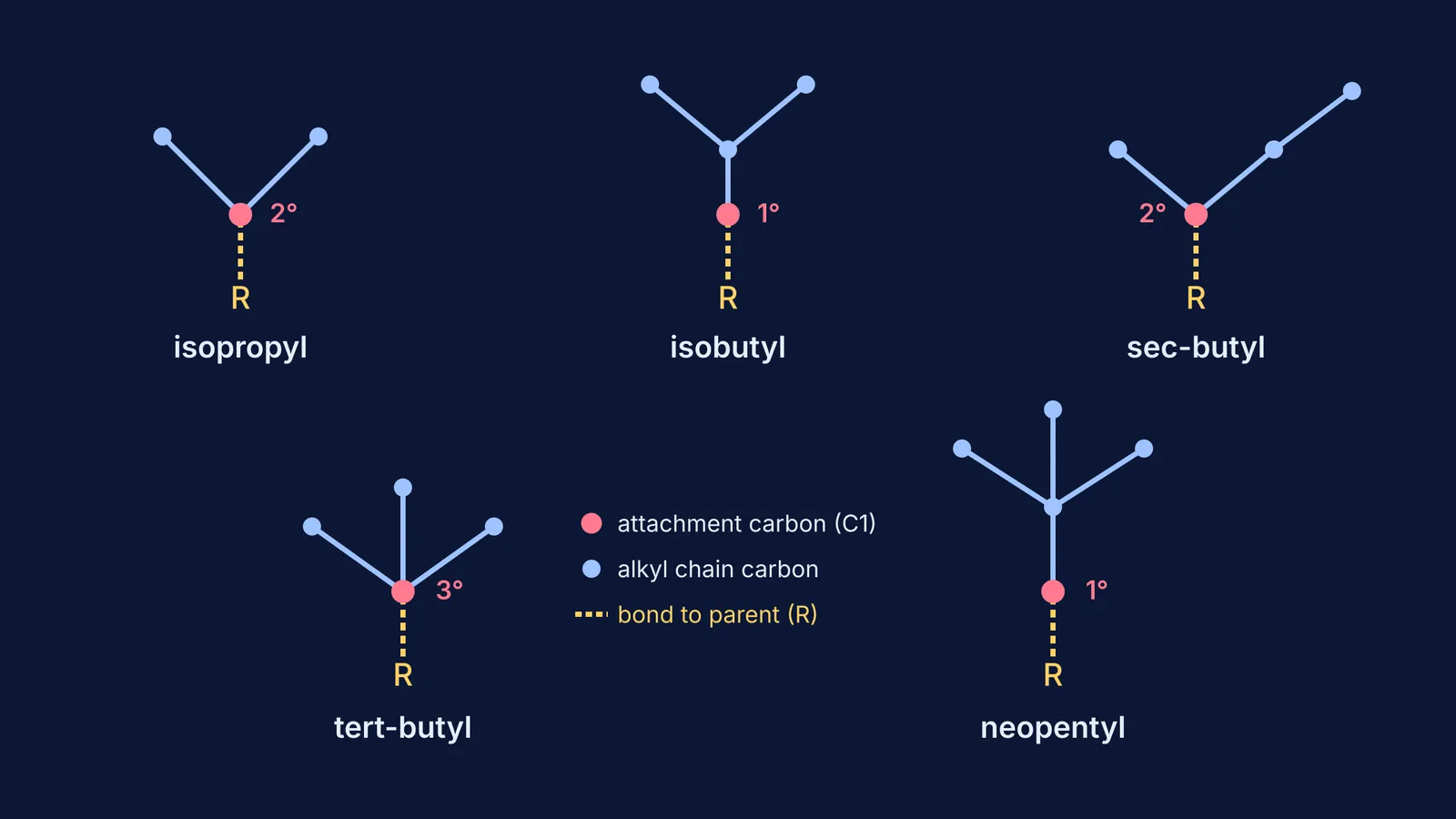
iso-: Describes a chain ending in a (CH₃)₂CH− group (a single methyl branch on the penultimate carbon) with no other branches. In isopropyl, (CH₃)₂CH−, the attachment is at the branched carbon. In isobutyl, (CH₃)₂CHCH₂−, the attachment is at the primary −CH₂− carbon.
neo-: Describes a chain ending in a (CH₃)₃C− group (two methyl branches on the penultimate carbon). Because *neo-* requires a central carbon bonded to three methyl groups and an attaching carbon, it requires at least 5 carbons, as in neopentyl, (CH₃)₃CCH₂−.
sec- (secondary): Specifies that the attachment point to the parent chain is a secondary (2°) carbon bonded to two other carbons. This prefix is unambiguous only for 4 carbons: sec-butyl, CH₃CH₂CH(CH₃)−.
tert- (tertiary): Specifies that the attachment point is a tertiary (3°) carbon bonded to three other carbons, as seen in tert-butyl, (CH₃)₃C−.
The Fermi Concept Library covers every concept in chemistry, giving each topic its own lesson and place in the map to connect isomerism with reaction mechanisms.
How do you convert common alkyl groups to systematic IUPAC names?
When converting common names to systematic IUPAC substituents, follow the core numbering rule codified in IUPAC Rule P-29 (IUPAC Blue Book Chapter P-2) and taught in the NCERT Class 11 Chemistry curriculum: the carbon atom directly bonded to the parent chain is always designated as carbon 1 (C1). Number the longest continuous chain starting from C1:
Isopropyl, (CH₃)₂CH−: C1 is the attaching −CH− group. The longest chain from C1 has 2 carbons (ethyl) with a methyl at C1, giving (1-methylethyl). Under modern IUPAC Blue Book Chapter P-5 rules, its Preferred IUPAC Name (PIN) is propan-2-yl.
Isobutyl, (CH₃)₂CHCH₂−: C1 is the attaching −CH₂− group. The longest chain from C1 has 3 carbons with a methyl at carbon 2, giving (2-methylpropyl). Its IUPAC PIN is 2-methylpropyl.
sec-Butyl, CH₃CH₂CH(CH₃)−: C1 is the attaching −CH− group. The longest chain from C1 has 3 carbons with a methyl at carbon 1, giving (1-methylpropyl). Its IUPAC PIN is butan-2-yl.
tert-Butyl, (CH₃)₃C−: C1 is the central carbon. The longest chain from C1 has 2 carbons with two methyl groups at carbon 1, giving (1,1-dimethylethyl). Under IUPAC rule P-57.1.2, tert-butyl is also retained as a PIN.
Neopentyl, (CH₃)₃CCH₂−: C1 is the attaching −CH₂− group. The longest chain from C1 has 3 carbons with two methyl groups at carbon 2, giving (2,2-dimethylpropyl). Its IUPAC PIN is 2,2-dimethylpropyl.
This builds on earlier rules for naming carbon compounds in Class 10 and identifying C4H10O isomers.
Why are sec- and tert- ignored during alphabetical ordering?
In multi-substituent IUPAC names, ordering prefixes incorrectly is a frequent source of lost marks:
iso- and neo- count: Because they describe structural shape as part of an unhyphenated word, they are alphabetized under i and n (e.g., isopropyl under i, neopentyl under n).
sec- and tert- are ignored: Because they describe attachment position, they are hyphenated, italicized, and ignored during alphabetization. Both sec-butyl and tert-butyl are alphabetized under b for butyl.
Systematic names in parentheses: If you write substituents as systematic names in parentheses, such as (1-methylethyl) or (1,1-dimethylethyl), you alphabetize by the very first letter inside the parentheses: (1,1-dimethylethyl) under d and (1-methylethyl) under m.
Reviewing the structural isomers of butane reinforces why butane yields two distinct butyl groups with straight skeletons and two with branched skeletons.
How do these prefixes appear in exam questions?
Examiners test these prefixes by pairing nomenclature with reaction behavior:
Alphabetical ordering in alkanes: In 4-tert-butyl-5-isopropyloctane, tert-butyl (alphabetized under b) precedes isopropyl (alphabetized under i). Because numbering from either end yields the identical locant set (4, 5), IUPAC seniority rules assign the lower locant 4 to the alphabetically prior tert-butyl group. When written systematically as 4-(1,1-dimethylethyl)-5-(1-methylethyl)octane, the "d" in dimethylethyl still precedes the "m" in methylethyl, maintaining the same locants.
Classification of alcohols and halides: A common misconception is assuming that all isobutyl compounds are secondary or tertiary species. Isobutyl alcohol, (CH₃)₂CHCH₂OH, has its −OH group on a 1° carbon, making it a primary alcohol. In contrast, sec-butyl alcohol is secondary (2°), and tert-butyl alcohol is tertiary (3°).
When practicing organic nomenclature, having a step-by-step breakdown makes spotting these subtle traps straightforward. The Fermi Problem Library provides worked problems with a step-by-step solver that explains the reasoning rather than printing an answer.


