

On this page
Testing for alcohols is a classic organic chemistry experiment and a common exam topic in papers like JEE Main and NEET-UG. When you add a few drops of an unknown alcohol to a solution of acidified potassium dichromate, the resulting colour tells you what type of alcohol you have in the test tube.
What is the acidified potassium dichromate test for alcohols?
The reagent for this test is potassium dichromate (K₂Cr₂O₇) mixed with a dilute acid, typically sulfuric acid. The active species that drives the test is the hexavalent chromium (Cr⁶⁺) in the dichromate ion, which has a bright orange colour.
When this orange solution reacts with an alcohol that can be oxidised, the hexavalent chromium is reduced to trivalent chromium (Cr³⁺) (Wikipedia). This trivalent chromium ion is green. If the alcohol cannot be oxidised by the dichromate, no reaction happens, and the solution stays orange. In a laboratory setting, the reaction is often carried out by gently warming the mixture in a water bath to ensure the reaction proceeds at a noticeable rate, making the colour change easier to observe.
What is the colour change for primary, secondary and tertiary alcohols?
The way an alcohol reacts with the orange dichromate solution depends entirely on where its hydroxyl (−OH) group is attached:
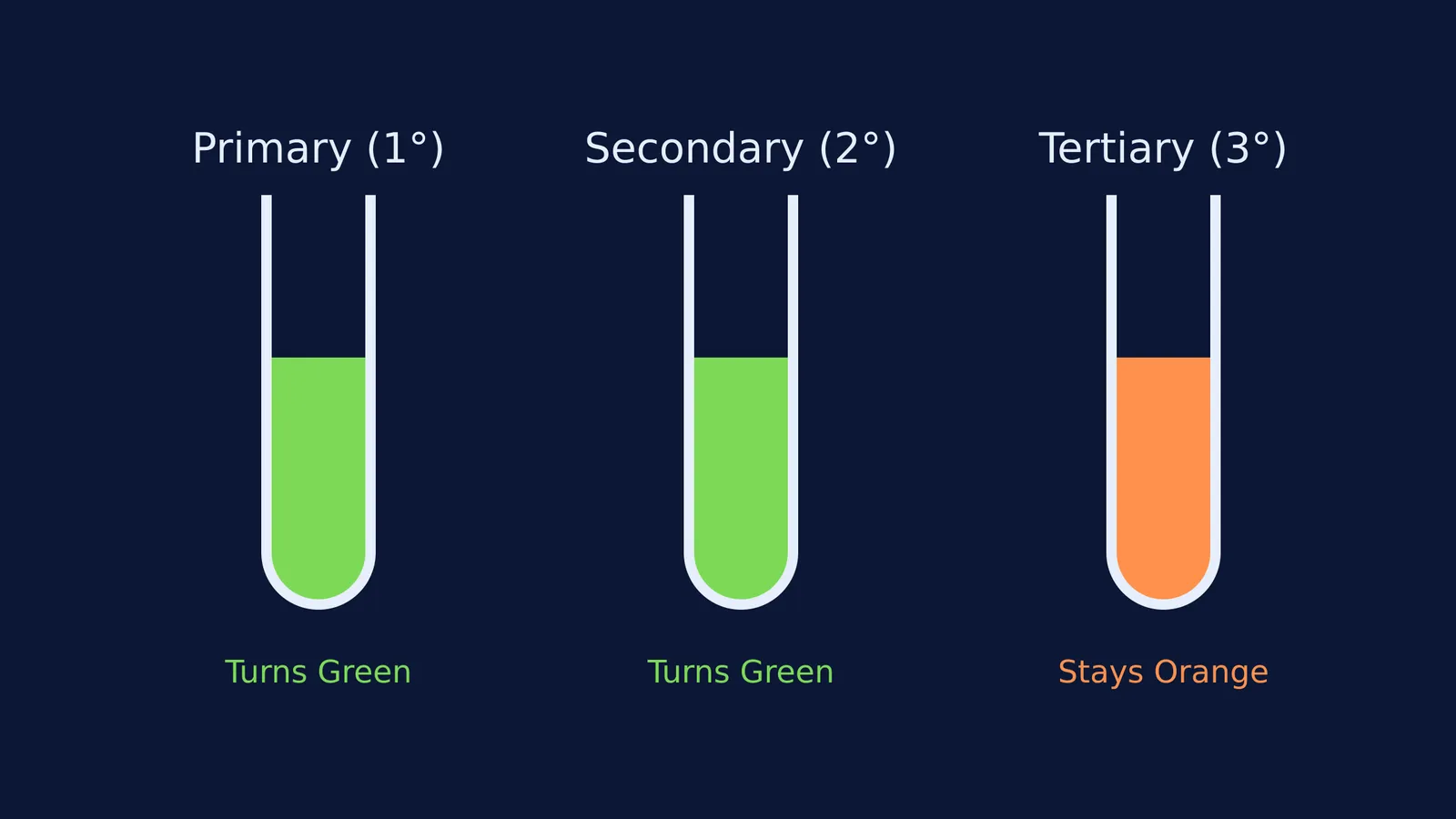
Primary (1°) alcohols: These are readily oxidised into aldehydes, and then further into carboxylic acids if heated under reflux. The orange dichromate is reduced, and the solution turns green.
Secondary (2°) alcohols: These are oxidised into ketones, which resist any further oxidation. The orange dichromate is reduced, and the solution turns green.
Tertiary (3°) alcohols: These cannot be oxidised by potassium dichromate. No reaction occurs, and the solution remains orange.
While this test quickly separates tertiary alcohols from the rest, it cannot tell a primary alcohol from a secondary one on its own. For that, you need to test the product with Tollens' reagent or Fehling's solution, or use a different method entirely like the Lucas test.
Why do tertiary alcohols fail the test?
The oxidation mechanism relies on removing a hydrogen atom from the carbon bonded to the hydroxyl group.
In primary and secondary alcohols, this carbon has at least one hydrogen atom attached to it, allowing the oxidation to proceed. In a tertiary alcohol, the carbon bonded to the −OH group is attached to three other carbon atoms and has no hydrogen to lose. To oxidise a tertiary alcohol, the reagent would have to break strong carbon-carbon bonds, which potassium dichromate is not powerful enough to do under these conditions.
If you have a concept gap on how these structures differ, the Fermi Concept Library has every concept in chemistry, each with its own lesson and its place in the map.
How do you use this in exam problems?
Exam questions often ask you to identify a compound from a series of chemical tests. Here is a framework for how this appears in practice.
Imagine you are given three unlabelled bottles containing ethanol, propan-2-ol, and 2-methylpropan-2-ol. You add a few drops of acidified potassium dichromate to each and warm them gently in a water bath for a few minutes.
The ethanol (a primary alcohol) turns the orange solution green as it oxidises into ethanal and then ethanoic acid. This reaction happens readily and is widely tested.
The propan-2-ol (a secondary alcohol) turns the orange solution green as it oxidises into propanone. The reaction stops at the ketone stage.
The 2-methylpropan-2-ol (a tertiary alcohol) causes no change; the solution remains orange, confirming its structure.
If you often find yourself stuck on qualitative analysis questions, the Fermi Problem Library has worked problems with a step-by-step solver that explains the reasoning rather than printing an answer.


