

On this page
When you have an unknown organic compound in the lab, finding its functional group is the first step. For alcohols, the ceric ammonium nitrate (CAN) test is the standard qualitative check.
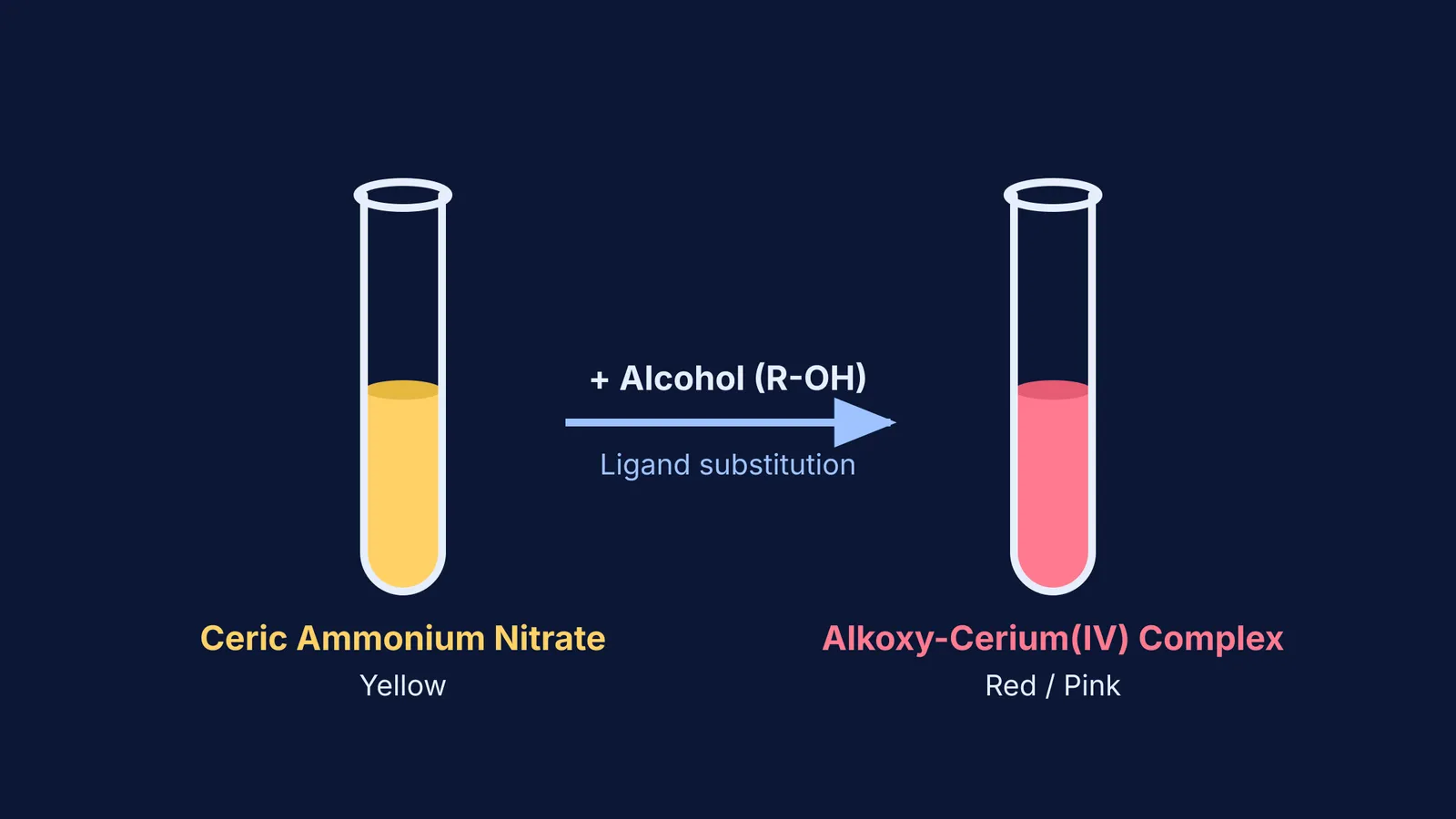
Ceric ammonium nitrate, (NH₄)₂[Ce(NO₃)₆], is a bright orange-yellow solid that dissolves in water to give a yellow solution. When you add a few drops of this reagent to an alcohol, the mixture turns a distinct red or pink. This rapid colour change confirms the presence of a hydroxyl (–OH) group attached to an alkyl chain, according to the NCERT Class 12 chemistry lab manual.
Why does the ceric ammonium nitrate test turn red?
The test relies on a ligand substitution reaction. In the CAN reagent, the cerium(IV) ion sits at the centre of a coordination complex, surrounded by six nitrate (NO₃⁻) ligands.
When an alcohol (R–OH) is introduced, the alcohol molecules displace one or more of the nitrate ions from the coordination sphere of the cerium ion. This forms an alkoxy-cerium(IV) complex. According to the eGyanKosh laboratory manual for qualitative analysis, the general reaction is:
[Ce(NO₃)₆]²⁻ + R–OH → [Ce(OR)(NO₃)₅]²⁻ + HNO₃
This new complex is what gives the solution its characteristic red colour. The intense colour arises from a phenomenon called ligand-to-metal charge transfer (LMCT). When light hits the complex, an electron briefly jumps from the oxygen atom of the alcohol ligand to the empty orbitals of the cerium(IV) ion. This absorbs certain wavelengths of light, causing the solution to reflect the deep red colour we see. The cerium ion remains in the +4 oxidation state during this initial substitution.
If you are trying to keep track of the different functional group tests in organic chemistry, the Fermi Concept Library places them in a clear map so you can see how they relate and why certain reagents are chosen.
How do you perform the test in the lab?
The NCERT Class 12 chemistry lab manual outlines a straightforward procedure for students:
Take about 1 mL of the organic compound in a clean, dry test tube. If the compound is a solid or does not dissolve easily in water, dissolve it in a little dioxane first.
Add a few drops of the yellow ceric ammonium nitrate reagent to the test tube.
Shake the test tube well to mix the solutions.
An immediate shift from yellow to a deep red or pink colour is a positive result for an alcohol.
What happens if the alcohol is not soluble in water?
Many organic compounds with longer carbon chains do not dissolve in water. If you try to mix a water-insoluble alcohol directly with the aqueous ceric ammonium nitrate reagent, the two liquids will form separate layers. The reaction will only happen slowly at the boundary between the layers, making the colour change hard to see.
To solve this, the NCERT lab manual recommends dissolving the unknown compound in dioxane. Dioxane is an organic solvent that mixes well with both water and alcohols, allowing the reagent and the alcohol to meet in a single, clear phase so the red colour appears instantly.
Does it work for all alcohols?
The CAN test is highly sensitive and works well for primary, secondary and tertiary alcohols. This makes it a reliable general test to confirm the presence of the –OH group. (Once you know you have an alcohol, you would typically follow up with the Lucas test to tell primary, secondary and tertiary alcohols apart).
However, phenols—compounds where the –OH group is attached directly to a benzene ring—also react with ceric ammonium nitrate. Instead of forming a clear red solution, phenols typically give a brown or black precipitate, or a very dark red colour. If you suspect your compound might be a phenol based on this dark colour, you would usually run a neutral ferric chloride test to confirm it.
When you are practising identifying compounds from a series of tests, the Fermi Problem Library breaks down organic chemistry logic step by step, explaining the reasoning behind each observation rather than just printing an answer.
How do you handle the reagent safely?
While the test is simple, ceric ammonium nitrate is a strong oxidising agent and can be corrosive. When performing the test, always wear safety goggles and a lab coat.
Skin contact: The reagent can irritate the skin. If you spill it, wash the area immediately with plenty of water.
Disposal: Because it contains heavy metal ions (cerium) and nitrates, the waste from this test should be placed in designated heavy-metal waste containers rather than poured down the sink.
For more on qualitative analysis, read about Tollens' and Fehling's tests for aldehydes, or see how to spot methyl ketones with the iodoform test.


