

On this page
What is the difference between D/L, R/S, and (+)/(−)?
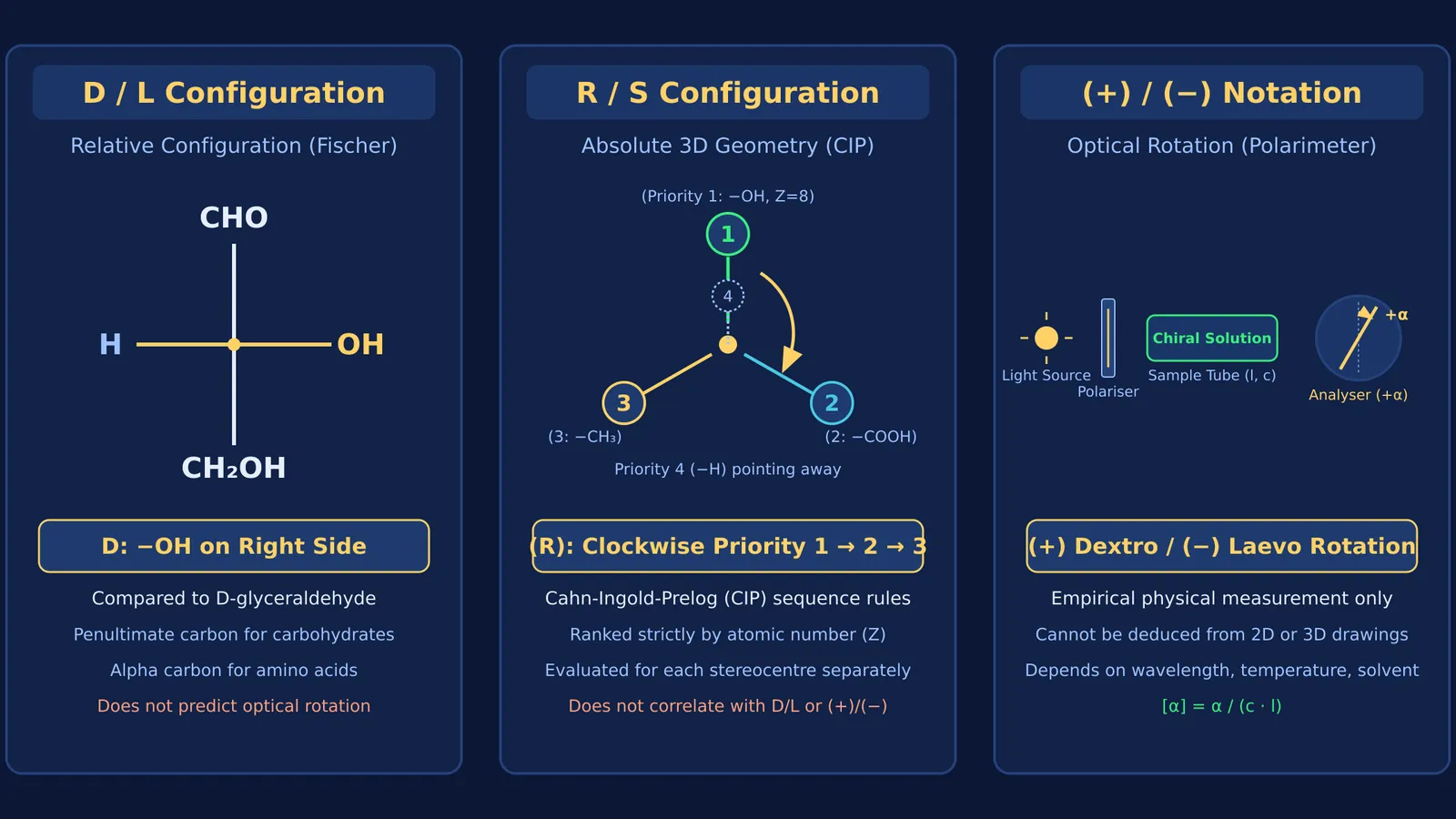
Many chemistry students assume that stereochemical prefixes are interchangeable translations of the same property—that a D-isomer must be (R) or rotate polarised light to the right (+). In reality, each notation answers a different question, as codified in the IUPAC stereochemical terminology recommendations compiled by G. P. Moss in 1996. The D/L system describes relative configuration by comparing a molecule's Fischer projection to glyceraldehyde. The R/S system defines absolute configuration by assigning spatial priority in three dimensions. The plus (+) and minus (−) signs record optical activity—an empirical physical property measured in a polarimeter.
In 1906, chemist Martin André Rosanoff published M. A. Rosanoff's classification of stereoisomers in the *Journal of the American Chemical Society*, establishing glyceraldehyde as the reference standard for carbohydrates. If a sugar's penultimate chiral centre placed its hydroxyl group on the right, it belonged to the D-series; if on the left, the L-series. In 1951, Johannes Martin Bijvoet used anomalous X-ray dispersion in J. M. Bijvoet's determination of absolute configuration on sodium rubidium tartrate, proving that Emil Fischer's original 50% arbitrary guess for D-glyceraldehyde's geometry was physically correct.
Why does D/L configuration not predict optical rotation?
The direction a molecule rotates plane-polarised light depends on the overall electronic environment across the structure, not simply which side one hydroxyl group occupies. According to NCERT Class 12 Chemistry textbooks prescribed for CBSE, JEE Main, and NEET-UG, optical rotation is designated strictly by (+) for dextrorotatory (clockwise) and (−) for laevorotatory (anti-clockwise) rotation, measured in a polarimeter.
A classic demonstration appears in simple hexoses. Naturally occurring D-glucose has an aqueous specific optical rotation of +52.5°, making it D-(+)-glucose. In contrast, naturally occurring D-fructose carries a specific optical rotation of −92.4°, making it D-(−)-fructose. Both belong to the D-series because their penultimate carbon (C-5) places the hydroxyl group on the right. Yet one turns light clockwise and the other counter-clockwise. You can explore how functional groups alter sugar behaviour in our guide to glucose open-chain and cyclic forms.
Furthermore, optical rotation can invert when conditions change, even while spatial configuration remains untouched. For instance, L-lactic acid is dextrorotatory (+) in aqueous solution, but converting it to its sodium salt in basic solution flips its optical rotation to levorotatory (−). When stereocentres feel difficult to visualise from flat paper, the Fermi Simulation Lab provides interactive simulations for the ideas that are easier to see than to read.
Why can an L-amino acid have an (R) absolute configuration?
To establish universal three-dimensional descriptors for any stereocentre, Robert Sidney Cahn, Christopher Kelk Ingold, and Vladimir Prelog published the Cahn-Ingold-Prelog specification of molecular chirality in 1966. Under CIP sequence rules, atoms bonded to a chiral centre are ranked by atomic number from highest (priority 1) to lowest (priority 4). Viewing the centre with priority 4 pointing away, a clockwise 1 → 2 → 3 progression yields (R) (Latin *rectus*, right), while a counter-clockwise progression yields (S) (Latin *sinister*, left).
Because D/L relies on analogy to glyceraldehyde while R/S relies on atomic numbers, structurally analogous biomolecules can receive opposite labels. In a Fischer projection with the carboxyl carbon (−COOH) at the top and the side chain at the bottom, all nineteen standard chiral amino acids place the amino group (−NH₂) on the left, classifying them as L-amino acids.
For L-alanine, nitrogen (atomic number 7) is priority 1, carboxyl carbon (priority 2), methyl carbon (priority 3), and hydrogen (priority 4), giving an (S) configuration. However, L-cysteine carries a thiol side chain (−CH₂SH). Because sulfur has atomic number 16—higher than oxygen's 8—the −CH₂SH group outranks the −COOH group. This atomic priority shift makes L-cysteine an (R)-amino acid. Our profile on Emil Fischer and stereochemical structures highlights how early stereochemical models evolved to address these distinctions.
How do you determine stereochemical labels without confusion?
To avoid common exam traps, follow this four-step checklist whenever identifying a chiral compound:
Never infer optical rotation (+/−) from drawings: Optical activity is an empirical physical property. Without polarimeter measurements, rotation cannot be deduced from a 2D or 3D formula.
Check the reference centre for D/L: Orient the Fischer projection with the most oxidised carbon at the top. For carbohydrates, inspect the penultimate carbon (the stereocentre furthest from C-1); for amino acids, inspect the alpha carbon (C-2). If the characteristic substituent (−OH or −NH₂) is on the right, the molecule belongs to the D-series; if on the left, the L-series.
Apply CIP priority rules for R/S: Rank four substituents by atomic number. In a Fischer projection, if priority 4 lies on a horizontal bond, reverse the apparent result (clockwise becomes S, counter-clockwise becomes R).
Treat multiple stereocentres independently: D/L assigns a single descriptor based on one carbon, whereas R/S must be evaluated for every chiral centre. See our guide to counting stereoisomers from chiral centres for multi-centre molecules.
The Fermi Problem Library has worked problems with a step-by-step solver that explains the reasoning rather than printing an answer. You can explore related stereoisomerism topics in the Fermi Concept Library, which covers every concept in physics, chemistry, biology, mathematics and computing, each with its own lesson and its place in the map.


