On this page
These rules, exceptions and questions follow NCERT Class 11 Biology, Chapter 19, Chemical Coordination and Integration (Reprint 2026-27), which the NEET (UG) 2026 syllabus lists as "Chemical coordination and regulation" under Unit 5, Human Physiology. All questions are original, not past-paper items or predictions.
What are the NCERT exceptions in Chemical Coordination and Integration?
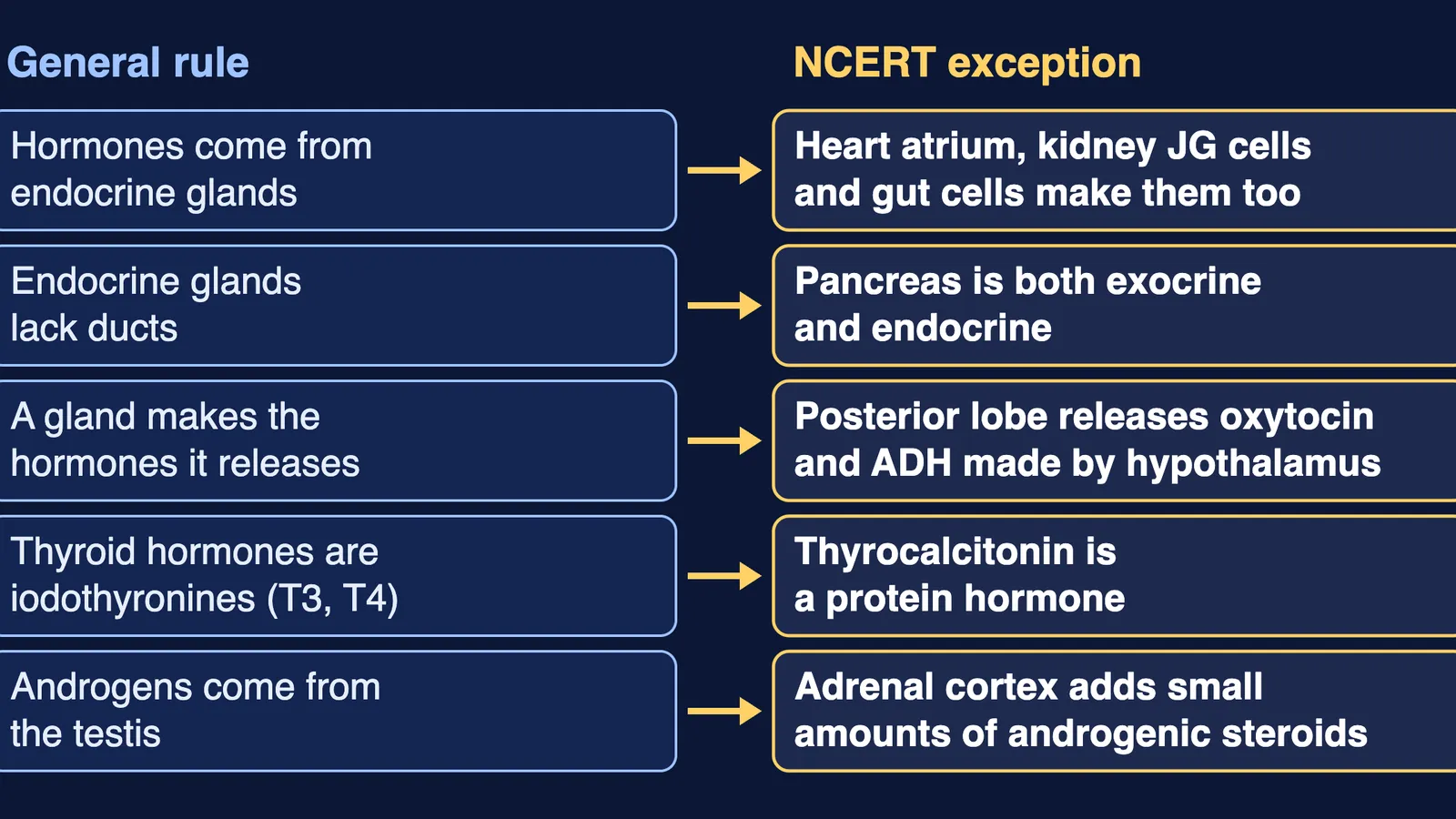
Each line gives a rule the chapter states, then the case NCERT itself sets apart, with its section.
Hormones are classically the secretions of organised endocrine glands; NCERT adds tissues that are not endocrine glands: the heart's atrial wall (ANF), kidney juxtaglomerular cells (erythropoietin) and gut endocrine cells (19.1, 19.2, 19.3).
The same section adds one more non-gland source: several other non-endocrine tissues secrete growth factors, needed for normal tissue growth and repair (19.3).
Endocrine glands lack ducts; the pancreas is a composite gland, acting as both exocrine and endocrine (19.1, 19.2.8).
An endocrine gland's job is hormones; the testis has dual functions, as a primary sex organ and an endocrine gland, and the ovary produces an ovum each cycle as well as steroid hormones (19.2.9, 19.2.10).
A gland makes the hormones it secretes; the posterior pituitary just holds and releases oxytocin and vasopressin, which are actually synthesised in the hypothalamus (19.2.2).
The adenohypophysis has two portions, pars distalis and pars intermedia; however, in humans the pars intermedia has nearly fused into the pars distalis (19.2.2).
Thyroid hormones are iodothyronines (T4 and T3); the thyroid also secretes thyrocalcitonin, a protein hormone that lowers blood calcium (19.2.4, 19.4, Summary).
Androgens come from the testis's Leydig cells; the adrenal cortex also secretes small amounts of androgenic steroids (19.2.7, 19.2.9).
How do you handle odd-one-out and exception questions?
Write the stem's basis in the margin first.
Test every option on it, then on source gland, chemical class and target. A well-built item gives the same answer on every feature, or splits the rest evenly.
In "NOT an exception" items, pick the option that obeys its rule.
Circle only, all and never in statements; NCERT's hedges often sink them.
Odd-one-out questions
How to attack this format: judge on the stated basis, then confirm no other feature singles out a different option.
Q1. Judged by chemical class as NCERT groups hormones, which is the odd one out? (1) Estradiol (2) Progesterone (3) Cortisol (4) Thyrocalcitonin
Answer: (4). TCT is a protein hormone; the other three are steroids in NCERT's list.
Q2. Judged by whether NCERT names an organised endocrine gland as its source, which is the odd one out? (1) Gastrin (2) Secretin (3) Glucagon (4) Cholecystokinin
Answer: (3). Glucagon comes from α-cells of the pancreatic islets; the other three come from endocrine cells of the gut.
Q3. Judged by whether NCERT gives the organ a role besides secreting hormones, which is the odd one out? (1) Testis (2) Ovary (3) Pancreas (4) Thyroid
Answer: (4). The testis and ovary are primary sex organs and the pancreas is also exocrine; NCERT gives the thyroid no such second role.
Which is NOT an exception?
How to attack this format: the option that follows its rule is the answer.
Q4. Which is NOT a case NCERT sets apart from a general rule? (1) The pancreas working as both exocrine and endocrine gland (2) The adrenal cortex secreting androgenic steroids (3) Thyroid follicular cells synthesising T4 and T3 (4) The posterior pituitary releasing hormones it does not make
Answer: (3). Iodothyronines from follicular cells are the thyroid's normal output; the exception is its protein hormone, TCT.
Q5. Which pairs a rule with a case that is NOT its exception? (1) Endocrine glands lack ducts: pancreas (2) A gland makes what it releases: posterior pituitary (3) Hormones come from endocrine glands: growth factors (4) Androgens come from the testis: ovary
Answer: (4). NCERT gives the ovary estrogen and progesterone; the androgen exception is the adrenal cortex.
Two-statement questions
How to attack this format: judge each line alone.
Options for Q6 to Q8: (1) both right (2) both wrong (3) only I is right (4) only II is right.
Q6. Statement I: Neurosecretory nuclei in the hypothalamus, the basal part of the diencephalon, produce hormones. Statement II: Islets of Langerhans make up most of the human pancreas.
Answer: (3). NCERT puts the islets at only 1 to 2 per cent of pancreatic tissue.
Q7. Statement I: In vertebrates, only a handful of chemicals act as hormones. Statement II: Invertebrates have very simple endocrine systems with few hormones.
Answer: (4). NCERT says vertebrates use many chemicals as hormones.
Q8. Statement I: The testis works both as a primary sex organ and as an endocrine gland. Statement II: The testes sit in the scrotal sac, outside the abdomen.
Answer: (1). NCERT states both in its section on the testis.
Single-correct questions
How to attack this format: find the rule hidden in the stem, then the option NCERT treats differently.
Q9. NCERT says hypothalamic hormones regulate pituitary secretion. Which hormone synthesised in the hypothalamus acts instead on smooth muscle, including the uterus at childbirth? (1) GnRH (2) Somatostatin (3) Oxytocin (4) Prolactin
Answer: (3). Oxytocin is made in the hypothalamus; prolactin comes from the pars distalis.
Q10. The thyroid's protein hormone, thyrocalcitonin: (1) raises blood Ca2+ (2) lowers blood Ca2+ (3) is an iodothyronine (4) is made only when iodine is deficient
Answer: (2). NCERT's summary says TCT regulates blood calcium by decreasing it.
Q11. What does NCERT call the hormones that several non-endocrine tissues secrete for normal tissue growth and repair? (1) Growth hormones (2) Gonadotrophins (3) Growth factors (4) Corticoids
Answer: (3). Growth hormone comes from the pituitary; growth factors come from non-endocrine tissues.
What should you do after this set?
Redo all 11 with answers covered.
Add every miss to your rule-and-exception list with its section.
Then switch formats: statement and match-the-list questions on this chapter, diagram-based chemical coordination questions and assertion-reason questions on hormones.
Which exception keeps slipping away? Fermi's AI tutor works out what you already know and builds a plan for the session.