On this page
Chemical coordination is a short chapter with long lists: glands, hormones, target organs, disorders. Assertion-reason and Statement I/II questions ask whether each line is true, and then whether one line actually causes the other. Every statement below was checked against the 2026-27 reprint of NCERT Class 11 Biology, Chapter 19, Chemical Coordination and Integration, and every topic sits inside the "Chemical coordination and regulation" topic of the NMC NEET (UG)-2026 syllabus published by NTA. For the full chapter map, start with our Human Physiology for NEET preparation guide.
How do you answer assertion-reason questions on hormones?
Use these keys throughout.
Assertion-reason: (A) Both A and R are true and R is the correct explanation of A. (B) Both A and R are true but R is NOT the correct explanation of A. (C) A is true but R is false. (D) A is false but R is true.
Statement pairs: (A) Both statements are correct. (B) Both statements are incorrect. (C) Statement I is correct, Statement II is incorrect. (D) Statement I is incorrect, Statement II is correct.
Judge A and R separately first. Only when both are true do you ask the second question: is R the reason NCERT gives for A? A true fact about the same gland is not automatically the explanation.
Assertion-reason questions on chemical coordination
Q1 (easy). Assertion (A): Glucagon is a hyperglycemic hormone. Reason (R): In liver cells, glucagon switches on both glycogenolysis and gluconeogenesis.
Answer: (A). Both are true, and NCERT gives these two liver actions as the reason glucagon raises blood sugar.
Trap: mixing up glucagon (alpha cells, raises glucose) with insulin (beta cells, lowers it).
Q2 (easy). Assertion (A): Vasopressin is released into the blood from the posterior pituitary. Reason (R): Vasopressin is synthesised by cells of the posterior pituitary.
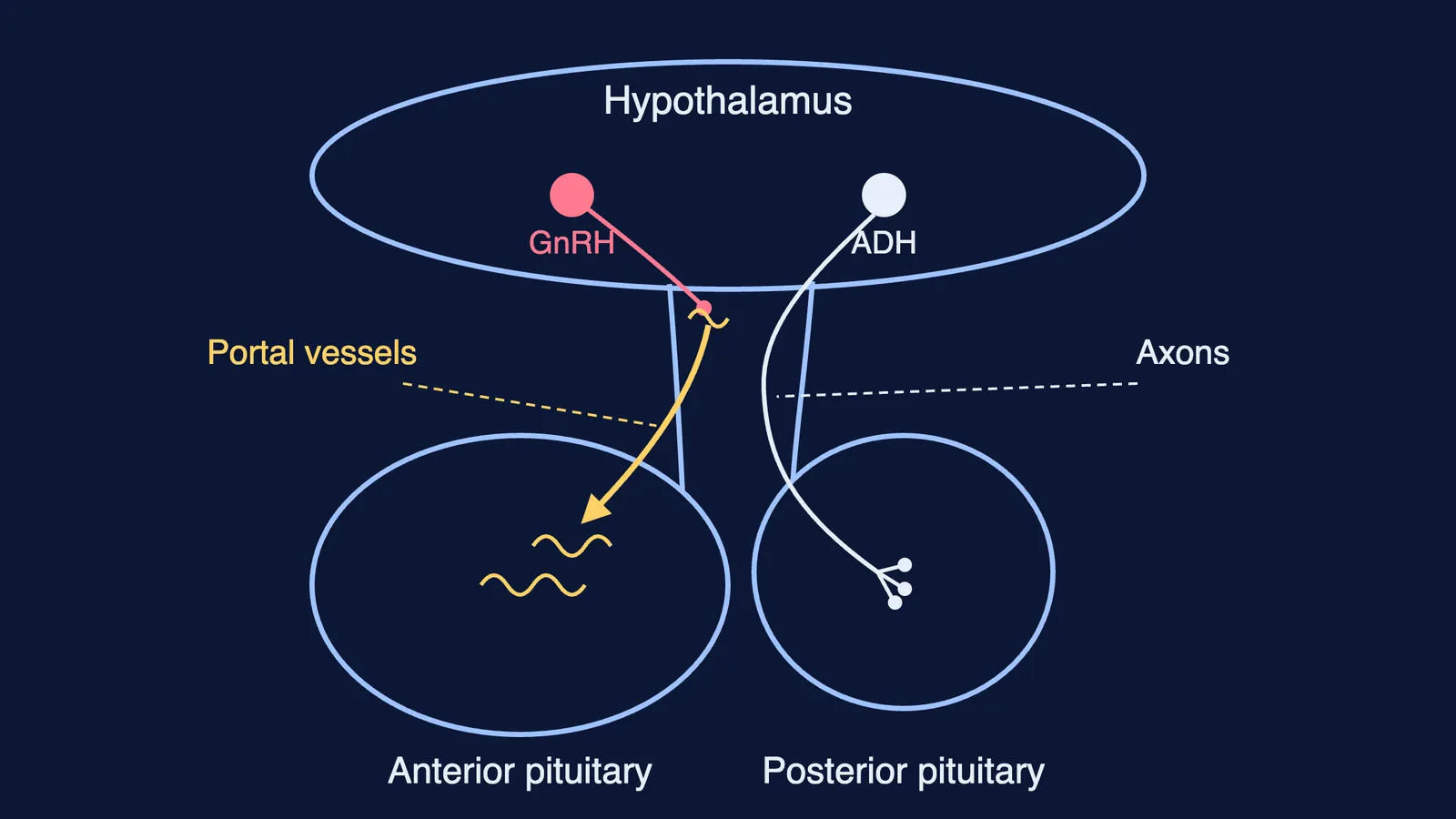
Answer: (C). The neurohypophysis stores and releases vasopressin and oxytocin, so A is true. Both are synthesised in the hypothalamus and carried down axons, so R is false.
Trap: "released from" is not "made in".
Q3 (medium). Assertion (A): Parathyroid hormone is a hypercalcemic hormone. Reason (R): How much PTH the parathyroids release depends on the Ca2+ level in circulating blood.
Answer: (B). Both are true. PTH raises blood Ca2+ because it stimulates bone resorption, renal reabsorption of Ca2+ and Ca2+ absorption from digested food; what controls its secretion does not explain its effect.
Trap: picking (A) because both lines mention calcium.
Q4 (medium). Assertion (A): Addison's disease results from over-production of hormones by the adrenal cortex. Reason (R): Different corticoids control carbohydrate metabolism and the water-electrolyte balance.
Answer: (D). NCERT links Addison's disease to underproduction of adrenal cortex hormones, so A is false. R is true: glucocorticoids act on carbohydrate metabolism and mineralocorticoids on water and electrolytes.
Trap: remembering the gland but not the direction of the fault.
Q5 (medium). Assertion (A): Aldosterone helps maintain blood pressure. Reason (R): Aldosterone makes the renal tubules take back more Na+ and water.
Answer: (A). Both are true. NCERT states that through this Na+ and water reabsorption, aldosterone maintains body fluid volume, osmotic pressure and blood pressure.
Trap: linking blood pressure only to the heart.
Q6 (hard). Assertion (A): T3 and T4 mostly act by regulating gene expression in their target cells. Reason (R): T3 and T4 are peptide hormones that bind membrane-bound receptors.
Answer: (C). A is true: NCERT names iodothyronines alongside steroids as hormones that use intracellular receptors and act on the genome. R is false: they form their own chemical class, iodothyronines, and are not peptides.
Trap: assuming every non-steroid hormone works through cAMP at the membrane.
Statement I and II questions on hormones
Q7 (medium). Statement I: MSH is the only hormone NCERT assigns to the pars intermedia. Statement II: In humans, the pars intermedia is barely separate from the pars distalis.
Answer: (A). Both are NCERT statements about the adenohypophysis.
Trap: marking II false because it sounds like an exception.
Q8 (medium). Statement I: Cortisol is the main mineralocorticoid in the human body. Statement II: The zona glomerulosa is the innermost layer of the adrenal cortex.
Answer: (B). Cortisol is the main glucocorticoid; aldosterone is the main mineralocorticoid. The zona glomerulosa is the outer layer; the zona reticularis is the inner one.
Trap: knowing one fact and guessing the other.
Q9 (hard). Statement I: In females, LH maintains the corpus luteum. Statement II: The corpus luteum mainly secretes estrogen.
Answer: (C). LH induces ovulation and maintains the corpus luteum, so I is correct. Estrogen comes mainly from growing ovarian follicles; the corpus luteum mainly secretes progesterone.
Trap: treating "ovary hormone" as one answer for every ovarian structure.
Q10 (hard). Statement I: Hypothalamic releasing hormones such as GnRH reach the posterior pituitary through a portal circulation. Statement II: Somatostatin is a hypothalamic hormone that holds back growth hormone release by the pituitary.
Answer: (D). Portal circulation carries hypothalamic hormones to the anterior pituitary; the posterior pituitary is under direct neural control. Statement II is correct: NCERT gives somatostatin as the hypothalamic hormone that inhibits GH release.
Trap: swapping "anterior" and "posterior".
How should you use this set?
Attempt all ten in one sitting without notes, writing your key and a one-line reason for each.
Mark each wrong answer by error type: a false fact you believed, or a true fact you linked wrongly.
For every factual error, reread that subsection of Chapter 19 and rewrite the corrected line from memory a day later.
For every linking error, apply the "because" test to the original NCERT sentence and note the word ("thus", "hence", "as a result") that signals a real cause.
If one gland keeps catching you, the Fermi Concept Library covers every concept in biology, each with its own lesson and its place in the map. For a broader method, see our guide to handling assertion-reason questions step by step, and revise the glands themselves with chemical coordination for NEET: glands, hormones and their actions.