On this page
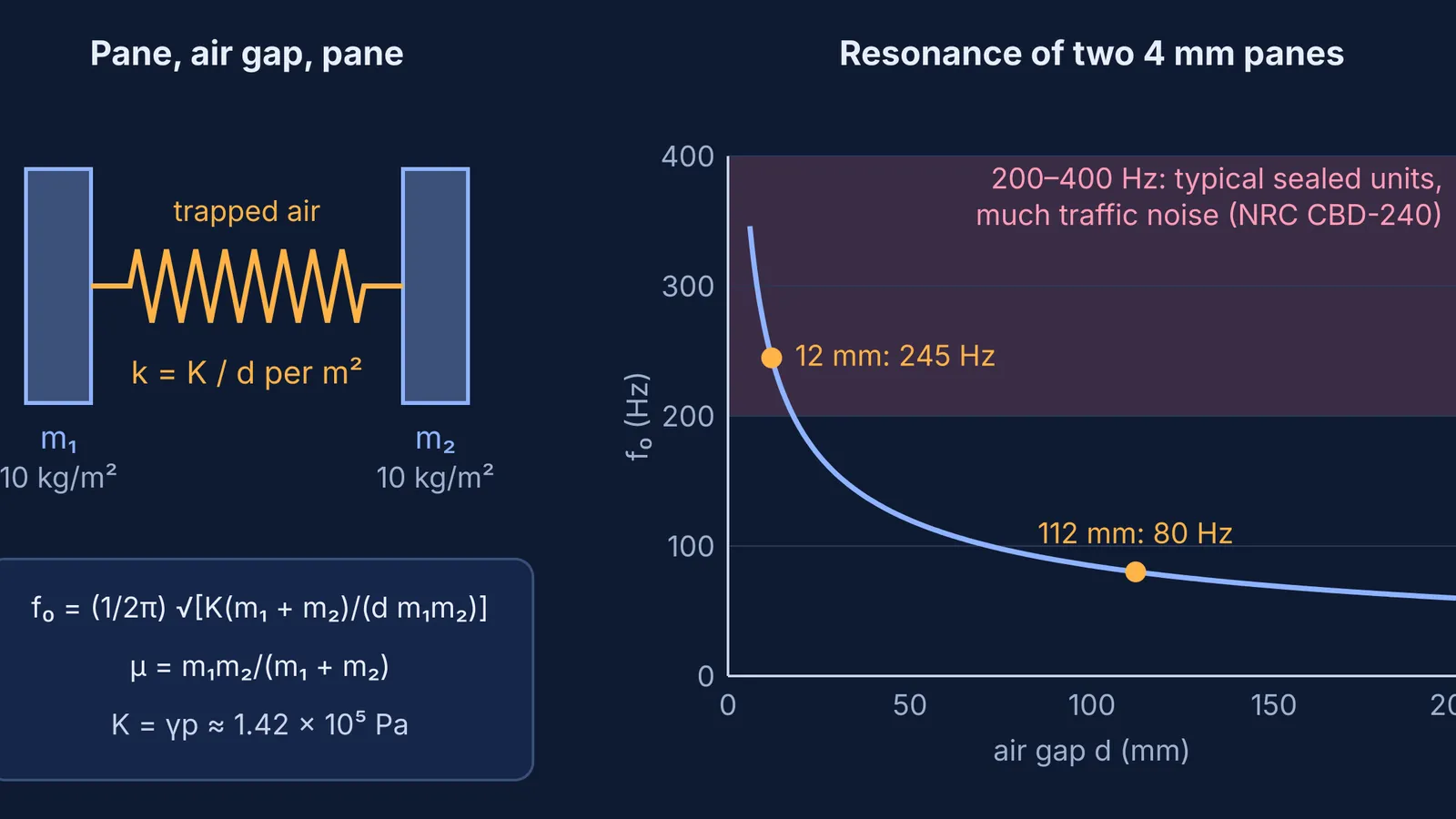
If you live beside a highway or an elevated metro line, you may have been told that double-glazed windows will keep the noise out. Often they help. But a standard double-glazed unit, two 4 mm panes on a 12 mm air gap, has a weak spot: near 245 Hz the two panes and the air between them bounce together like two blocks joined by a spring, and sound passes through far more easily. That frequency sits in the low rumble of traffic. The physics is a two-body spring problem and the bulk modulus of a gas, both from Class 11.
The heat side of double glazing, and the general claim that a sealed window cuts noise, are covered in why AC train coaches have sealed windows. The mass law for a single wall is in why you hear only the bass from your neighbour's music. Here the question is what the air gap itself does.
Why does the air gap act like a spring?
The air in the gap is sealed in. If sound pushes the outer pane inward by a small distance x, the gas layer of thickness d is squeezed by a fraction x/d. Its pressure rises by
Δp = K × (x / d)
where K is the bulk modulus of the air. Pressure is force per unit area, so for each square metre of window the restoring force is K x / d. That is Hooke's law with a spring constant, per square metre, of
k = K / d
A thinner gap is a stiffer spring.
Which bulk modulus should you use?
Sound in the audible range squeezes and releases the gap hundreds of times a second, far too fast for heat to flow in or out of the air. The compression is adiabatic, so K = γp = 1.4 × 1.013 × 10⁵ = 1.42 × 10⁵ Pa. This is the same as ρc² for air (1.20 kg/m³ × 343² = 1.42 × 10⁵ Pa), which is no accident: the speed of sound is set by the adiabatic bulk modulus. Why sound uses γp rather than p is explained in isothermal and adiabatic bulk modulus of a gas.
Using the isothermal value p = 1.01 × 10⁵ Pa by mistake gives a frequency about 15% too low.
What is the resonance frequency of two panes on an air spring?
Two masses m₁ and m₂ joined by a spring of stiffness k, free to move, oscillate against each other with angular frequency ω² = k/μ, where μ = m₁m₂/(m₁ + m₂) is the reduced mass. The centre of mass stays put; only the gap breathes. Working with masses per square metre and k = K/d:
f₀ = (1/2π) √[K (m₁ + m₂) / (d m₁ m₂)]
Acousticians call f₀ the mass-air-mass resonance. Near it, a small push on the outer pane drives a large motion of the inner pane, which radiates sound into your room. Well above f₀, the spring isolates the inner pane and double glazing works far better than a single pane. Below f₀ the two panes move together as one, and you get only the mass law for the total glass.
Worked example: a standard 4-12-4 unit
Two panes of 4 mm glass on a 12 mm air gap. Take glass density as about 2,500 kg/m³.
Mass per square metre of each pane. m = 2,500 × 0.004 = 10 kg/m².
Reduced mass. μ = (10 × 10) / (10 + 10) = 5 kg/m².
Spring constant per square metre. k = 1.42 × 10⁵ / 0.012 = 1.183 × 10⁷ N/m per m².
Angular frequency. ω = √(1.183 × 10⁷ / 5) = 1,538 rad/s.
Frequency. f₀ = 1,538 / 2π = 245 Hz.
Units: (N/m) / kg = s⁻², so ω is in s⁻¹. Change the gap and f₀ ∝ 1/√d: a 6 mm gap gives 346 Hz and a 16 mm gap 212 Hz. A 4 mm pane and a 6 mm pane (15 kg/m²) on a 12 mm gap give 223 Hz. Using unequal panes is also a common trick, because the two panes then do not share the same bending resonances higher up.
Can double glazing be worse than a single pane?
Yes, near f₀. J. D. Quirt of Canada's National Research Council measured a large set of windows and summarised the results in a building digest. He found that the resonance falls between about 200 and 400 Hz for typical factory-sealed double glazing, that much of the sound energy of road traffic and aircraft falls in that same range, and that with a small gap the overall rating is only slightly higher than, or may be lower than, a single layer of the same glass (NRC Canadian Building Digest 240). Each doubling of the air space raised the rating by about 3.
The simple model is a guide, not the full answer. It ignores the panes' own bending, the frame and the damping of the air, so a real measurement shows a broad dip near f₀ rather than a sharp spike. Quirt's detailed laboratory data, and how well simple models fit them, are in his papers in the Journal of the Acoustical Society of America (1982 and 1983).
How wide must the gap be to keep traffic rumble out?
Rearrange the formula for d. To bring f₀ for two 4 mm panes down to 80 Hz:
d = K (m₁ + m₂) / [(2π f₀)² m₁ m₂] = 1.42 × 10⁵ × 20 / (502.7² × 100) = 0.112 m
That is 112 mm, nearly ten times the gap of a standard unit. A secondary window fitted 100 to 200 mm behind the first gives f₀ from 85 down to 60 Hz. That is why noise-control windows near airports and busy roads use a wide gap, and why Quirt's digest recommends the largest spacing the wall allows.
So the thermal unit and the acoustic unit are designed for different jobs. A narrow gap of 12 to 16 mm suits heat insulation, because a wider gap lets the air circulate and carry heat. Good sound insulation wants a wide gap, heavier glass and a well-sealed frame.
This problem joins two JEE favourites, the two-body oscillator and the bulk modulus of a gas. If you are preparing for JEE Main and Advanced, Fermi Test Prep offers personalised preparation with an AI tutor, live classes, adaptive mocks, mentorship and a study plan that updates based on mastery.
Quick checklist
The sealed air gap is a spring: k = K/d per square metre.
Use the adiabatic bulk modulus, γp = ρc² ≈ 1.42 × 10⁵ Pa.
Two free panes: ω² = k/μ, with μ = m₁m₂/(m₁ + m₂).
A 4-12-4 unit resonates near 245 Hz, inside the traffic-noise band.
Near f₀ double glazing can be no better than a single pane.
Getting f₀ down to 80 Hz needs a gap of about 112 mm.