

On this page
What is the bulk modulus of an ideal gas?
Bulk modulus, denoted by B, measures a fluid's resistance to uniform compression:
B = −V (dP / dV)
The negative sign keeps B positive, because an increase in pressure (dP > 0) causes a decrease in volume (dV < 0). It is measured in pascals (Pa) or newtons per square metre (N/m²).
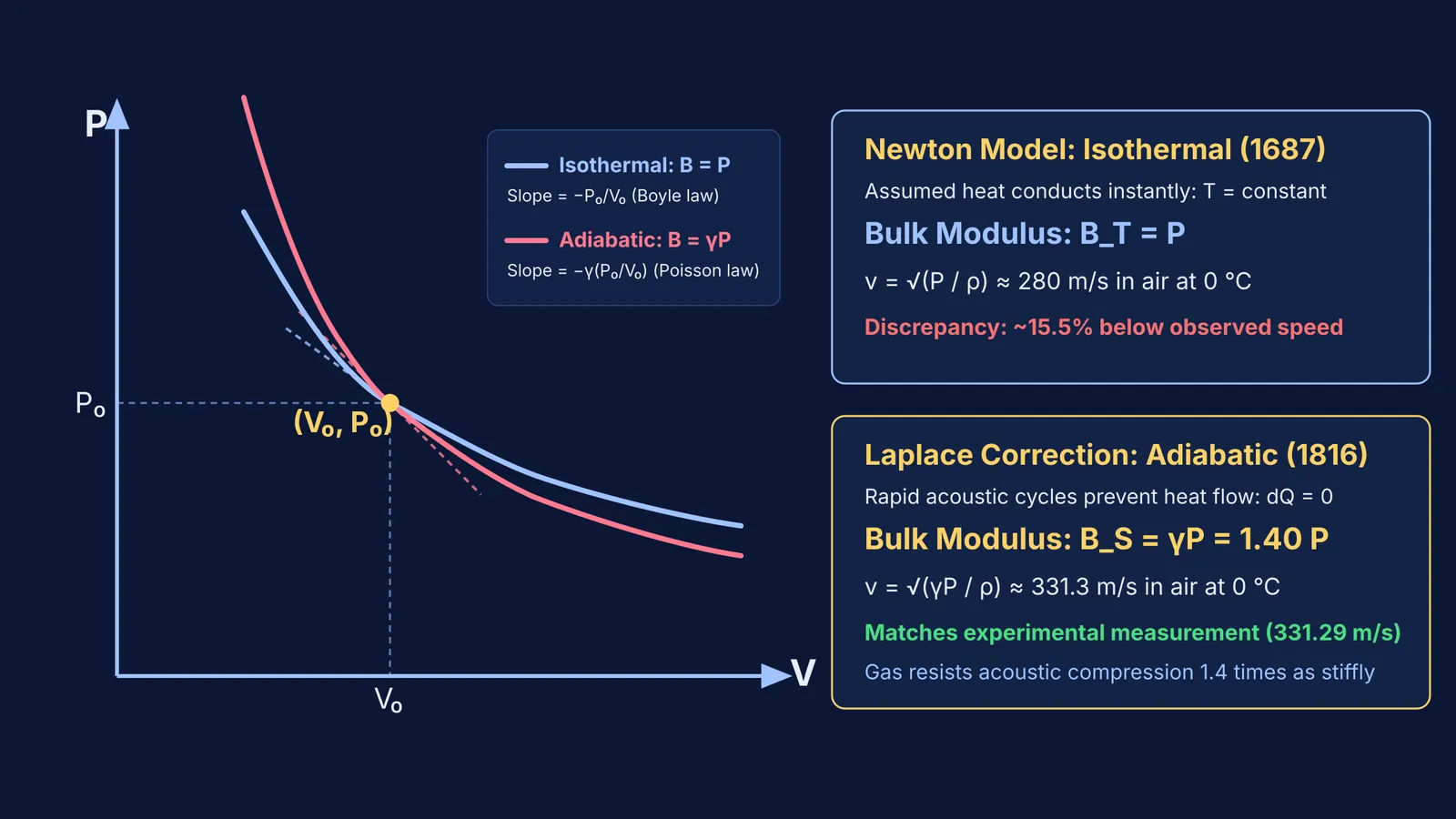
Unlike solids and liquids with fixed elastic moduli, a gas possesses a bulk modulus that depends entirely on the thermodynamic path of compression. An ideal gas compressed at constant temperature behaves differently from one compressed without heat exchange. Understanding this begins with work done and PV diagrams in isothermal and adiabatic processes. Under standard conditions, atmospheric air rests at a baseline pressure of 101,325 Pa, as recorded by the NIST CODATA Fundamental Physical Constants.
Why does an isothermal process yield B = P?
In an isothermal compression, heat flows freely through conducting container walls, keeping temperature T constant. For an ideal gas obeying Boyle's law, PV = constant. Differentiating with respect to V:
P + V (dP / dV)_T = 0
(dP / dV)_T = −P / V
Substituting this derivative into the bulk modulus definition yields the isothermal bulk modulus, B_T:
B_T = −V (dP / dV)_T = −V (−P / V) = P
Because heat escapes freely during slow compression, temperature does not rise, and the restoring pressure comes solely from confining molecules into less volume.
Why does an adiabatic process yield B = γP?
In an adiabatic process, compression occurs without heat exchange (dQ = 0). The gas obeys Poisson's relation, P V^γ = constant, where γ = C_p / C_v is the heat capacity ratio. Differentiating with respect to V:
(dP / dV) V^γ + γ P V^(γ−1) = 0
Dividing by V^(γ−1) gives:
V (dP / dV)_S + γ P = 0
(dP / dV)_S = −γ P / V
Substituting into the bulk modulus formula yields the adiabatic bulk modulus, B_S:
B_S = −V (dP / dV)_S = −V (−γ P / V) = γ P
Because γ > 1 for all real gases, the adiabatic bulk modulus is always strictly greater than the isothermal bulk modulus. For dry air, thermodynamic data benchmarked by George S. K. Wong in *The Journal of the Acoustical Society of America* establishes a standard heat capacity ratio of γ = 1.40. The Fermi Concept Library covers every concept across physics and chemistry, placing each topic in the knowledge map to connect microscopic degrees of freedom with macroscopic moduli.
Why do sound waves propagate adiabatically instead of isothermally?
Sound travels as longitudinal waves of alternating compressions and rarefactions. In the 1687 *Principia* (Book II), Sir Isaac Newton modeled sound propagation as an isothermal process, setting B_T = P in his wave speed formula v = √(B / ρ):
v = √(P / ρ)
At standard atmospheric pressure of 101,325 Pa, as recorded by NIST CODATA, and a dry air density of 1.293 kg/m³, this gives v ≈ 280 m/s. Experimental measurements at 0 °C consistently yielded approximately 331 m/s, leaving a 15.5% discrepancy.
In 1816, Pierre-Simon Laplace resolved the problem, as analysed by Bernard S. Finn in *Isis*. Acoustic oscillations occur hundreds of times per second. Because air conducts heat slowly, thermal energy cannot cross the half-wavelength distance between compression and rarefaction zones during a single cycle. Compressions warm and rarefactions cool adiabatically:
v = √(γ P / ρ)
With γ = 1.40 for air, v = √(1.40 × 101,325 / 1.293) ≈ 331.3 m/s. George S. K. Wong in *The Journal of the Acoustical Society of America* established the modern reference speed in standard dry air at 0 °C and 101.325 kPa as 331.29 m/s. Explore our guides on displacement and pressure waves in sound and Laplace's correction to Newton's sound formula. The Fermi Simulation Lab offers interactive simulations for ideas that are easier to see than read, showing how rapid acoustic cycles outrun thermal conduction.
How do you calculate bulk modulus and sound speed in exam problems?
Consider standard dry air at pressure P = 101,325 Pa, density ρ = 1.293 kg/m³, and γ = 1.40, benchmarked to NIST CODATA standards:
Isothermal bulk modulus: B_T = P = 1.013 × 10⁵ Pa
Adiabatic bulk modulus: B_S = γ P = 1.40 × 101,325 Pa = 1.419 × 10⁵ Pa
Isothermal sound speed: v_iso = √(B_T / ρ) = √(101,325 / 1.293) ≈ 279.9 m/s
Adiabatic sound speed: v_ad = √(B_S / ρ) = √(141,855 / 1.293) ≈ 331.2 m/s
The adiabatic modulus is 40% higher than the isothermal modulus, increasing sound speed by √1.40 ≈ 1.183. The Fermi Problem Library provides worked problems with a step-by-step solver that explains the reasoning rather than printing an answer, helping students master multi-step thermodynamics.
When solving exam problems in JEE Main, JEE Advanced, or NEET-UG:
Identify process speed: slow compression in conducting vessels means isothermal (B = P); rapid acoustic waves mean adiabatic (B = γP).
Match atomicity: use γ = 5/3 ≈ 1.67 for monatomic gases, γ = 7/5 = 1.40 for diatomic gases, and γ = 4/3 ≈ 1.33 for polyatomic gases.
Read P-V curves: the adiabatic curve is γ times steeper than the isothermal curve at any common intersection point.


