On this page
The NMC's NEET (UG) 2026 syllabus puts Breathing and Respiration in Unit 5, Human Physiology. Every rule, exception and answer comes from Chapter 14 of NCERT's Class 11 Biology, Reprint 2026-27, with its section. All 10 questions are ours: no past-paper items, no predictions.
Study summary, not medical advice: disorder lines restate NCERT for revision only.
What are the NCERT exceptions in Breathing and Exchange of Gases?
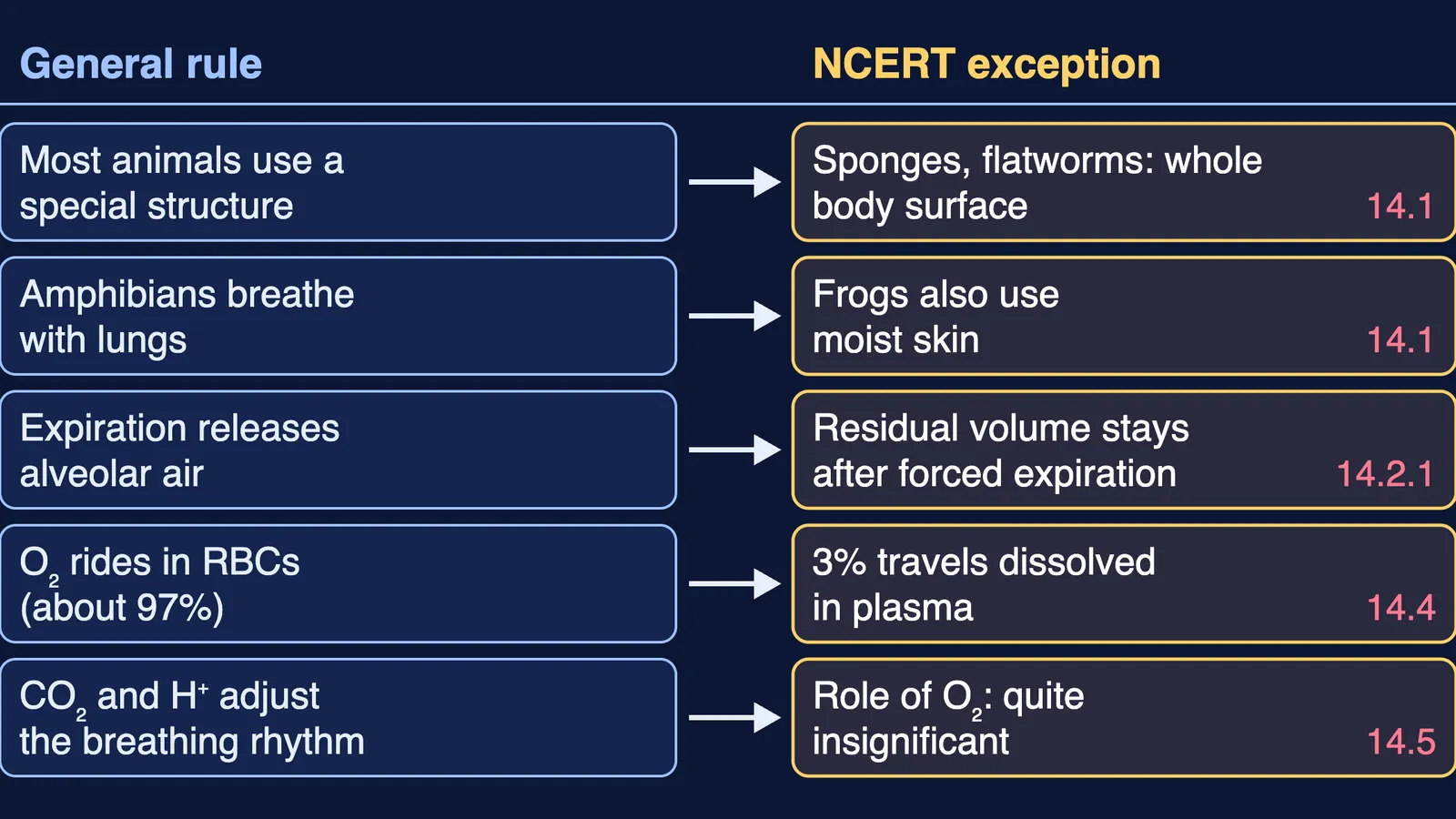
Most animals use a special structure: gills, lungs or tracheal tubes. Exception: sponges, coelenterates and flatworms use simple diffusion over the whole body surface (14.1).
Amphibians respire through lungs. Exception: frogs can also respire through moist skin, cutaneous respiration (14.1).
The diaphragm and intercostals create the breathing gradients. Exception: abdominal muscles can add strength to inspiration and expiration (14.2).
Expiration releases alveolar air. Exception: the residual volume stays even after a forcible expiration (14.2.1).
Alveoli are the primary sites of gas exchange. Exception: gases are also exchanged between blood and tissues (14.3).
Oxygen travels mainly in RBCs, as oxyhaemoglobin. Exception: the remaining 3 per cent is dissolved in plasma (14.4, Summary).
O₂ binding to haemoglobin depends primarily on pO₂. Exception: pCO₂, H⁺ concentration and temperature can interfere (14.4.1).
Carbamino binding is related to pCO₂. Exception: pO₂ is also a major factor affecting it (14.4.2).
Carbonic anhydrase is concentrated in RBCs. Exception: minute quantities are present in plasma too (14.4.2).
The rhythm centre in the medulla is primarily responsible for regulation. Exception: the pneumotaxic centre in the pons can moderate it (14.5).
Rising CO₂ and H⁺ trigger adjustments in the breathing rhythm. Exception: oxygen's role in the rhythm is quite insignificant (14.5).
The conducting part clears foreign particles from inhaled air. Exception: grinding and stone-breaking create more dust than the body's defences can fully handle; prolonged exposure ends in fibrosis (14.1.1, 14.6).
How do you handle odd-one-out and exception questions?
Read the basis the stem names; judge by that alone.
Write a one-word verdict next to each option: fits or breaks.
If none or two break, reread the basis.
For "NOT an exception", restate the rule, then test each option against the chapter's wording.
Odd-one-out questions
Q1. Judged by whether NCERT describes the structure as vascularised, which is the odd one out? (1) Gills of fishes (2) Tracheal tubes of insects (3) Lungs of reptiles (4) Gills of aquatic molluscs
Answer: (2). Gills and lungs are vascularised; tracheal tubes carry air within the body (14.1).
Q2. Judged by whether NCERT uses the term for gas exchange through an organ or body surface, which is the odd one out? (1) Branchial respiration (2) Pulmonary respiration (3) Cutaneous respiration (4) Cellular respiration
Answer: (4). The other three name gills, lungs and skin; cellular respiration is the cells' use of O₂ (14.1, 14.1.1).
Q3. Judged by whether NCERT names it as one of the three major layers of the diffusion membrane, which is the odd one out? (1) Squamous epithelium of alveoli (2) Endothelium of alveolar capillaries (3) Basement substance between them (4) Inner pleural membrane
Answer: (4). The pleura covers the lungs; it is not part of the diffusion membrane (14.3).
Q4. Judged by NCERT's account of which changes significantly adjust the respiratory rhythm, which is the odd one out? (1) A change in O₂ (2) A rise in CO₂ (3) A rise in H⁺ concentration (4) CO₂ and H⁺ changes reported by receptors on the aortic arch and carotid artery
Answer: (1). Oxygen's role is quite insignificant (14.5).
Which is NOT an exception?
Q5. Which of these is NOT an exception that NCERT states? (1) Minute quantities of carbonic anhydrase occur in plasma, though RBCs hold a very high concentration (2) Gases are exchanged between blood and tissues, not only in the alveoli (3) pO₂ affects carbamino binding, though that binding is related to pCO₂ (4) Birds, besides lungs, respire through moist skin
Answer: (4). NCERT names amphibians like frogs, not birds, for skin respiration (14.1, 14.3, 14.4.2).
Two-statement and single-correct questions
Codes for Q6 to Q9: (1) Both correct (2) Only I correct (3) Only II correct (4) Neither correct.
Q6. I: Plasma contains no carbonic anhydrase at all. II: Haemoglobin is a red, iron-containing pigment present in RBCs.
Answer: (3). Plasma has minute quantities of the enzyme (14.4.1, 14.4.2).
Q7. I: NCERT says a spirometer helps in clinical assessment of pulmonary functions. II: Gas exchange takes place only at the alveoli.
Answer: (2). Alveoli are the primary sites, but exchange also occurs between blood and tissues (14.2, 14.3).
Q8. I: Carbamino binding depends on pCO₂ alone; pO₂ has no effect on it. II: NCERT says fishes respire through lungs as well as gills.
Answer: (4). pO₂ is a major factor in that binding; fishes use gills (14.4.2, 14.1).
Q9. I: Flatworms swap O₂ for CO₂ by simple diffusion across the whole body surface. II: NCERT lists diffusion of O₂ and CO₂ between blood and tissues as a step of respiration.
Answer: (1). Both match NCERT (14.1, 14.1.1).
Q10. Which rule-exception pair matches NCERT? (1) The medulla's rhythm centre is primarily responsible; a pons centre can moderate it (2) Expiration empties the lungs, except during exercise (3) Falling O₂ drives the rhythm; CO₂ plays a minor part (4) Carbonic anhydrase is mostly in plasma, with a trace in RBCs
Answer: (1). Residual volume always stays, O₂ matters little in regulation, and the enzyme is concentrated in RBCs (14.2.1, 14.4.2, 14.5).
What should you do with your misses?
Missed Q1, Q2, Q5 or Q8: list each 14.1 group with its surface and NCERT's term for it. Missed Q3, Q6 or Q7: redraw an alveolus with its capillary and mark where each enzyme and layer sits. Missed Q4 or Q10: write each "primarily" rule with its exception. More practice: the breathing statement and match-the-list questions, the diagram-based questions on breathing or the assertion-reason questions on this chapter.
Which exception keeps slipping away from you? Fermi's AI tutor works out what you already know and builds a plan for the session.