

On this page
Ten original questions on Breathing and Exchange of Gases, easy to hard, each with the key, a short explanation and the trap.
How do you read assertion-reason questions on this chapter?
Breathing and Respiration is in Unit 5, Human Physiology, of the NMC NEET (UG)-2026 syllabus. Every statement is judged against Chapter 14 of NCERT Class 11 Biology (Reprint 2026-27).
Use these keys for every assertion-reason item:
(A) Both A and R are true and R is the correct explanation of A.
(B) Both A and R are true but R is NOT the correct explanation of A.
(C) A is true but R is false.
(D) A is false but R is true.
Use these keys for every statement pair:
(A) Both statements are correct.
(B) Both statements are incorrect.
(C) Statement I is correct, Statement II is incorrect.
(D) Statement I is incorrect, Statement II is correct.
Judge A and R separately. Only when both are true, ask whether R is NCERT's cause for A. More on the method: our assertion-reason strategy guide.
Assertion-reason questions: can you spot the real cause?
All facts and values below are from NCERT Class 11 Biology, Chapter 14.
Q1 (easy). Assertion (A): Food normally does not enter the larynx when we swallow. Reason (R): The epiglottis, a thin elastic flap of cartilage, can close over the glottis while food is being swallowed.
Answer: (A). Both are true, and covering the glottis is how food is kept out. Trap: (C), from thinking the epiglottis is a muscle; NCERT calls it a cartilaginous flap.
Q2 (easy). Assertion (A): O2 and CO2 are exchanged with blood in the alveoli and not in the bronchi. Reason (R): The conducting part of the respiratory system humidifies inhaled air and brings it to body temperature.
Answer: (B). Both are true. Exchange happens in the alveoli because they form the exchange part: very thin, vascularised sacs. Conditioning air does not explain where diffusion happens. Trap: (A), because R is about the same airway.
Q3 (medium). Assertion (A): During normal inspiration, the intra-pulmonary pressure falls below atmospheric pressure. Reason (R): Relaxation of the diaphragm increases the volume of the thoracic chamber in the antero-posterior axis.
Answer: (C). A is true. R is false: the diaphragm contracts to enlarge the chamber; its relaxation reduces thoracic volume during expiration. Trap: swapping contract and relax.
Q4 (medium). Assertion (A): Vital capacity equals total lung capacity minus expiratory reserve volume. Reason (R): Residual volume is the air that remains in the lungs even after a forcible expiration.
Answer: (D). A is false: TLC is RV + ERV + TV + IRV, so VC = TLC − RV. R is the NCERT definition. Trap: mixing up ERV with RV because both are "left after breathing out".
Q5 (hard). Assertion (A): For the same partial-pressure difference across the alveolar membrane, a far larger amount of CO2 than O2 crosses it. Reason (R): CO2 dissolves 20 to 25 times more readily than O2.
Answer: (A). Both are true, and NCERT gives solubility as the reason. Trap: choosing (D) because the CO2 gradient (45 to 40 mm Hg) looks small next to oxygen's (104 to 40); A is per unit of difference.
Q6 (hard). Assertion (A): A person with emphysema has less surface available for gas exchange in the lungs. Reason (R): Emphysema is a chronic disorder that damages the alveolar walls.
Answer: (A). Both are true, and NCERT gives the damaged alveolar walls as the reason the respiratory surface falls. Trap: (B), from remembering smoking as the cause of emphysema and missing that R is the direct cause of A.
Statement I and II questions: are both halves true?
Values are from Table 14.1 and section 14.4 of NCERT Chapter 14.
Q7 (easy). Statement I: The trachea divides into the right and left primary bronchi at the level of the 5th cervical vertebra. Statement II: The inner pleural membrane is in contact with the lung surface.
Answer: (D). I is false: the division is at the 5th thoracic vertebra, in the mid-thoracic cavity. II is true; the outer membrane lines the thorax. Trap: reading "5th" and stopping before "cervical".
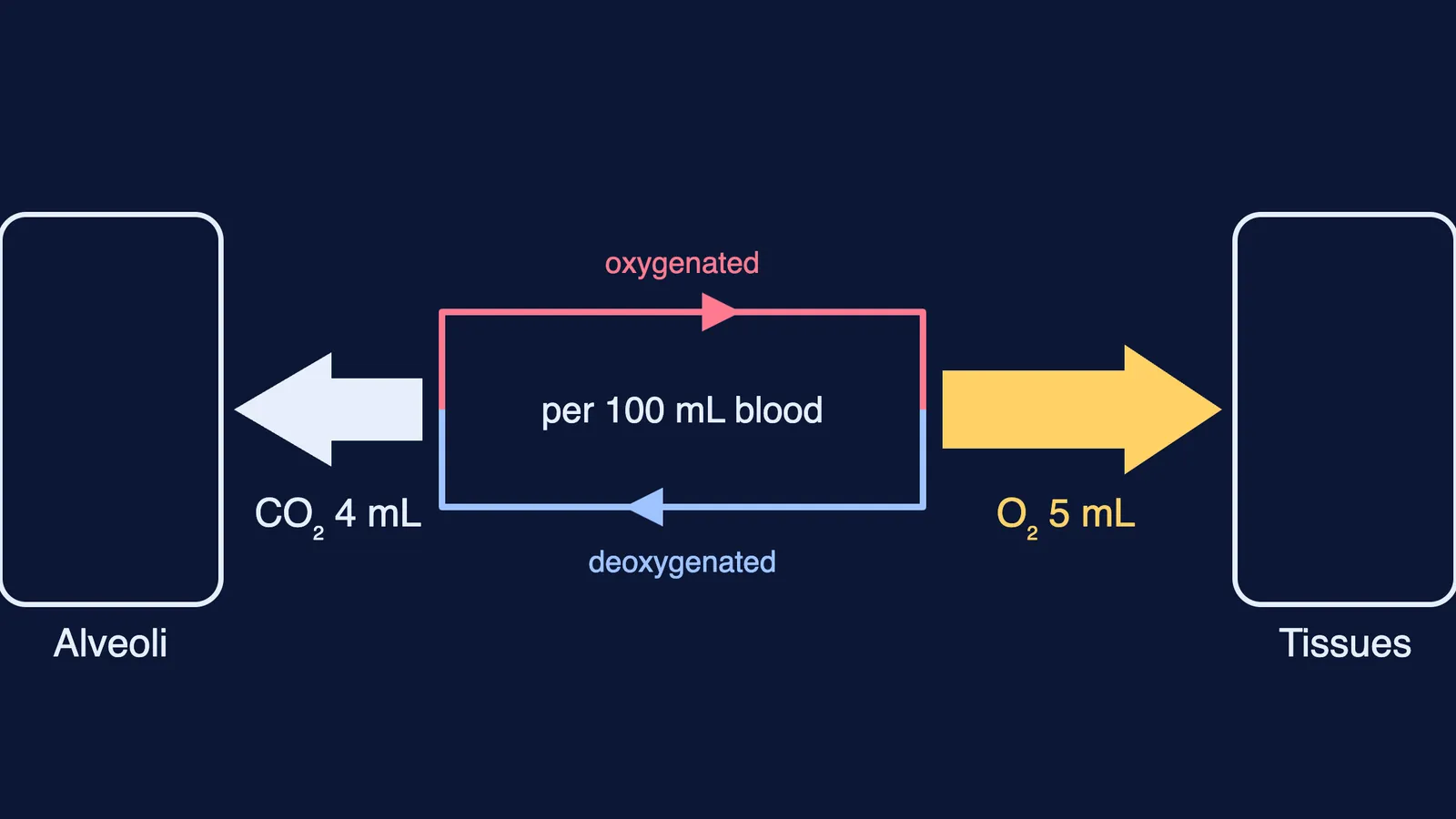
Q8 (medium). Statement I: Under normal conditions, each 100 ml of oxygenated blood gives up about 5 ml of O2 to the tissues. Statement II: Each 100 ml of deoxygenated blood gives up about 5 ml of CO2 at the alveoli.
Answer: (C). I is true. II is false: NCERT gives about 4 ml of CO2 per 100 ml of deoxygenated blood. Trap: assuming the two deliveries must be equal.
Q9 (hard). Statement I: Atmospheric air has a higher pCO2 than alveolar air. Statement II: The pO2 of oxygenated blood is equal to the pO2 of alveolar air.
Answer: (B). In NCERT Table 14.1, pCO2 is 0.3 mm Hg in atmospheric air but 40 mm Hg in alveoli, so I is false. Oxygenated blood has a pO2 of 95 mm Hg, not alveolar 104, so II is false. Trap: assuming blood leaving the lungs matches alveolar air exactly.
Q10 (hard). Statement I: In the tissues, where pCO2 is high and pO2 is low, more CO2 binds to haemoglobin as carbamino-haemoglobin. Statement II: At the alveoli, where pCO2 is low, the carbonic anhydrase reaction runs towards CO2 and H2O.
Answer: (A). Both are true. Carbonic anhydrase speeds the reaction in both directions: towards HCO3− and H+ at the tissues, back to CO2 and H2O at the alveoli. Trap: (C), from learning the enzyme as one-way.
How should you use this set?
Sort each miss into a bin:
Fact slip (Q4, Q7, Q8, Q9): redo the NCERT table or list from memory.
Mechanism swap (Q3, Q10): redraw the process with arrows.
Causal link (Q1, Q2, Q5, Q6): say the NCERT cause aloud before reading R.
Revise the chapter with Breathing and Exchange of Gases Class 11 notes and sums, then plan the unit with Human Physiology for NEET: chapters, traps and a study plan.
If gas transport still feels shaky, the Fermi Concept Library covers every concept in biology, each with its own lesson and its place in the map.


