On this page
This guide covers Chapter 14's 2026-27 syllabus, worked numbers and original practice questions.
What does the 2026-27 syllabus include for this chapter?
The CBSE Biology curriculum for 2026-27 puts it in Unit V, Human Physiology: 18 marks of the 70-mark Class XI theory paper, shared by Chapters 14 to 19, with no per-chapter figure. Respiratory organs in animals are recall only.
We follow the current NCERT chapter (Reprint 2026-27).
Source: the NCERT rationalised content booklet for Class XI.
How does air get in and out of the lungs?
In the NCERT chapter, air passes nostrils, pharynx, larynx and trachea (dividing at the 5th thoracic vertebra), then bronchi and bronchioles to the alveoli.
Conducting part: nostrils to terminal bronchioles; filters, humidifies and warms air.
Exchange part: alveoli and their ducts, where O2 and CO2 diffuse.
A double-layered pleura with pleural fluid reduces friction on the lungs.
Breathing in: the diaphragm contracts and the external intercostals raise the ribs and sternum, so the chest and lungs enlarge, lung pressure drops under atmospheric, and air is pushed in. Relaxation reverses this. A healthy human breathes 12 to 16 times a minute.
How do you work out lung volumes and gradients?
NCERT's ranges: TV about 500 mL, IRV 2500–3000 mL, ERV 1000–1100 mL, RV 1100–1200 mL. Every capacity is a sum of these.
Worked example (our numbers). TV = 520 mL, IRV = 2600 mL, ERV = 1080 mL, RV = 1130 mL, 14 breaths a minute.
Inspiratory capacity = TV + IRV = 520 + 2600 = 3120 mL.
Expiratory capacity = TV + ERV = 520 + 1080 = 1600 mL.
Functional residual capacity = ERV + RV = 1080 + 1130 = 2210 mL.
Vital capacity = ERV + TV + IRV = 1080 + 520 + 2600 = 4200 mL.
Total lung capacity = VC + RV = 4200 + 1130 = 5330 mL.
Air per minute = 520 × 14 = 7280 mL, inside NCERT's 6000 to 8000 mL.
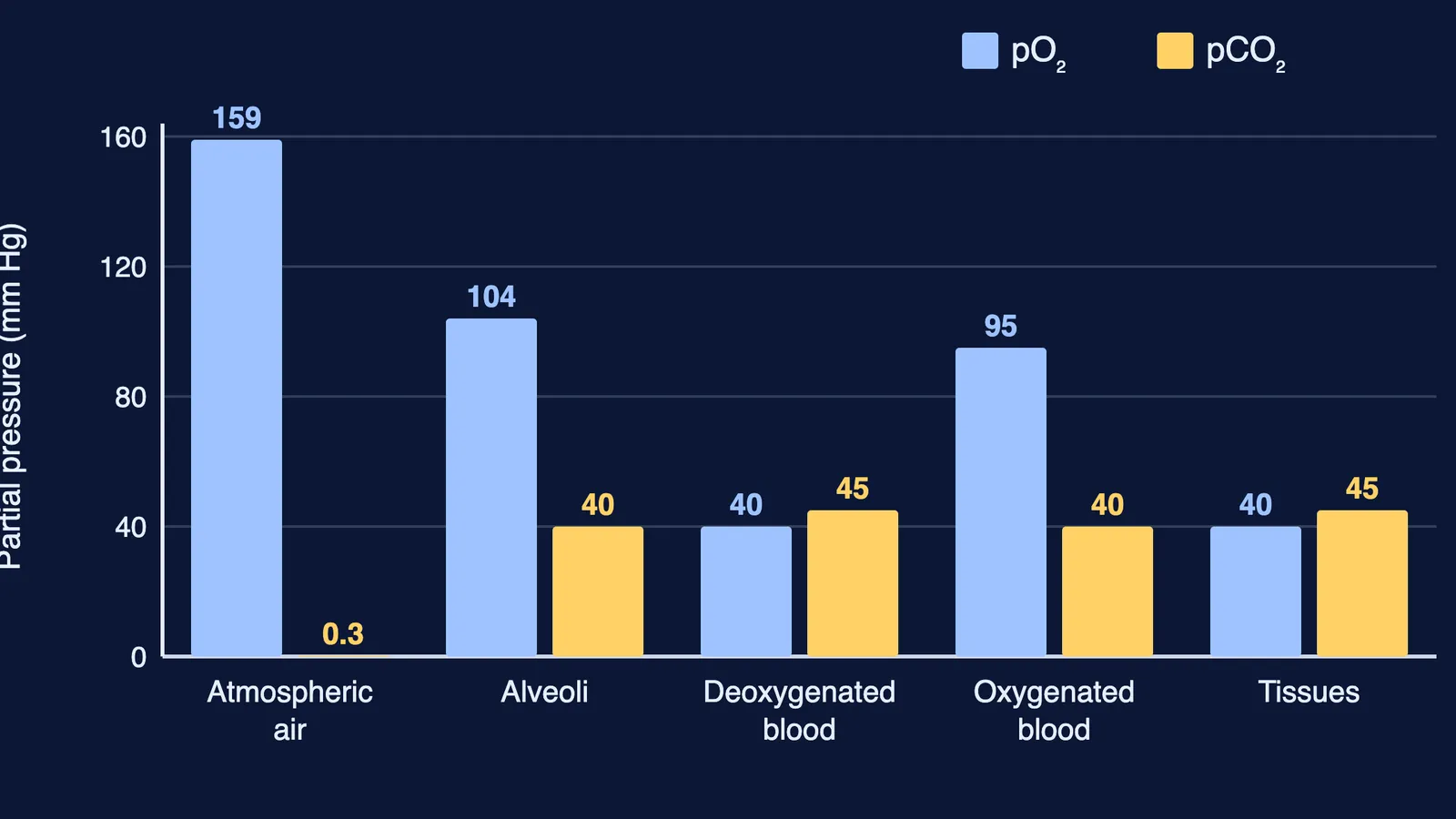
The chart plots NCERT's Table 14.1. Oxygen's drop is 64 mm Hg at the alveoli (104 to 40) and 55 mm Hg at the tissues (95 to 40); carbon dioxide's is 5 mm Hg at each site (45 to 40). CO2 keeps pace because it is 20 to 25 times as soluble, across a membrane much less than a millimetre thick.
How are oxygen and carbon dioxide carried in blood?
From the NCERT chapter:
Oxygen: about 97 per cent rides in RBCs as oxyhaemoglobin (up to four O2 per haemoglobin); 3 per cent is dissolved in plasma.
Carbon dioxide: roughly 70 per cent as bicarbonate, a fifth to a quarter bound to haemoglobin, about 7 per cent dissolved.
Bicarbonate: carbonic anhydrase in RBCs turns CO2 and water into carbonic acid, then HCO3− and H+; this reverses at the alveoli.
Delivery: each 100 mL of blood gives tissues about 5 mL of O2 and alveoli about 4 mL of CO2, so 3 litres deliver about 150 mL and 120 mL.
The oxygen dissociation curve is sigmoid. High pO2, low pCO2, fewer H+ and lower temperature favour binding in the alveoli; the reverse favours release in tissues.
Rhythm comes from a medulla centre; the pneumotaxic centre in the pons can cut inspiration short; a nearby chemosensitive area reacts to CO2 and H+. Disorders: asthma, emphysema (smoking is a major cause) and occupational dust fibrosis.
What practice questions should you try?
Mark labels are ours; formats follow the Class XII Biology sample paper for 2026-27, as no Class XI paper is published.
(1 mark) Name two sites outside the brain whose receptors detect changes in CO2 and H+.
(2 marks) IRV = 2800 mL, TV = 460 mL, ERV = 1040 mL, RV = 1180 mL. Find FRC and vital capacity.
(2 marks) A classmate says CO2 exchange must be slow because its gradient is only 5 mm Hg. Correct them.
(3 marks) A sprinter's muscle is warm, acidic and rich in CO2. How does this affect oxyhaemoglobin?
(5 marks) Using Table 14.1 and the carbonic anhydrase reaction, explain how extra CO2 from an exercising muscle reaches the alveoli and why H+ rises near the muscle.
Answers: 1. Aortic arch, carotid artery. 2. FRC 2220 mL; VC 4300 mL. 3. CO2 is 20 to 25 times more soluble. 4. All three favour O2 release. 5. CO2 diffuses into blood (45 vs 40 mm Hg); carbonic anhydrase makes H2CO3, which gives HCO3− and H+; low alveolar pCO2 reverses this and CO2 diffuses out.
How should you revise this chapter?
Redraw the chart from memory. More practice: lung volume sums and oxygen transport. Pair this with Structural Organisation in Animals for Class 11 (frog respiration) and Cell: The Unit of Life for Class 11. For NEET, read Human Physiology for NEET.
Not sure where to start? Fermi's AI tutor works out what you already know and builds a plan for the session, so you start from the gap.