

On this page
Here are 12 new practice items on Breathing and Exchange of Gases, each with an NCERT-based answer. None is a past-paper question or prediction.
Where does this chapter sit in NEET Biology?
The NMC syllabus for NEET (UG)-2026 lists Breathing and Respiration under Unit 5, Human Physiology. Every answer traces to the NCERT chapter (Class 11 Biology, Chapter 14, Reprint 2026-27).
The NEET (UG)-2026 Information Bulletin gives Biology 90 of the 180 questions. A right answer earns +4 and a wrong one −1.
How do you attack Statement I and Statement II questions?
Judge each statement alone. One wrong word makes it false.
Options for Q1 to Q5: (1) both correct; (2) both incorrect; (3) only I correct; (4) only II correct.
Q1.
Statement I: Earthworms carry air through the body in tracheal tubes.
Statement II: Most aquatic arthropods and molluscs exchange gases through lungs.
Answer: (2). Earthworms use a moist cuticle; those animals use gills.
Q2.
Statement I: Incomplete cartilage rings support the trachea and bronchi.
Statement II: The larynx, a cartilaginous box, helps produce sound.
Answer: (1). Both match section 14.1.1.
Q3.
Statement I: Functional residual capacity includes the tidal volume.
Statement II: Inspiratory capacity is the air you can inhale after a normal expiration.
Answer: (4). FRC is ERV + RV only; IC is TV + IRV.
Q4.
Statement I: One haemoglobin molecule carries at most two O2 molecules.
Statement II: Haemoglobin saturation plotted against pO2 is sigmoid.
Answer: (4). The maximum is four.
Q5.
Statement I: Pleural fluid reduces friction on the lung surface.
Statement II: The vertebral column forms the ventral wall of the thoracic chamber.
Answer: (3). It is dorsal; the sternum is ventral.
How do you handle "which of these are correct" questions?
Mark each line T or F. Strike options that include an F or omit a T.
Q6. Which statements about the mechanism of breathing are correct?
A. External intercostals contract to raise the ribs and sternum, widening the thorax dorso-ventrally.
B. In normal expiration, intra-pulmonary pressure rises slightly above atmospheric.
C. We can change pulmonary volume directly, with no change in thoracic volume.
D. An average healthy rate is 12 to 16 breaths per minute.
E. Abdominal muscles must contract in every normal inspiration.
(1) A, B and D only (2) A, C and D only (3) B, D and E only (4) A, B, C and D
Answer: (1). Pulmonary volume follows thoracic volume (C); abdominal muscles only add strength (E).
Q7. Which statements about gas exchange are correct?
A. The diffusion membrane has three major layers.
B. The diffusion membrane is a few millimetres thick.
C. pO2 is 40 mm Hg in both the tissues and deoxygenated blood.
D. pCO2 is 40 mm Hg in both the alveoli and oxygenated blood.
E. Solubility and membrane thickness affect diffusion rate.
(1) A, C, D and E only (2) A, B and C only (3) B, D and E only (4) B, C and E only
Answer: (1). The membrane is far thinner than a millimetre.
Q8. Which statements about respiratory disorders are correct?
A. Asthma causes wheezing because the bronchi and bronchioles are inflamed.
B. Cigarette smoking is one of the major causes of emphysema.
C. Years of dust in stone-breaking work can inflame the lungs and lead to fibrosis.
D. Fibrosis means the breakdown of fibrous tissue.
(1) A, B and C only (2) A, C and D only (3) B and D only (4) A, B, C and D
Answer: (1). Fibrosis is a proliferation of fibrous tissue. This is a study summary, not medical advice.
How do you solve match-the-list questions on breathing?
Read the coded rows first. Fix one pair you know cold, delete rows that contradict it, then decide the pair separating the survivors.
Q9. Match the animal group with how it exchanges gases.
List-I: (A) Sponges (B) Insects (C) Fishes (D) Frogs, besides lungs
List-II: (I) Gills (II) Moist skin (III) Tracheal tubes (IV) Diffusion over the body surface
(1) A-IV, B-III, C-I, D-II (2) A-IV, B-I, C-III, D-II (3) A-II, B-III, C-I, D-IV (4) A-III, B-IV, C-I, D-II
Answer: (1). Per section 14.1, frogs also use moist skin; sponges, body-surface diffusion.
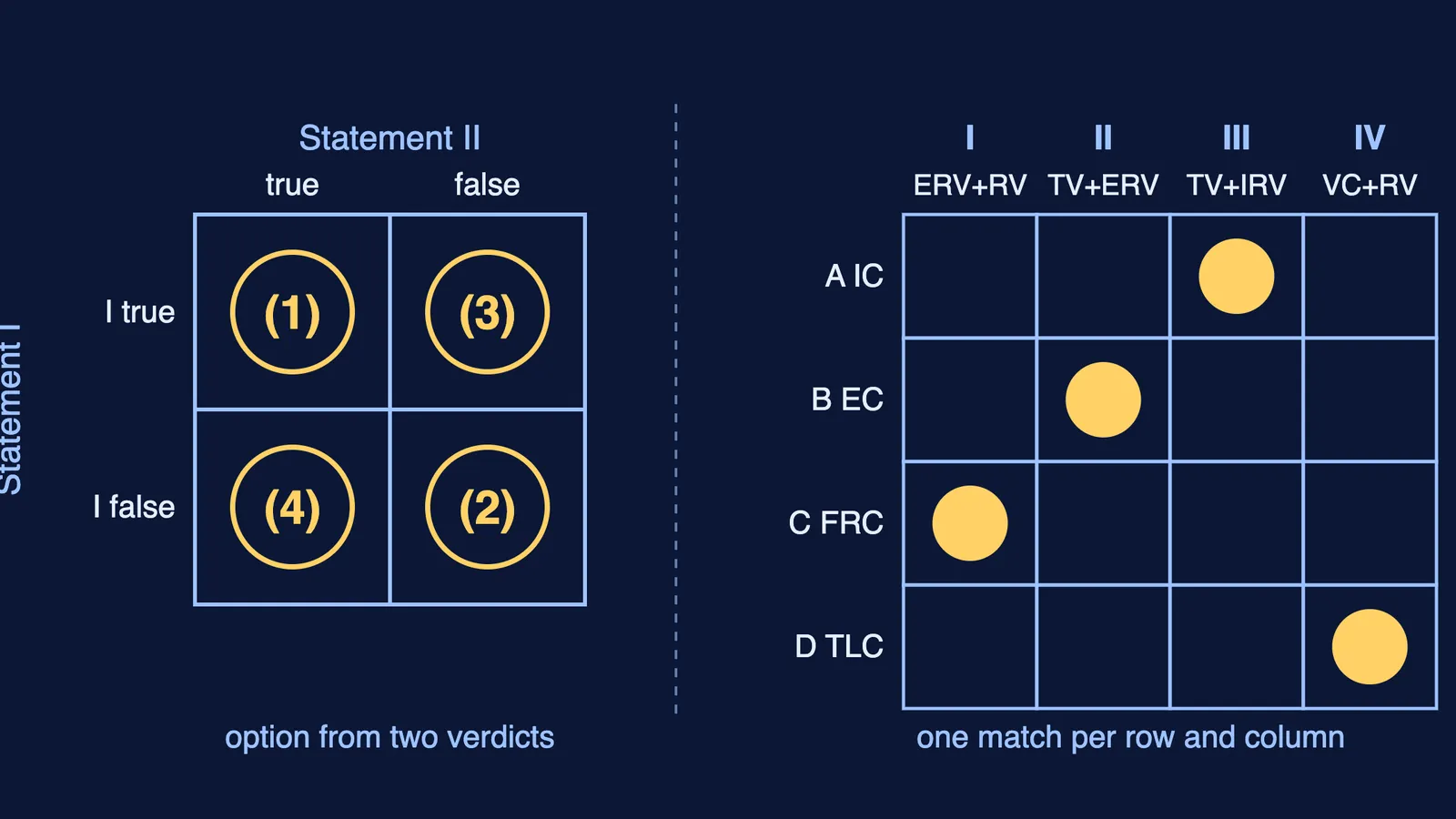
Q10. Match each capacity with its sum.
List-I: (A) Inspiratory capacity (B) Expiratory capacity (C) Functional residual capacity (D) Total lung capacity
List-II: (I) ERV + RV (II) TV + ERV (III) TV + IRV (IV) VC + RV
(1) A-III, B-I, C-II, D-IV (2) A-II, B-III, C-I, D-IV (3) A-III, B-II, C-I, D-IV (4) A-III, B-II, C-IV, D-I
Answer: (3). IC = TV + IRV removes (2); FRC = ERV + RV settles the rest.
Q11. Match each value with Table 14.1.
List-I: (A) pO2 of atmospheric air (B) pO2 of alveolar air (C) pO2 of oxygenated blood (D) pCO2 of deoxygenated blood
List-II: (I) 95 mm Hg (II) 159 mm Hg (III) 45 mm Hg (IV) 104 mm Hg
(1) A-II, B-I, C-IV, D-III (2) A-II, B-IV, C-I, D-III (3) A-IV, B-II, C-I, D-III (4) A-II, B-IV, C-III, D-I
Answer: (2). pO2 falls 159, 104, 95 from air to oxygenated blood.
Q12. Match each part of the control system with its role.
List-I: (A) Rhythm centre (B) Pneumotaxic centre (C) Chemosensitive area (D) Aortic arch and carotid artery receptors
List-II: (I) Beside the rhythm centre, senses CO2 and H+ (II) Medulla, main regulator (III) Report CO2 and H+ changes to the rhythm centre (IV) Pons, can shorten inspiration
(1) A-II, B-IV, C-I, D-III (2) A-IV, B-II, C-I, D-III (3) A-II, B-IV, C-III, D-I (4) A-II, B-I, C-IV, D-III
Answer: (1). Only the chemosensitive area lies beside the medulla's rhythm centre; the pons centre moderates it.
What should you do with your wrong answers?
Sort each miss: a number or sum (Q3, Q4, Q7, Q10, Q11), a swapped word (Q1, Q5, Q6, Q8) or a role (Q2, Q9, Q12).
Rewrite each false statement so it is true.
Write your own match list and swap it with a friend.
Next, try our assertion-reason questions on breathing, or our guides to statement-based NEET questions and match-the-list questions in NEET.
Not sure which Human Physiology chapter to fix first? Fermi's AI tutor works out what you already know and builds a plan for the session.


