

On this page
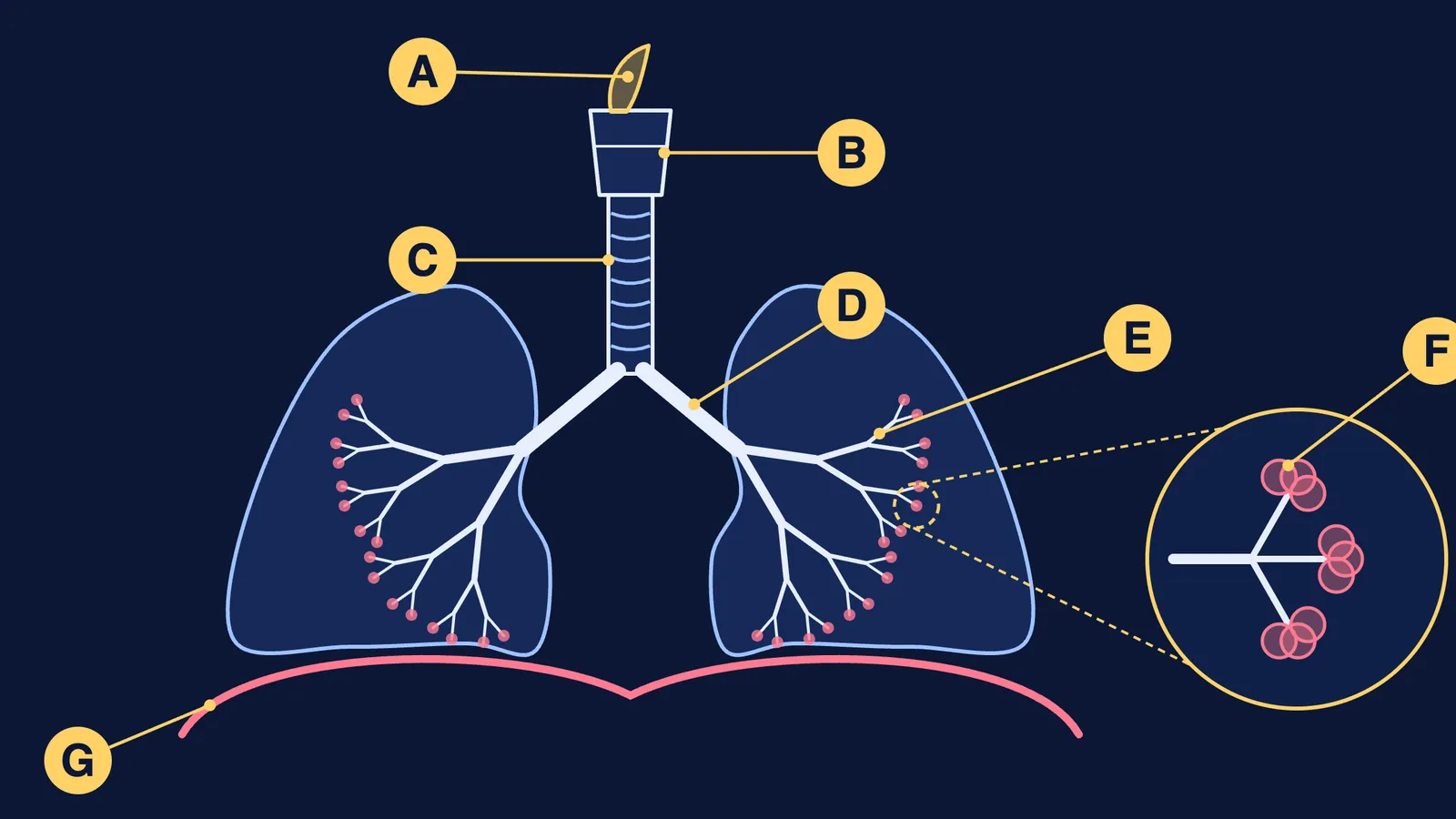
Thirteen fresh items, all answered from NCERT; none is taken from an old paper or a forecast. Q1 to Q6 use the lettered diagram; the rest describe figures in words.
Where is this chapter in the NEET syllabus?
Breathing and Respiration falls under Unit 5, Human Physiology, in the NMC NEET (UG)-2026 syllabus. All answers rest on Chapter 14 of NCERT Class 11 Biology (Reprint 2026-27).
Per the NEET (UG)-2026 Information Bulletin, Biology makes up 90 of 180 questions in a 180-minute paper, scored +4 for correct and −1 for incorrect.
How should you approach a lettered diagram?
Write a name beside each letter before you look at the choices.
Follow the path: air moves one way, so the order of parts is a clue.
Trust where the leader line ends, not where the letter sits.
Strike any option that misnames a letter you are sure of.
Questions 1 to 6: can you name the lettered parts?
How to attack: test each statement on its own; a single wrong term makes it false. In match items, fix the surest pair and drop rows that disagree.
Options for Q3, Q6, Q7 and Q9: (1) I and II right; (2) I and II wrong; (3) I right, II wrong; (4) I wrong, II right.
Q1. Which letter marks the thin, elastic cartilage flap that can close over the glottis?
(1) B (2) A (3) C (4) G
Answer: (2). The epiglottis keeps food out of the larynx during swallowing.
Q2. In which order does inhaled air pass the lettered parts?
(1) C, B, D, E, F (2) B, C, E, D, F (3) B, C, D, E, F (4) A, B, C, F, E
Answer: (3). Larynx, trachea, primary bronchus, bronchiole, then alveoli.
Q3.
Statement I: Parts C, D and E form the exchange part of the respiratory system.
Statement II: The conducting part, which includes C, D and E, clears inhaled air of foreign particles.
Answer: (4). Up to the terminal bronchioles is conducting; alveoli and their ducts exchange gases.
Q4. Match each lettered part with its role.
List-I: (a) Part B (b) Part C (c) Part F (d) Part G
List-II: (I) Where O2 and CO2 actually diffuse between air and blood (II) Cartilaginous sound box (III) Contracts to enlarge the thorax along the antero-posterior axis (IV) Straight tube reaching the mid-thoracic cavity
(1) a-IV, b-II, c-III, d-I (2) a-II, b-III, c-I, d-IV (3) a-II, b-IV, c-I, d-III (4) a-I, b-IV, c-II, d-III
Answer: (3). Larynx, trachea, alveoli and diaphragm, in that order.
Q5. Which part forms the floor of the air-tight thoracic chamber, and along which axis does its contraction enlarge the chamber?
(1) G; antero-posterior (2) G; dorso-ventral (3) F; antero-posterior (4) C; dorso-ventral
Answer: (1). The dome-shaped diaphragm; external intercostals work dorso-ventrally.
Q6.
Statement I: Each terminal branch of E gives rise to many thin, irregular-walled, vascularised sacs like F.
Statement II: The branching network formed by D, E and F makes up the lungs.
Answer: (1). Both match NCERT section 14.1.1.
Questions 7 to 13: what do the other figures show?
How to attack: sketch the figure first, then ask which way each arrow, pressure or curve runs. Facts follow NCERT Chapter 14, sections 14.2 to 14.4.
Q7. A two-panel figure shows inspiration (a) and expiration (b).
Statement I: In panel (a), the internal intercostal muscles contract and lift the ribs and sternum.
Statement II: In panel (b), intra-pulmonary pressure falls below atmospheric pressure.
Answer: (2). External intercostals do the lifting; in expiration pressure rises slightly above atmospheric.
Q8. In panel (a), why does air enter the lungs?
(1) The alveoli contract and pull air in (2) The diaphragm relaxes and rises into the chest (3) Atmospheric pressure rises at that moment (4) A larger thoracic volume enlarges the lungs and drops intra-pulmonary pressure below atmospheric
Answer: (4). A rise in thoracic volume causes a matching rise in pulmonary volume.
Q9. A figure traces O2 and CO2 between alveolus, blood and tissue.
Statement I: O2 moves from the alveoli into deoxygenated blood because its partial pressure is higher in the alveoli.
Statement II: At the tissue, CO2 moves from blood into the cells because pCO2 is lower there.
Answer: (3). The CO2 gradient runs the other way: tissues to blood to alveoli.
Q10. Match how each gas travels in the same figure.
List-I: (a) O2 carried by RBCs (b) O2 dissolved in plasma (c) CO2 carried by RBCs (d) CO2 dissolved in plasma
List-II: (I) About 3 per cent (II) About 97 per cent (III) 20 to 25 per cent (IV) About 7 per cent
(1) a-II, b-IV, c-III, d-I (2) a-II, b-I, c-III, d-IV (3) a-I, b-II, c-IV, d-III (4) a-III, b-I, c-II, d-IV
Answer: (2). Bicarbonate carries the remaining CO2, about 70 per cent.
Q11. An oxygen dissociation curve plots haemoglobin's percentage saturation against pO2. What is O2 binding to haemoglobin primarily related to?
(1) Temperature (2) Partial pressure of O2 (3) Hydrogen ion concentration (4) Partial pressure of CO2
Answer: (2). NCERT lists the other three as factors that can interfere with binding.
Q12. On the same curve, which conditions favour the formation of oxyhaemoglobin?
(1) High pO2, low pCO2, fewer H+ ions, lower temperature (2) Low pO2, high pCO2, more H+ ions, higher temperature (3) High pO2, high pCO2, more H+ ions, lower temperature (4) Low pO2, low pCO2, fewer H+ ions, higher temperature
Answer: (1). These are alveolar conditions; (2) describes the tissues, where O2 is released.
Q13. A head-and-neck section shows the airway. Which part carries both food and air?
(1) Nasal chamber (2) Larynx (3) Pharynx (4) Trachea
Answer: (3). The nasal chamber opens into the pharynx, part of which is shared.
Answer key for the lettered diagram
A: epiglottis
B: larynx
C: trachea
D: primary bronchus
E: bronchiole
F: alveoli
G: diaphragm
What should you do after checking your answers?
Missed Q1, Q2, Q4 or Q5? Redraw the schematic from memory tomorrow.
Missed Q7, Q8 or Q12? Write the process as a chain: muscle, volume, pressure, airflow.
Next, try our statement and match-the-list questions and assertion-reason questions on breathing, or revise with our chapter notes with worked sums.
Unsure which physiology chapter needs work first? Fermi's AI tutor works out what you already know and builds a plan for the session.


