

On this page
If you have ever stood next to a metal train coach in the Indian summer sun, you know it gets hot enough to burn. Yet inside an AC coach, the temperature remains comfortable. The key to this is not just a powerful air conditioning unit, but the design of the windows.
Air-conditioned coaches rely on a specific thermal trick: the windows are made of two thick panes of glass separated by a sealed gap. This design relies on the physics of heat transfer to keep the cool air in and the heat out.
Why do AC train coaches have sealed windows?
The primary reason is thermal insulation. Glass is a poor insulator; its thermal conductivity is approximately 0.96 W/(m·K) (Engineering ToolBox). If an AC coach used a single pane of glass, heat from the hot exterior would easily conduct through it, forcing the air conditioner to run constantly to maintain the cabin temperature.
To fix this, engineers use double glazing. By placing two panes of glass slightly apart, they trap a layer of air or argon gas in between. Air is a terrible conductor of heat—its thermal conductivity is just 0.026 W/(m·K), which is about 37 times lower than that of glass (Engineering ToolBox). The trapped air acts as a massive thermal barrier.
How does the air gap prevent heat transfer?
Heat transfers in three ways: conduction, convection, and radiation. The thick glass panes handle the structural stress of a moving train, while the air gap stops conduction.
Because the windows are hermetically sealed with heavy-duty gaskets, the air inside cannot move. This prevents convective heat transfer. To stop radiant heat—the direct warmth you feel from sunlight—modern coaches often use tinted glass or a low-emissivity (Low-E) film on the outer pane.
Worked example: calculating thermal resistance
You can calculate exactly why the air gap matters by finding the thermal resistance (R = d / k) of each layer.
A 5 mm glass pane: R = 0.005 m / 0.96 W/(m·K) ≈ 0.0052 K·m²/W.
A 10 mm air gap: R = 0.010 m / 0.026 W/(m·K) ≈ 0.385 K·m²/W.
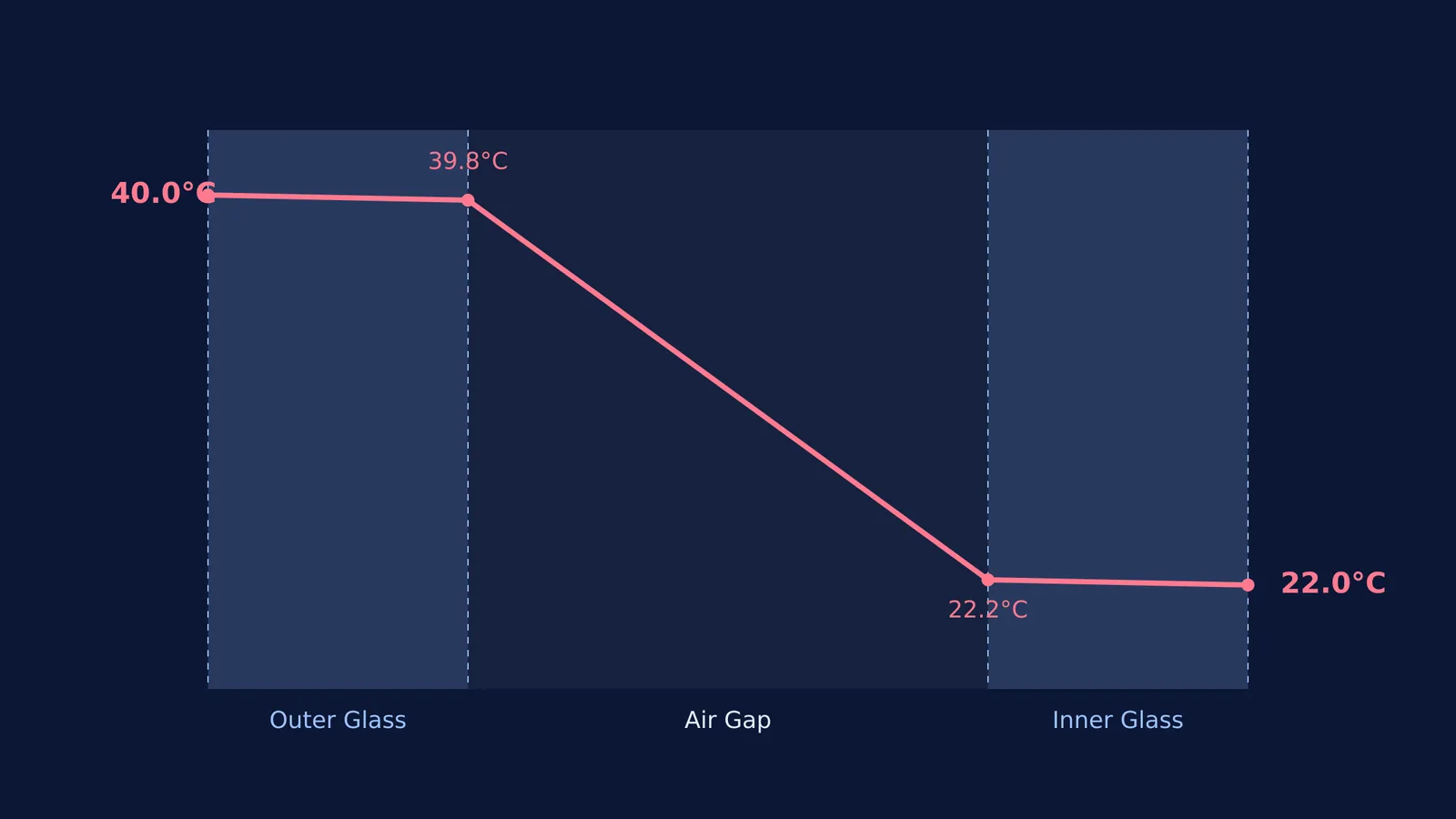
The 10 mm layer of air offers over 70 times more resistance to heat flow than the glass itself. This is why the temperature drops so steeply across the gap, keeping the inside pane cool.
When you study heat conduction for JEE or NEET, equations like Q = k A ΔT / d can feel abstract. In the Fermi Simulation Lab, you can find interactive simulations for the ideas that are easier to see than to read, such as visualizing how the gap width alters heat transfer.
Do sealed windows reduce track noise?
Yes. A train travelling at speed generates an immense amount of aerodynamic and mechanical noise.
Sound waves travel as vibrations through the air and through solids. When a sound wave hits a single pane of glass, the glass vibrates and transmits the noise into the cabin. In a double-glazed sealed window, the sound wave must travel through the first pane, pass through the dead air gap, and then vibrate the second pane. This transition dampens the energy of the wave.
Standard double glazing significantly reduces external noise compared to a single pane. This turns the roar of the tracks into a gentler hum, making the journey much more comfortable for passengers.
How does this affect the cooling load?
The "cooling load" is the amount of heat energy the AC system must remove to keep the cabin comfortable.
If the windows were openable, or even just poorly sealed, hot and humid outside air would constantly leak into the coach—a process called infiltration. The AC would have to waste energy cooling and dehumidifying this fresh supply of hot air.
By using sealed double glazing, the coach becomes an airtight envelope. The AC system only needs to process a controlled mixture of fresh air and recirculated cabin air. This slashes the cooling load, saving massive amounts of electrical power drawn from the locomotive.
Understanding how systems exchange energy is a core part of thermodynamics. If you are preparing for exams, you can read more about how heat behaves in constrained systems in our guide to Heat in isobaric and isochoric processes: using nCpΔT and nCvΔT, or explore what happens when gases expand without doing work in Free expansion of an ideal gas: why work and ΔU are both zero.


