On this page
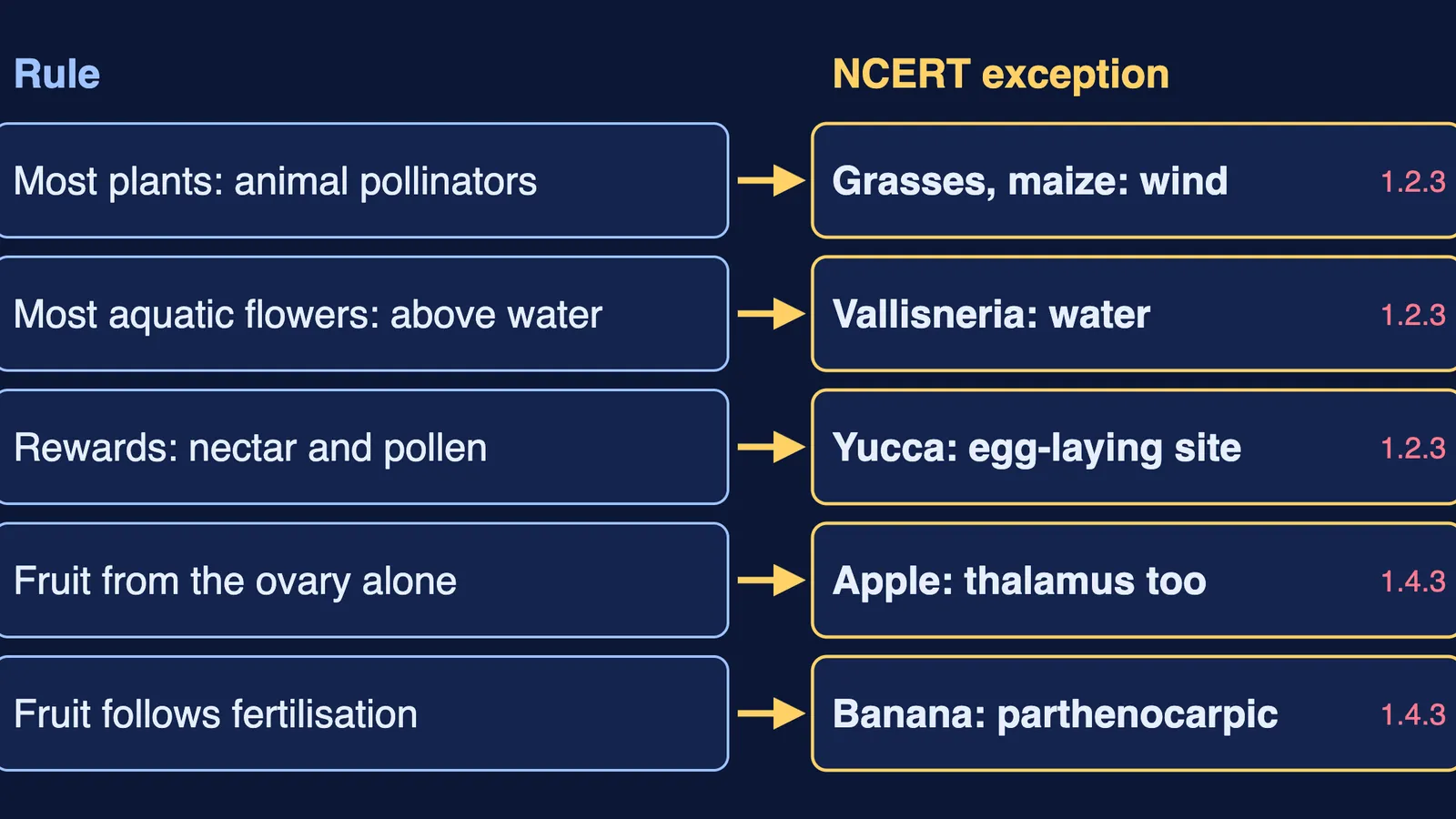
Part 1 pairs 12 rules from Chapter 1 of NCERT Class 12 Biology, Reprint 2026-27 with the exception it names. Part 2 has 11 original NEET-format questions, none a prediction. The chapter heads Biology Unit 6, Reproduction, in the NEET (UG) 2026 syllabus notice.
Which rules in sexual reproduction in flowering plants have NCERT exceptions?
The exine is a sporopollenin wall (1.2.1). Exception: germ pores, where sporopollenin is missing.
In a flower that opens, complete autogamy is rare (1.2.3). Exception: cleistogamous flowers of Viola, Oxalis and Commelina never open and are always autogamous.
Most flowering plants use animals as pollinators (1.2.3). Exception: a small share uses abiotic agents, mostly wind, as in grasses and the maize cob.
Most aquatic plants, like water hyacinth and water lily, raise flowers above water for insects or wind (1.2.3). Exception: Vallisneria, Hydrilla and the seagrass Zostera use water.
Pollinators are usually insects, birds or bats (1.2.3). Exception: lemurs, tree-dwelling rodents, and gecko and garden lizards, reported in some species.
Animal-pollinated flowers attract with colour or fragrance (1.2.3). Exception: fly- and beetle-pollinated flowers give off foul odours.
Floral rewards are usually nectar and pollen (1.2.3). Exception: Amorphophallus and Yucca offer a safe egg-laying site.
Unisexual flowers guard against self-pollination (1.2.3). Exception: monoecious castor and maize block autogamy yet allow geitonogamy; only dioecy, as in papaya, blocks both.
The nucellus does not last into the mature seed (1.4.3). Exception: black pepper and beet keep a remnant, the perisperm.
Most fruits come from the ovary alone (1.4.3). Exception: in apple, strawberry and cashew the thalamus joins in, giving false fruits.
Fruits usually follow fertilisation (1.4.3). Exception: parthenocarpic, seedless fruits such as banana.
Seeds generally follow fertilisation, with the embryo from the zygote (1.4.2, 1.5). Exception: apomixis in some Asteraceae and grasses; nucellar embryos in many Citrus and mango varieties (polyembryony).
How should you attack odd-one-out and exception questions?
Name the stem's basis, the shared feature, before reading options.
Test all four options against it, your favourite included.
For "NOT an exception", look for the option that obeys the rule; a plant that fits the majority is the usual trap.
Can you spot the odd one out?
Q1. By whether NCERT names it as bearing cleistogamous flowers, which is the odd one out?
(1) Viola (2) Oxalis (3) Papaya (4) Commelina
Answer: (3). Papaya is NCERT's dioecious example; the rest bear cleistogamous flowers (1.2.3).
Q2. By whether NCERT presents it as a device that discourages inbreeding, which is the odd one out?
(1) Pollen released before the stigma is receptive (2) Anther and stigma set at different positions (3) Self-incompatibility (4) Cleistogamy
Answer: (4). Cleistogamous flowers are invariably autogamous; the other three are NCERT's outbreeding devices (1.2.3).
Q3. By whether NCERT describes the change as happening in most flowering plants, which is the odd one out?
(1) Integuments harden into the seed coat (2) The ovary wall becomes the pericarp (3) Ovules mature into seeds (4) The thalamus of apple joins the fruit
Answer: (4). Only a few species, apple among them, form such false fruits; usually other floral parts fall off (1.4.3).
Q4. By whether fertilisation is needed to form it, which is the odd one out?
(1) An apomictic seed in some Asteraceae (2) A banana fruit (3) A nucellar embryo in Citrus (4) The primary endosperm nucleus
Answer: (4). It comes from triple fusion; the other three need no fertilisation (1.3, 1.4.3, 1.5).
Which option is NOT an exception at all?
Q5. Which pairing is NOT an exception in NCERT's account?
(1) Black pepper: a nucellus remnant persists in the seed (2) Sunbird: carries pollen between flowers (3) Some grasses: seeds form without fertilisation (4) Lemur: reported as a pollinator in some species
Answer: (2). Birds such as sunbirds are among the common pollinating agents (1.2.3).
Can you judge these exception statements?
Codes for Q6 to Q9: (1) I and II both true (2) Neither is true (3) I true, II false (4) I false, II true
Q6. Statement I: Wind-pollinated flowers often have one ovule per ovary and many flowers packed into an inflorescence. Statement II: In many seagrasses, pollen grains are long and ribbon-like.
Answer: (1). Both are NCERT facts (1.2.3).
Q7. Statement I: Self-incompatibility blocks self-pollen by inhibiting its germination or tube growth in the pistil. Statement II: Here "self-pollen" means pollen from the same flower only.
Answer: (3). NCERT includes pollen from other flowers of the same plant (1.2.3).
Q8. Statement I: Most insect-pollinated flowers are small, dull and nectarless. Statement II: Fly- and beetle-pollinated flowers secrete foul odours.
Answer: (4). NCERT describes the majority as big, bright, scented and rich in nectar (1.2.3).
Q9. Statement I: Every insect that takes nectar or pollen from a flower pollinates it. Statement II: In most flowering plants, one megaspore is functional and the other three degenerate.
Answer: (4). Visitors that feed without touching anthers and stigma are pollen/nectar robbers (1.2.3); monosporic development is the majority pattern (1.2.2).
Which single-correct MCQs test the exceptions?
Q10. How does NCERT say parthenocarpy can be induced?
(1) By applying growth hormones (2) By emasculation and bagging (3) By growing male and female plants apart (4) By making nucellar cells divide
Answer: (1). Such induced fruits are seedless (1.4.3).
Q11. Most flowering plants bear hermaphrodite flowers, so pollen easily reaches its own stigma. Continued self-pollination leads to:
(1) inbreeding depression (2) polyembryony (3) parthenocarpy (4) perisperm formation
Answer: (1). This is why plants evolved outbreeding devices (1.2.3).
What should you do after the set?
Attempt all 11 with answers hidden; mark each miss as a lost rule or a lost exception, and redo the set after three days.
Next, try the statement and match-the-list set on this chapter and the assertion-reason questions on sexual reproduction in flowering plants, or begin with a NEET study plan for this chapter.
Mixing up apomixis and parthenocarpy? Fermi's AI tutor works out what you already know and builds a plan for the session.