

On this page
Under the NEET (UG)-2026 syllabus, this chapter is the first topic of Biology Unit 6, Reproduction. Per the NEET (UG)-2026 information bulletin, Biology supplies 90 of the paper's 180 questions, marked +4 for a correct response and −1 for an incorrect one.
All 14 items are our own; none is a prediction. Each answer traces to Chapter 1 of NCERT's Class 12 Biology textbook (Reprint 2026-27). New to it? See our NEET preparation plan for this chapter.
Which statements on gametophytes and pollination are true?
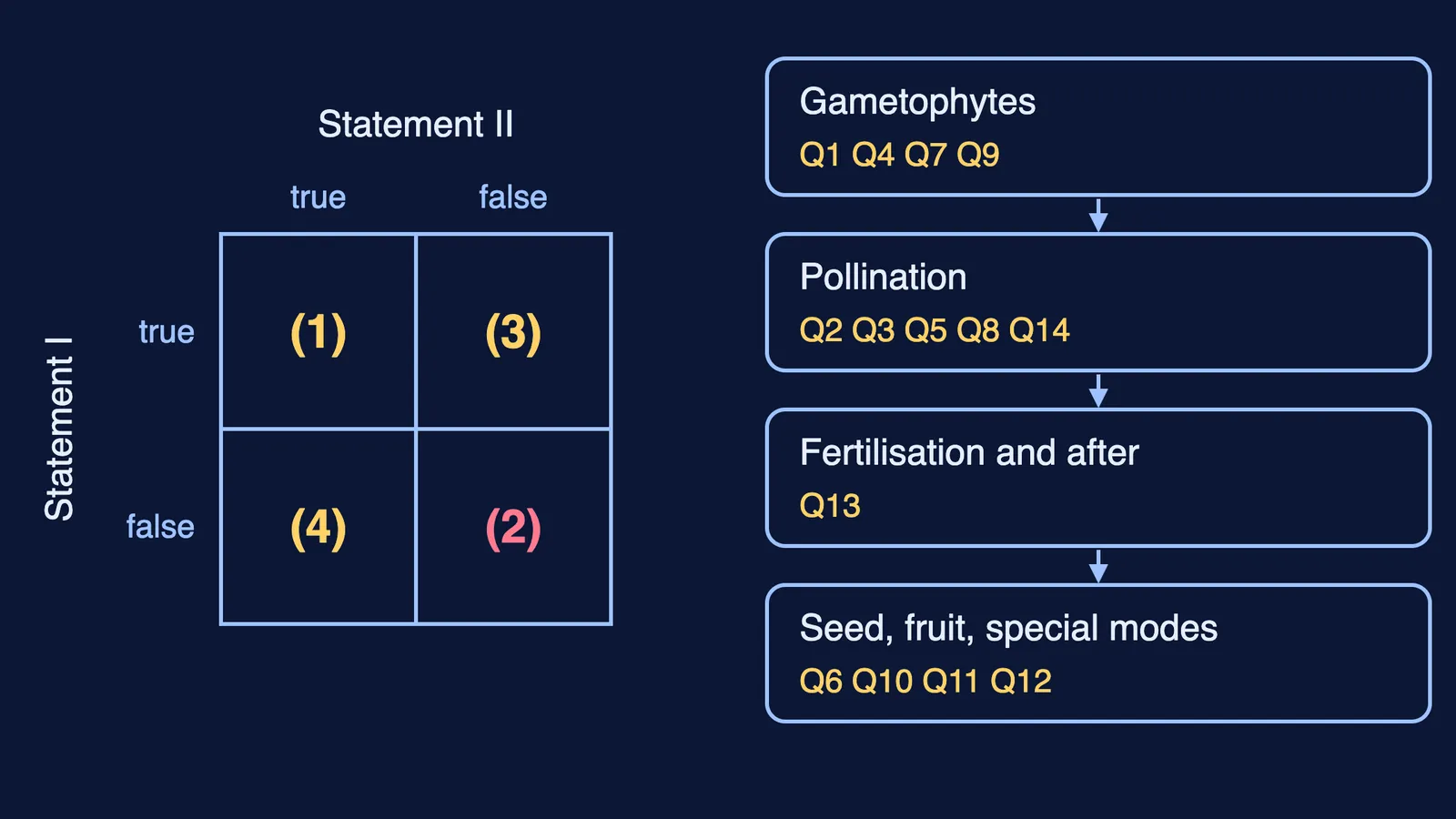
Attack plan: place each statement on the chapter's timeline (gametophytes, pollination, fertilisation, seed and fruit), then recall NCERT's line for that stage. A false line here usually keeps the stage but misnames the example, agent or division.
Key for Q1–Q6: (1) Both statements hold. (2) Neither holds. (3) Only I holds. (4) Only II holds.
Q1. Statement I: An ovule usually has one megaspore mother cell, which forms near the micropylar end of the nucellus. Statement II: Each mitosis of the functional megaspore's nucleus is followed at once by wall formation.
Answer: (3). The divisions are strictly free nuclear; walls form only after the 8-nucleate stage.
Q2. Statement I: Hydrilla, a freshwater plant, is pollinated by water. Statement II: In most water-pollinated species, a mucilaginous covering keeps the pollen from getting wet.
Answer: (1). Both match NCERT.
Q3. Statement I: Water pollination is common in flowering plants, mostly dicots. Statement II: Wind- and water-pollinated flowers are usually colourful and nectar-rich.
Answer: (2). NCERT calls water pollination rare (about 30 genera, mostly monocots); such flowers lack bright colour and nectar.
Q4. Statement I: Parthenium (carrot grass), a cause of pollen allergy, reached India in imported rice. Statement II: Pollen is nutrient-rich, and pollen tablets are used as food supplements.
Answer: (4). Parthenium came with imported wheat. Study summary, not medical advice.
Q5. Statement I: Among animal pollinators, insects, particularly bees, dominate. Statement II: Gecko and garden lizards have been reported as pollinators in some species.
Answer: (1). NCERT names both reptiles as reported pollinators.
Q6. Statement I: In some apomictic species, a diploid egg forms without reduction division and becomes an embryo without fertilisation. Statement II: Fruit formation without fertilisation is apomixis.
Answer: (3). That is parthenocarpy; apomixis is seed formation without fertilisation.
Can you match ovules, pollinators, seeds and fruits?
Attack plan: sort List-II by stage first. A row fitting only one stage, such as a meiosis product, is your anchor; keep codes containing it and test one more row.
Q7. Match the part of the ovule with its description.
List-I: A. Hilum B. Funicle C. Chalaza D. Micropyle List-II: (i) Basal part of the ovule (ii) Stalk joining the ovule to the placenta (iii) Junction of the ovule body and its stalk (iv) Small opening at the tip of the integuments
(1) A-ii, B-iii, C-iv, D-i (2) A-iii, B-ii, C-iv, D-i (3) A-iv, B-ii, C-i, D-iii (4) A-iii, B-ii, C-i, D-iv
Answer: (4). The hilum joins funicle and ovule body; the chalaza lies opposite the micropyle.
Q8. Match the plant with its pollination feature.
List-I: A. Maize B. Amorphophallus C. Yucca D. Zostera List-II: (i) Female flowers stay submerged; pollen is released in the water (ii) A moth lays eggs in the ovary's locule (iii) Cob threads are stigma and style trapping wind-borne pollen (iv) A very tall flower offering a safe egg-laying site
(1) A-iv, B-iii, C-ii, D-i (2) A-iii, B-ii, C-iv, D-i (3) A-iii, B-iv, C-ii, D-i (4) A-i, B-iv, C-ii, D-iii
Answer: (3). Zostera is a seagrass; NCERT gives the Amorphophallus flower as about 6 feet tall.
Q9. Match the process with its product.
List-I: A. Microsporogenesis B. Division of the generative cell C. Mitoses in the functional megaspore D. Megasporogenesis List-II: (i) Four megaspores (ii) A microspore tetrad (iii) Two male gametes (iv) Eight free nuclei
(1) A-ii, B-iii, C-iv, D-i (2) A-i, B-iii, C-iv, D-ii (3) A-ii, B-iv, C-iii, D-i (4) A-iv, B-iii, C-ii, D-i
Answer: (1). Meiosis gives the tetrads; mitosis gives the gametes and the 8-nucleate sac.
Q10. Match the plant with its NCERT seed fact.
List-I: A. Lupinus arcticus B. Phoenix dactylifera C. Orchid D. Ficus List-II: (i) A viable seed about 2000 years old, excavated near the Dead Sea (ii) Thousands of tiny seeds per fruit (iii) Flowered after an estimated 10,000 years of dormancy (iv) A tiny seed growing into a huge tree
(1) A-i, B-iii, C-ii, D-iv (2) A-iii, B-i, C-ii, D-iv (3) A-iii, B-i, C-iv, D-ii (4) A-iii, B-ii, C-i, D-iv
Answer: (2). Lupine: Arctic Tundra. Date palm: King Herod's palace.
Q11. Match the fruit with its feature.
List-I: A. Guava B. Mustard C. Strawberry D. Banana List-II: (i) Dry fruit (ii) The thalamus helps form the fruit (iii) Develops without fertilisation (iv) Fleshy fruit
(1) A-i, B-iv, C-ii, D-iii (2) A-iv, B-i, C-iii, D-ii (3) A-iv, B-ii, C-i, D-iii (4) A-iv, B-i, C-ii, D-iii
Answer: (4). Strawberry is a false fruit; banana is parthenocarpic.
Which single option is right?
Attack plan: in a "how many are correct" item, tick or cross every line and count only at the end, before looking at the options.
Q12. Which is NOT an advantage of seeds listed by NCERT?
(1) Food reserves feed the seedling until it can photosynthesise (2) A hard seed coat protects the embryo (3) New genetic combinations give variation (4) Seed formation relies on water to carry male gametes
Answer: (4). Pollination and fertilisation need no water here, so seed formation is dependable.
Q13. Where in the embryo sac does the embryo develop?
(1) At the micropylar end (2) At the chalazal end, near the antipodals (3) In the central cell, among the endosperm nuclei (4) At the hilum
Answer: (1). The zygote sits there.
Q14. How many of these statements are correct? (a) Small insect-pollinated flowers are often clustered into an inflorescence. (b) Most flowering plants use abiotic agents for pollination. (c) Pollen of animal-pollinated flowers is generally sticky. (d) Wind-pollinated flowers often have large, feathery stigmas. (e) Wind pollination is quite common in grasses.
(1) Two (2) Five (3) Three (4) Four
Answer: (4). Only (b) is wrong: most use biotic agents.
What should you do with your mistakes?
Sort each miss by stage, reread that NCERT paragraph, then rewrite the item so another option wins. For cause-and-effect pairs, try assertion-reason questions on this chapter; for worked MCQs, see the solved NEET practice questions.
Pollination clear, but embryo sac stages still hazy? Fermi's AI tutor works out what you already know and builds a plan for the session.


