On this page
Assertion-reason and Statement I/II questions test two things: whether each line is true, and whether one line explains the other. This chapter is full of true facts that sit side by side without causing each other. These 10 new questions run from easy to hard, and every answer rests on a textbook sentence.
What does this set cover?
The NEET (UG)-2026 syllabus issued by the National Medical Commission lists this chapter under Biology Unit 6, Reproduction, from gametophytes to apomixis and polyembryony. Every answer here is checked against Chapter 1 of NCERT Class 12 Biology, Reprint 2026-27.
New to the chapter? Start with our plan on how to prepare sexual reproduction in flowering plants for NEET.
How do you read assertion-reason and statement questions?
These keys apply throughout.
Assertion-reason (Q1-Q6):
(A) Both A and R are true and R is the correct explanation of A.
(B) Both A and R are true but R is NOT the correct explanation of A.
(C) A is true but R is false.
(D) A is false but R is true.
Statement pairs (Q7-Q10):
(A) Both statements are correct.
(B) Both statements are incorrect.
(C) Statement I is correct, Statement II is incorrect.
(D) Statement I is incorrect, Statement II is correct.
Assertion-reason questions: Q1 to Q6
Q1 (easy). Assertion (A): Pollen grains survive well in the fossil record. Reason (R): Their exine contains sporopollenin, which withstands high temperatures and strong acids and alkalis, and no known enzyme breaks it down.
Answer: (A). NCERT gives sporopollenin as the reason pollen fossilises well. Trap: picking (B) because fossils feel unrelated to wall chemistry.
Q2 (easy). Assertion (A): Wind-pollinated flowers produce a very large amount of pollen compared with the number of ovules. Reason (R): Pollen of wind-pollinated flowers is heavy and sticky, so it travels in clumps.
Answer: (C). A is true: extra pollen makes up for the chance of missing a stigma. R is false: wind-borne pollen is light and non-sticky. Trap: borrowing the sticky pollen of animal-pollinated flowers.
Q3 (medium). Assertion (A): Pollen-pistil interaction ends as soon as a pollen grain germinates on the stigma. Reason (R): The pistil can reject incompatible pollen by blocking its germination on the stigma or its tube growth in the style.
Answer: (D). A is false: the interaction covers every event from pollen landing until the pollen tube enters the ovule. R is true; the pistil still acts after germination, in the style. Trap: equating interaction with the moment of landing.
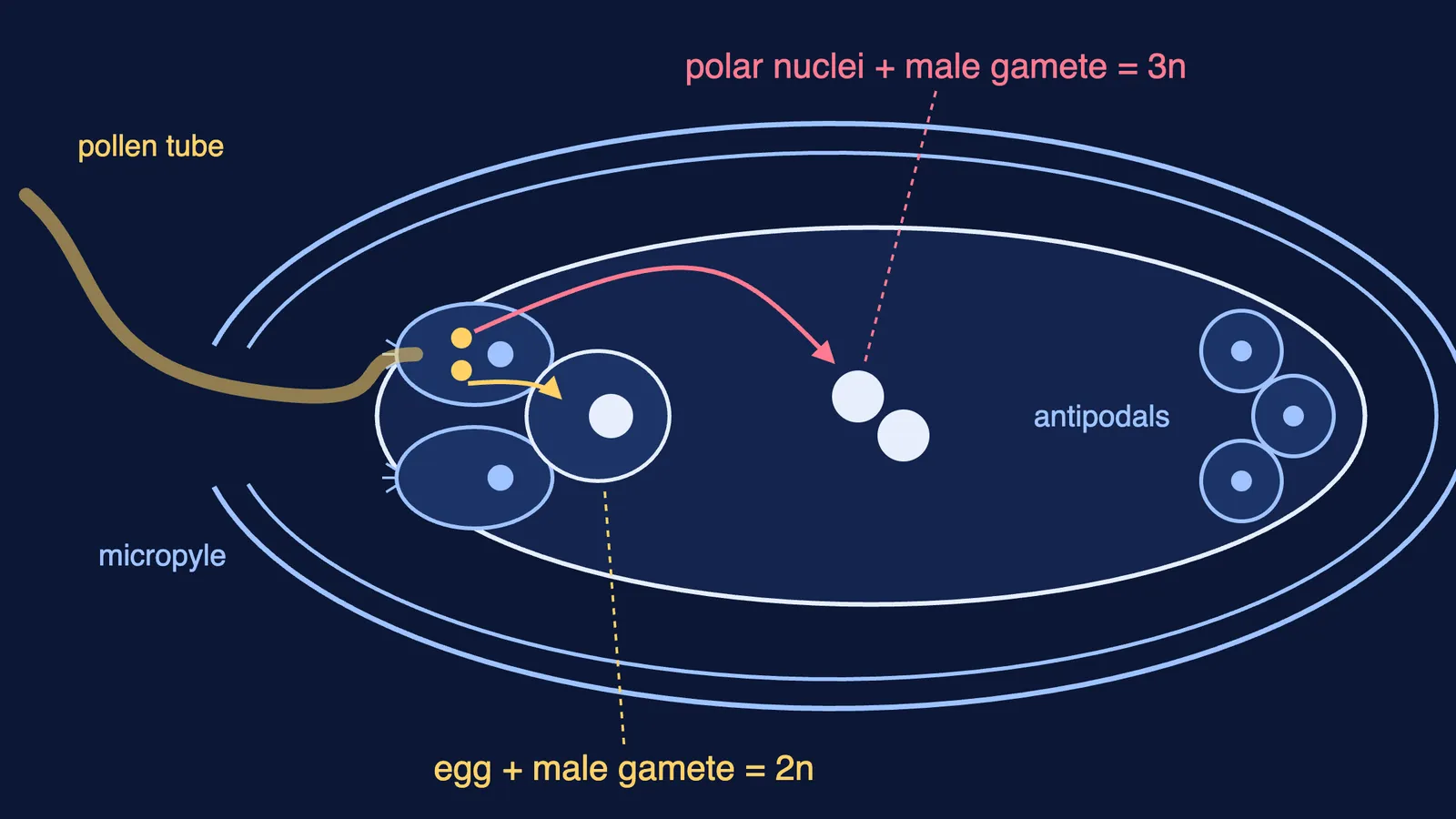
Q4 (medium). Assertion (A): The water of a tender coconut is free-nuclear endosperm. Reason (R): The primary endosperm nucleus is triploid, formed when a male gamete fuses with the two polar nuclei.
Answer: (B). Both are true, but being triploid says nothing about whether the nuclei have walls; the white kernel is triploid too, yet cellular. Trap: R is the best-known endosperm fact, so it feels like an explanation.
Q5 (medium). Assertion (A): In artificial hybridisation, a female parent with unisexual flowers does not need emasculation. Reason (R): Bagging protects the stigma from unwanted pollen.
Answer: (B). Both are true. Emasculation means removing anthers, and a female flower has none. Bagging is still done on these flowers, so it cannot be why emasculation is skipped. Trap: linking two steps of one procedure.
Q6 (hard). Assertion (A): If a hybrid variety were made apomictic, a farmer could sow seed saved from it every year without losing the hybrid characters. Reason (R): Apomictic seeds form without fertilisation, so the hybrid characters do not segregate in the progeny.
Answer: (A). Hybrid seed is bought every year because saved seed segregates; NCERT gives the absence of segregation in apomicts as the direct reason. Trap: marking R false because apomixis is asexual; it is asexual reproduction that still makes seeds.
Statement I and Statement II questions: Q7 to Q10
Facts and numbers below come from the same NCERT Chapter 1 text.
Q7 (easy). Statement I: A typical angiosperm anther is bilobed and dithecous, with four microsporangia, two in each lobe. Statement II: Microspores form from pollen mother cells by mitosis.
Answer: (C). I is correct. II is wrong: microsporogenesis is meiosis, so the microspores are haploid. Trap: remembering the tetrad and forgetting the division that made it.
Q8 (medium). Statement I: Pollen grains of rice and wheat stay viable for several months after release. Statement II: Pollen of many species can be stored for years in liquid nitrogen at -196 °C.
Answer: (D). I is wrong: rice and wheat pollen lose viability within 30 minutes of release; it is some members of Rosaceae and Solanaceae that keep it for months. II is correct. Trap: swapping the cereal and the long-lived examples.
Q9 (medium). Statement I: In Vallisneria, pollination happens at the water surface: a long stalk raises the female flower to it, and floating pollen drifts there with the currents. Statement II: Water hyacinth and water lily grow in water, yet their flowers are held above it and pollinated by insects or wind.
Answer: (A). Both are NCERT statements. Trap: assuming every aquatic plant is water-pollinated.
Q10 (hard). Statement I: The perisperm of black pepper and beet is leftover endosperm, so its cells are triploid. Statement II: In a grass embryo, the scutellum is the sheath that encloses the radicle and root cap.
Answer: (B). I is wrong: perisperm is residual nucellus, parent tissue (2n), not endosperm. II is wrong: the scutellum is the lateral cotyledon; the sheath around the radicle is the coleorrhiza. Trap: real terms attached to the wrong structures.
How should you use this set?
Attempt all 10 with the answers covered, about a minute each.
For each miss, note what failed: the truth of a line, or the because link.
Find the NCERT sentence behind it and rewrite the item so another key becomes correct.
Redo the set after a week.
For the format itself, see our strategy for assertion-reason questions, and for standard MCQs, try the sexual reproduction in flowering plants practice questions with solutions.
If a miss came from a shaky idea such as perisperm rather than a misread, the Fermi Concept Library has every concept in biology, each with its own lesson, so you can fix the gap first.