On this page
You may have heard that glass is really a liquid, and that the proof is in old cathedral windows, which are thicker at the bottom because the glass has slowly run down over the centuries. It is a good story, and it is easy to test with one line of Class 11 physics: strain rate equals stress divided by viscosity. The test says no. Even with a viscosity far lower than any published estimate, a window pane would shorten by less than a wavelength of light in 800 years. The thick bottoms come from how the glass was made and fitted.
Is glass a liquid or a solid?
Glass is an amorphous solid. Its atoms are arranged without the long-range order of a crystal, so its structure looks like a snapshot of a liquid, but it holds its shape like a solid. Some books call it a "supercooled liquid", and the post on why tar roads get soft in summer says amorphous solids can flow very slowly. Whether a material "flows" in practice is a question of how fast, and viscosity answers it. How glass is made, and why it has no sharp melting point, is covered in how glass is made from sand.
How fast would a window pane flow under its own weight?
A pane standing on its edge carries its own weight. At the bottom of a pane of height H, the stress from the glass above is
σ = ρgH
For a liquid of viscosity η, a stress σ makes the material stretch or shrink at a rate
strain rate = σ / (3η)
Why 3? Viscosity η is defined for shear, where layers slide past each other, as in the SI unit of viscosity and the poise. A pane sagging under its weight is squashed along its length instead. For a simple (Newtonian) liquid, the resistance to that kind of stretching is exactly three times the shear viscosity. This factor is called Trouton's ratio.
Using the stress at the bottom everywhere overestimates the flow, because higher up there is less glass above. That is fine for a myth test: we are looking for an upper limit.
How much would a pane sag in 800 years?
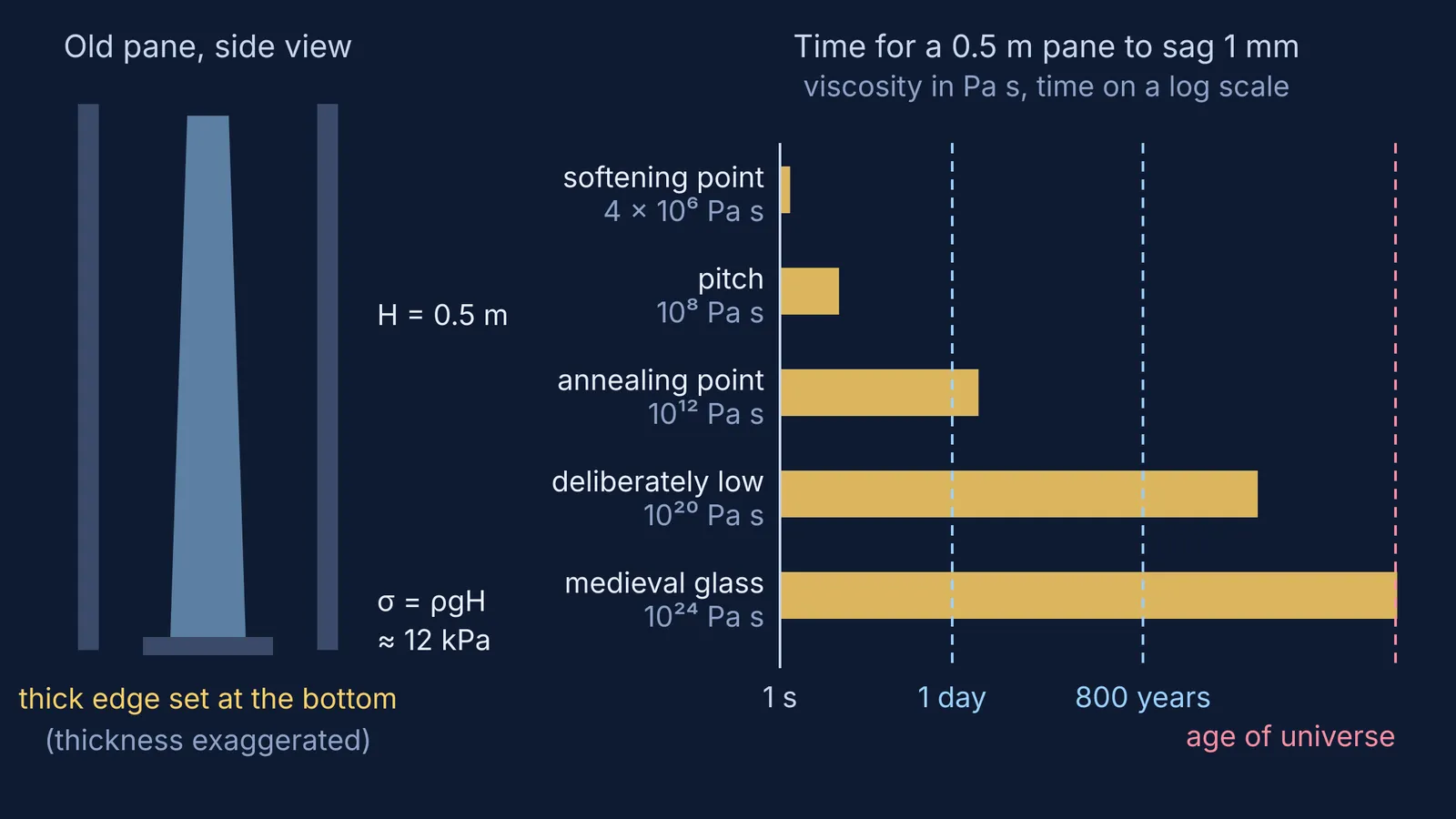
Take an illustrative pane 0.5 m tall, with glass of density about 2,500 kg/m³.
Stress at the bottom. σ = 2,500 × 9.81 × 0.5 = 1.23 × 10⁴ Pa, about 12 kPa.
Pick a viscosity. Use a deliberately low 10²⁰ Pa s, far runnier than any published estimate for window glass at room temperature (see below).
Strain rate. σ/(3η) = 1.23 × 10⁴ ÷ (3 × 10²⁰) = 4.1 × 10⁻¹⁷ per second.
Time. 800 years = 800 × 3.16 × 10⁷ s = 2.5 × 10¹⁰ s.
Strain. 4.1 × 10⁻¹⁷ × 2.5 × 10¹⁰ = 1.0 × 10⁻⁶.
Change in length. 1.0 × 10⁻⁶ × 0.5 m = 5 × 10⁻⁷ m, or 0.5 µm.
Units: Pa ÷ (Pa s) = s⁻¹, so strain rate is per second, and strain has no unit. The answer, 0.5 µm, is less than the wavelength of red light. No glazier, and no one with a ruler, could ever see it.
Turn the question round. A visible sag of 1 mm in a 0.5 m pane is a strain of 2 × 10⁻³. At 4.1 × 10⁻¹⁷ per second that takes 4.9 × 10¹³ s, about 1.6 million years. Cathedrals are under a thousand years old.
What is the real viscosity of glass at room temperature?
Nobody can measure 10²⁰ Pa s directly at room temperature, so it is estimated by extrapolating measurements made at higher temperatures. The estimates vary over many orders of magnitude, but all of them are far above 10²⁰ Pa s.
Zanotto, in the American Journal of Physics in 1998, used calculated viscosity curves for several modern and ancient glass compositions and concluded that window glass could flow at ambient temperature only over times that exceed the limits of human history. A 1999 follow-up by Zanotto and Gupta revised the estimate down by several orders of magnitude and reached the same conclusion.
Gulbiten, Mauro, Guo and Boratav, in the Journal of the American Ceramic Society in 2018, studied a typical medieval glass composition used in Westminster Abbey. They found a room-temperature viscosity of about 10²⁴ to 10²⁵ Pa s, about 16 orders of magnitude lower than an earlier estimate for soda-lime glass, and still far too high for flow to be seen. They calculated a maximum flow of about 1 nm over a billion years.
Put 10²⁴ Pa s into our pane. The strain rate drops 10,000 times, and the 1 mm sag would take about 16 billion years. That is longer than the age of the universe, about 13.8 billion years according to the Planck 2018 results. At 10²⁵ Pa s it would take about 11 times the age of the universe.
How runny is glass when it is hot?
Glass does flow when hot, and that is how it is shaped. NIST's certificate for its reference borosilicate glass, SRM 717a, lists the fixpoints. Its own viscosity fit gives about 10³ Pa s near 1,065 °C, roughly the runniness at which glass is worked, about 4 × 10⁶ Pa s at the softening point (719 °C) and about 10¹² Pa s at the annealing point (513 °C), where internal stresses relax.
Compare the time for our 0.5 m pane to sag 1 mm at each viscosity:
Softening point, about 4 × 10⁶ Pa s: about 2 seconds.
Pitch, about 10⁸ Pa s: about 50 seconds. The University of Queensland pitch-drop experiment describes room-temperature pitch as about 100 billion times more viscous than water, and it drips.
Annealing point, about 10¹² Pa s: about 6 days.
Our deliberately low 10²⁰ Pa s: about 1.6 million years.
Medieval glass at 10²⁴ Pa s: about 16 billion years.
So pitch at room temperature behaves the way the myth imagines glass does. Glass at room temperature is at least a trillion times stiffer.
Why are some old panes thicker at the bottom, then?
Because they were made uneven. Before float glass, flat glass was made by blowing and spinning. In the crown process a gob of glass was spun into a large disc, which came out thicker near the centre than at the edge. Panes cut from such a disc were never uniform, and, as the American Ceramic Society's report on the 2018 study puts it, it was natural to set the thicker part at the bottom.
If you want to see how stress, strain and viscosity fit together, the Concept Library covers each idea, and the Fermi Problem Library has a step-by-step solver for viscosity and elasticity numericals.
Quick checklist
Glass is an amorphous solid, not a liquid.
Stress at the bottom of a pane: σ = ρgH, about 12 kPa for 0.5 m.
Strain rate under stretching or squashing: σ/(3η); the 3 is Trouton's ratio.
Even at 10²⁰ Pa s, 800 years gives 0.5 µm on a 0.5 m pane.
Published room-temperature estimates are 10²⁴ Pa s or higher.
Thick bottoms come from uneven hand-made panes set thick edge down.